



Use Wozber and land your dream job
Create Resume
No registration required
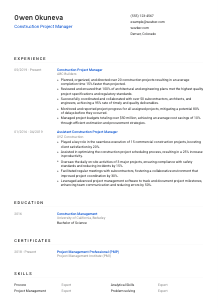
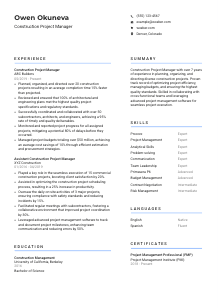
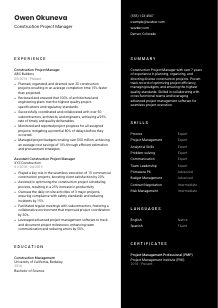
Juggling blueprints but your resume seems under construction? Nail it with this Construction Project Manager resume example, created with Wozber free resume builder. Learn how to showcase your build-savvy leadership to match job needs, laying the foundation for a career that rises just as high as your skyscrapers!
Construction Project Managers are trusted with schedules that slip, budgets that tighten, plan sets that change, and trade partners that need constant coordination. Your resume has to make that operating reality visible fast. Hiring teams want to see who can run a build from preconstruction planning through closeout while keeping cost, quality, safety, and compliance under control.
A tailored resume changes how quickly that story comes through, especially when an ATS first scans for construction-specific terms like budgeting, plan review, subcontractor coordination, and tools such as Procore or Primavera P6. Wozber's free resume builder helps you shape that language into an ATS-compliant resume without losing the practical detail that matters in construction hiring. The result should make it easy to see the scale of projects you have led and how you kept them moving.
This section is simple, but it still carries hiring weight. For a Construction Project Manager, it should confirm that you are easy to contact, clearly positioned for the role, and aligned with any practical requirements the employer has stated, including location when relevant.
Use your full name at the top in a clean, readable format. Construction hiring often involves several reviewers, from recruiters to operations leaders, so your header should be quick to scan and easy to remember.
Place "Construction Project Manager" directly under your name if that is the position you are targeting. This removes ambiguity right away, especially if your background includes adjacent titles such as Assistant Project Manager, Project Engineer, or Superintendent.
Include a current phone number and a professional email address. Double-check both. If a hiring manager wants to ask about project scope, budget ownership, or availability for an interview, this section should never slow that down.
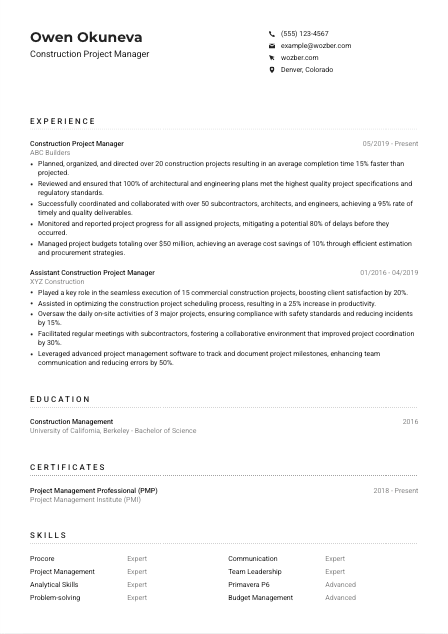
If the employer requires a local candidate or someone willing to relocate, include that clearly. In the example, listing Denver, Colorado directly supports a stated requirement and removes a common screening question before it comes up.
A LinkedIn profile or professional website can strengthen your header when it adds useful context, such as project portfolio highlights, construction credentials, or a fuller work history. Only include it if the content is current and supports your project management track record.
Keep your personal details clean and factual. For this role, the header should quickly confirm who you are, what job you are targeting, and whether any practical requirement like location is already covered.




This is where Construction Project Manager resumes usually separate themselves. Titles matter, but hiring teams pay closer attention to project size, delivery results, budget control, schedule performance, coordination across trades, and how you handled issues before they turned into delays or cost overruns.
Read the posting for the operating responsibilities behind the title. Here, the employer wants someone who can direct projects, review plans, coordinate subcontractors and design partners, track progress, solve delays, and manage budgets and procurement. Those are the themes your bullets should reflect if they match your actual work.
List your recent construction management positions first, starting with the role closest to full project ownership. Reverse chronological order works well because it shows how your scope has grown, whether that means larger budgets, more complex builds, or broader responsibility across planning, execution, and reporting.
Bullets should show what you delivered, not just what you were assigned to do. The example does this well by pairing core responsibilities with results, such as leading more than 20 projects and improving average completion time by 15%. That kind of framing tells a hiring manager how you performed under real schedule pressure.
Quantify your experience with measures that matter in this field: project count, budget size, completion speed, cost savings, deliverable timeliness, safety improvement, reduction in delays, or procurement efficiency. The sample's "$50 million" in managed budgets and "10%" savings are strong because they connect directly to cost control and commercial impact.
Trim experience that does not support construction project delivery. Prioritize items that show plan review, regulatory compliance, subcontractor management, client communication, scheduling, procurement, and risk response. If a bullet cannot help prove you can run construction work on time and on budget, replace it with one that can.
Your experience section should read like a record of projects delivered, problems handled, and budgets managed. When the bullets are specific, it becomes much easier to picture you leading the next job successfully.
For Construction Project Manager roles, education is usually straightforward, but it still needs to line up cleanly with the posting. A degree in Construction Management, Civil Engineering, or a related field helps confirm you have the technical base to work with plans, specifications, sequencing, and construction documentation.
If the posting asks for a bachelor's degree in a related field, list the degree, major, school, and graduation year clearly. Do not bury the field of study. In this case, a Bachelor of Science in Construction Management directly supports the requirement.
Keep the entry simple and readable: school, degree, field, and date. Construction resumes usually get reviewed quickly, and this section should confirm qualifications without forcing the reader to decode the layout.
Use the full degree title if it strengthens alignment with the role. The example's "Bachelor of Science" and "Construction Management" wording works because it mirrors the educational background the employer requested.
Most experienced candidates do not need to list coursework, but it can help early-career applicants or those moving from an adjacent field. Include it only if it reinforces construction scheduling, estimating, project controls, contract administration, or plan interpretation.
Add honors, leadership, or relevant academic projects when they show something useful for construction management, such as team leadership, cost estimation work, capstone builds, or field coordination experience. Leave out details that do not support the role.
Education does not need to do too much here. It simply needs to confirm that your academic background supports the technical and managerial demands of running construction projects.
Certifications carry real weight in construction management when they connect to project delivery, process discipline, and stakeholder confidence. They are especially useful when the employer has stated a preference, as this posting does with PMP.
Lead with credentials that directly support the employer's stated preferences or the role's core work. Here, PMP belongs at the top because it is explicitly preferred and aligns with schedule, budget, scope, and stakeholder management responsibilities.
Prioritize certifications tied to construction management, safety, scheduling, or contract oversight rather than filling the section with unrelated training. Each item should add context to how you manage projects in the field and across documentation workflows.
Include the issuing body and the date or active period when relevant. The example's PMP entry includes the issuer and ongoing validity, which helps confirm that the credential is current rather than outdated.
Construction methods, software, compliance expectations, and delivery models change over time. If you maintain certifications or complete relevant continuing education, that shows you are keeping your project management approach current.
Use this section to reinforce formal credibility, not to pad the page. The right certifications should support the kind of project oversight, communication, and control the role requires.
A Construction Project Manager skills section should feel grounded in how projects are actually delivered. That means balancing software knowledge with operational strengths such as budgeting, coordination, scheduling, negotiation, and problem-solving under field conditions.
Start with the exact capabilities the employer names, then add closely related skills you genuinely use. In this description, project management software, analytical ability, problem-solving, communication, and budget management are all worth surfacing because they connect to daily project oversight.
Lead with the software and management strengths most relevant to the job. Procore and Primavera P6 deserve prominent placement when you have them, since the employer specifically mentions them. Pair those with practical competencies such as project management, budget control, subcontractor coordination, and risk management.
Avoid turning this section into a long inventory. Choose skills that support construction planning, execution, reporting, procurement, and coordination across trades and consultants. A shorter, targeted list usually lands better than a broad list with weak relevance.
If someone reading this section can quickly tell how you plan work, control costs, use construction software, and coordinate project partners, the section is doing its job.
Construction Project Managers spend a large part of the job communicating: running meetings, clarifying issues in plans, updating owners, coordinating subcontractors, and documenting progress. Your languages section should support that reality without overstating your ability.
If the posting calls for English proficiency, list English clearly and give it an honest proficiency level. For a role that depends on written updates, meetings, and issue resolution, this is a baseline qualification, not a minor detail.
Put the primary business language first, then add others in descending order of strength. In the example, English appears first and Spanish follows, which is a sensible structure for a U.S.-based construction role.
Extra languages are worth listing if they support field communication, subcontractor coordination, or client interaction. They are not mandatory for every Construction Project Manager position, but they can be a practical advantage on diverse crews or multi-stakeholder projects.
Use clear proficiency labels such as Native, Fluent, Advanced, or Conversational. Overstating language ability can create real problems in a role where site communication and documentation accuracy matter.
Think about whether your projects involve multilingual teams, community stakeholders, or region-specific communication needs. If another language has helped you manage coordination more effectively, it is worth showing that capability here.
List languages that genuinely support how you work. For construction management, clear communication is operational, and this section should reinforce that you can handle it.
Your summary should quickly establish the level of construction work you have managed and the outcomes you are known for. Skip generic claims. Use the space to connect experience, project leadership, and measurable delivery results in a few direct lines.
Before writing, pull out the core themes from the job description. For this role, those include directing construction activities, reviewing plans, coordinating subcontractors and design partners, managing budgets, and keeping work on schedule. Your summary should reflect the priorities that match your background.
Start with your title and years of relevant experience. A line such as "Construction Project Manager with 7+ years of experience delivering commercial projects" gives immediate context and places your background at the right level.
Follow your opener with a compact statement about the work you handle well. The example summary points to project efficiency, budget management, quality standards, and software use. That works because those are core parts of the job, and they are supported by stronger detail later in the resume.
Aim for a short paragraph that sounds credible to someone who runs construction operations. Avoid empty adjectives. A good summary mentions project scope, management strengths, and one or two concrete areas such as schedule performance, cost control, plan review, or cross-functional coordination.
By the end of these few lines, the reader should already understand your level, your construction management strengths, and the kind of project results you are likely to deliver.
A Construction Project Manager resume should make project ownership, budget control, schedule discipline, plan review, and subcontractor coordination easy to see from the first scan. When each section is tailored to the posting, the resume reads less like a job history and more like a record of builds delivered.
Use Wozber's free resume builder and ATS resume scanner to sharpen that alignment, surface missing requirements, and present your background in an ATS-friendly resume format. The finished document should leave little doubt that you can step into the project, organize the moving parts, and keep the work on track.




