




Use Wozber and land your dream job
Create Resume
No registration required
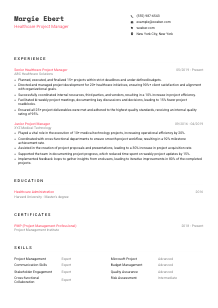
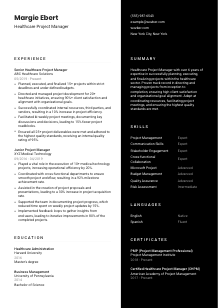
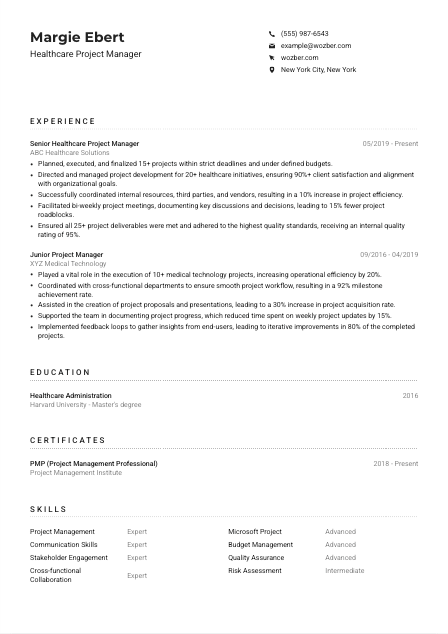
Leading health initiatives, but your resume seems a bit under the weather? Check out this Healthcare Project Manager resume example, created with Wozber free resume builder. It shows how to showcase your organizational and leadership skills to match job requirements, charting a career path as robust as the patients you serve!
Healthcare project management sits at the intersection of delivery discipline and clinical reality. Hiring teams want to see that you can move initiatives from kickoff to close without losing control of deadlines, budgets, vendor coordination, documentation, or quality standards. Your resume should make that operating range visible quickly, especially if you have handled cross-functional work in hospitals, health systems, medical technology, payer environments, or healthcare services.
A tailored resume changes how your background is read in both ATS screening and human review. When project scope, healthcare context, tools, and measurable outcomes are phrased in the same language used in the posting, Wozber's free resume builder helps you shape an ATS-compliant resume that surfaces the right details first, from project delivery metrics to stakeholder coordination. That makes it easier for the hiring team to see whether you can run healthcare projects with the structure and follow-through the role requires.
For a Healthcare Project Manager, the personal details section needs to do more than identify you. It should confirm practical basics fast, especially role title, contact accuracy, and any location requirement that could affect eligibility or interview timing.
Put your name at the top in a clean, readable format, then follow it with the target title: "Healthcare Project Manager." That immediate label helps position you for project delivery work in a healthcare setting instead of leaving room for interpretation around operations, administration, or general program support.
If your background aligns with the opening, use the same title the employer uses. Here, "Healthcare Project Manager" is the right choice because it matches both the functional scope and the industry context. It also strengthens ATS alignment by connecting your header to the title being searched.
Include one phone number and a professional email address you check regularly. Accuracy matters here more than style. A mistyped digit or outdated inbox can stall interview scheduling, especially when project-based roles move quickly between recruiter screens, stakeholder interviews, and final approvals.
If an employer specifies location, state yours clearly. This posting requires New York City, New York, so listing "New York City, New York" immediately answers a practical screening question. If you are relocating, say so briefly and directly rather than leaving the employer to guess.
A LinkedIn profile, portfolio, or professional website can help if it reinforces healthcare project work, certifications, or leadership experience. Keep it current and consistent with your resume. Skip personal details unrelated to hiring decisions, such as age, marital status, or a photo unless local norms require one.
This section should remove friction, not create it. When your title, contact details, and location are clear, the hiring team can move straight to your project delivery experience.




This is the section most likely to decide whether you move forward. In healthcare project management, employers look for signs that you can manage deadlines, budgets, multidisciplinary teams, vendors, documentation, and quality expectations in environments where delays and weak coordination can affect operations and client satisfaction.
Start by marking the responsibilities and requirements that define success in the role. In this description, that includes planning and finalizing projects on deadline and budget, managing full project development, coordinating internal and external resources, running regular meetings, and maintaining quality standards. Those themes should shape which achievements you choose and how you phrase them.
List your positions in reverse chronological order, with title, employer, and dates. Then make sure each role emphasizes project management work that fits healthcare delivery, healthcare technology, clinical operations, or adjacent regulated environments. If an earlier role is less relevant, trim it so your stronger examples stay in focus.
Use bullet points that show what you owned and what changed because of your work. The example resume does this well by moving beyond generic duties and showing results such as 15+ projects delivered under budget, 90%+ client satisfaction, and fewer roadblocks after structured bi-weekly meetings. That kind of phrasing tells a hiring manager how you run projects, not just that you participated in them.
Healthcare project management is measured through timelines, budgets, milestone completion, stakeholder satisfaction, quality scores, process improvement, and adoption outcomes. Add numbers wherever they are real and relevant. Metrics like project count, efficiency gains, milestone achievement rates, or quality ratings make your impact easier to compare across candidates.
Keep the section tightly focused on work that supports your case for this role. That usually means cross-functional coordination, vendor management, project planning, risk tracking, reporting cadence, and delivery results. Leave out unrelated accomplishments unless they clearly strengthen your case for managing healthcare initiatives.
Hiring teams are looking for repeatable execution, not one-off wins. Your experience section should show that you can take healthcare projects from plan to delivery while keeping teams aligned and standards intact.
Education matters here because the posting asks for a bachelor's degree in Healthcare Administration, Business Management, or a related field, with a master's degree preferred. Your education section should answer that requirement quickly and show the academic foundation behind your project, operational, or healthcare knowledge.
List your highest completed degree at the top, especially if it directly supports the role. A master's in Healthcare Administration, for example, speaks clearly to healthcare systems knowledge and organizational context, while a bachelor's in Business Management supports planning, budgeting, and process oversight.
For each entry, include degree, field of study, school, and graduation year or date. Hiring teams often review this section quickly to confirm baseline qualifications, so a straightforward layout works best.
If the employer prefers a master's degree and you have one, do not bury it. In the example, the master's degree in Healthcare Administration should sit above the bachelor's because it directly strengthens the candidate's profile for healthcare project leadership.
Early-career candidates can include selected coursework, capstone projects, or honors tied to healthcare operations, process improvement, analytics, or management. If you already have several years of project experience, keep this section lean unless a specific academic detail adds useful context.
Scholarships, honors, or student leadership can help when they connect to leadership, healthcare systems, team coordination, or analytical work. If they do not support your positioning as a Healthcare Project Manager, they can stay off the page.
This section should confirm that your academic background supports the work ahead. Once the degree requirement is clear, the rest of the resume can do the heavier lifting on project execution and results.
Certifications carry real weight in project management because they signal method, discipline, and continued professional development. For healthcare roles, they also help distinguish candidates who understand structured delivery in complex, regulated environments.
This posting asks for PMP or an equivalent healthcare project management certification, so those credentials belong near the top of the section. If you hold both a general project credential and a healthcare-specific one, list both to show range across formal project methods and industry context.
Only include certifications that support the role directly. PMP, healthcare project management credentials, quality or process-improvement certifications, and related leadership designations are far more useful here than general online course completions with little connection to project delivery.
List the certification name, issuing organization, and date earned or active range. That gives the hiring team enough context to understand whether the credential is current, especially for certifications tied to ongoing continuing education.
If you are aiming for larger healthcare programs, payer-provider transformation work, EHR implementations, or operational improvement projects, your certification plan should reflect that path. The right additions can strengthen later applications even when they are not mandatory for every opening.
Relevant certifications tell employers you work from established project practices and keep your skills current. In healthcare settings, that extra credibility can matter when multiple qualified candidates have similar years of experience.
A Healthcare Project Manager skills section should read like the toolkit behind your results. Focus on capabilities that support planning, stakeholder coordination, reporting, budgeting, tool usage, and quality control rather than filling the space with broad workplace traits.
Pull both explicit and implied skills from the posting. Here that includes project management, communication, cross-functional collaboration, vendor coordination, budgeting, quality oversight, and proficiency with tools such as Microsoft Project. These are the capabilities tied to day-to-day delivery, so they deserve space.
If the employer names a platform or tool category, include it when you have hands-on experience. Microsoft Project appears in this posting, and the example resume wisely lists it directly instead of hiding it inside a bullet. The same approach works for scheduling tools, reporting platforms, or risk-tracking systems you have actually used.
Lead with the skills most connected to project execution in healthcare. A compact list that includes project management, stakeholder engagement, budget management, quality assurance, and communication is stronger than a long list padded with vague strengths. If you use proficiency labels, make sure they are believable and consistent with your experience bullets.
This list should echo what your experience already proves. When the same core capabilities appear in both sections, your project management profile reads as consistent and well grounded.
Language skills matter in healthcare when projects involve multidisciplinary teams, patient-facing operations, vendor coordination, or diverse populations. For many roles, though, this section is mainly about confirming required communication ability rather than creating a separate selling point.
Check the posting for any stated requirement. Here, good English proficiency is mandatory, so English should appear first with an accurate proficiency level. That removes uncertainty around reporting, meeting facilitation, documentation, and stakeholder communication.
Put the employer's required language at the top, then add others that may support the work. In healthcare environments, additional languages can be useful when teams, vendors, or service populations are multilingual, but they should not overshadow the core requirement.
If you speak another language fluently, include it. In some healthcare organizations, that can help with community engagement, internal collaboration, or smoother communication across departments. It is a plus, not a substitute for project delivery experience.
Choose clear terms such as Native, Fluent, Advanced, Intermediate, or Basic, and use them consistently. Overstating language ability can create problems quickly in meetings, written updates, or executive presentations.
For a local healthcare project management role, language skills are usually secondary to delivery capability, stakeholder management, and documentation discipline. Include them, but keep the emphasis where the hiring decision usually sits.
If English proficiency is required, make that obvious. Any additional language then works as a useful extra, especially in diverse healthcare environments.
The summary sets the frame for the rest of the resume. In this role, it should quickly establish your experience level, healthcare context, and project delivery strengths so the reader understands your value before reaching the first job entry.
Before writing, identify the few points that matter most for the target role. In this case, that is healthcare project management experience, end-to-end delivery, deadlines and budgets, stakeholder coordination, and quality standards. Those themes should shape the summary instead of generic leadership claims.
Your first line should identify you as a Healthcare Project Manager and state your experience level clearly, such as "with 6+ years of experience" or similar. That tells the reader right away whether you likely meet the requirement for 5+ years in project management.
Use the next sentence or two to highlight outcomes or strengths that mirror the role. The sample summary works because it mentions planning and finalizing projects, client satisfaction, organizational alignment, coordination, and quality standards, all of which map directly to the posting. Keep your own version grounded in what you have actually done.
Aim for a short paragraph that sounds precise, not crowded. Three to four lines are usually enough to establish your healthcare focus, delivery record, and project management strengths before the reader moves into your detailed experience.
A sharp summary gives context to every section that follows. By the time the hiring team reaches your experience bullets, they should already expect to see healthcare projects delivered on time, on budget, and with strong stakeholder coordination.
A Healthcare Project Manager resume works best when it shows control over execution, not just familiarity with project terminology. If your sections consistently reflect healthcare context, measurable delivery results, stakeholder coordination, and the right qualifications, the hiring team can quickly understand where you fit and what level of responsibility you can handle.
Use Wozber's free resume builder to shape that story in an ATS-friendly resume format, then refine it with the ATS resume scanner to align your wording with the posting's actual priorities. The final result should make one thing clear without effort: you can lead healthcare projects from planning through delivery with structure, accountability, and results.