



Use Wozber and land your dream job
Create Resume
No registration required
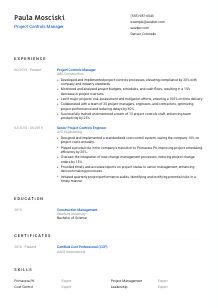
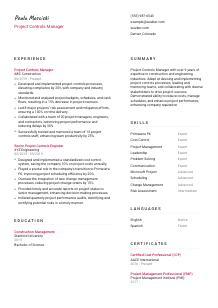
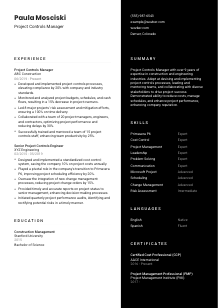
Keeping projects on track, but your resume feels off schedule? Check out this Project Controls Manager resume example, created with Wozber free resume builder. Learn how to present your project savvy to match job goals, positioning your career timeline in sync with success milestones!
Project Controls Managers sit at the point where schedule discipline, cost visibility, and delivery risk meet. Hiring teams want to see whether you can turn project data into decisions, keep controls processes consistent across active work, and intervene before delays, cash flow issues, or change impacts spread across the program. Your resume should make that operating range visible early.
Screening gets much easier when the resume clearly ties your background to the control systems the role depends on, especially scheduling, cost control, reporting, and change management. Wozber's free resume builder helps shape that experience into an ATS-compliant resume with language that matches the posting, so the hiring team can quickly see whether you have handled the reporting cadence, software, and delivery pressure expected in project controls leadership.
This section is simple, but it still carries a few practical hiring signals for project controls work. Clear contact details, the right job title, and location information that addresses a stated requirement can remove friction before anyone even reaches your schedule or cost experience.
Place your name at the top in a clean, readable format, then immediately identify yourself as a "Project Controls Manager." That title matters because it anchors the rest of the resume around controls leadership rather than broader project management, estimating, or engineering work.
If your recent background supports it, match the header title to the role you are pursuing. For this opening, "Project Controls Manager" is the clearest choice. It helps both recruiters and ATS systems connect your resume to leadership in scheduling, cost control, reporting, and project performance oversight.
Use a phone number you answer, a professional email address, and check them carefully. In a role that depends on precise reporting and disciplined controls, small errors in basic details can create the wrong impression before your qualifications are reviewed.
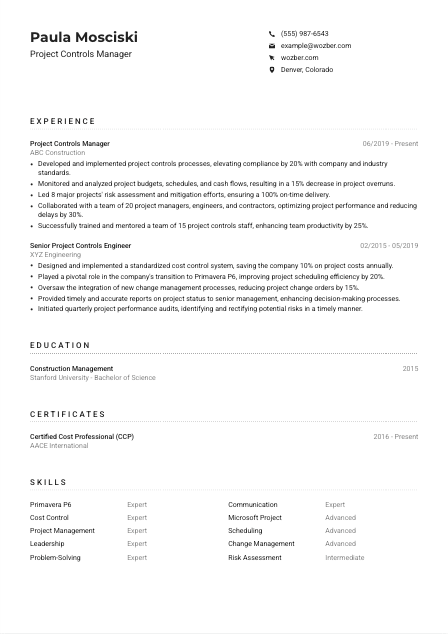
When a job specifies a location or relocation requirement, include your city and state. In the example, listing "Denver, Colorado" directly supports the employer's stated need and avoids questions about availability. Treat this as job-specific tailoring, not a rule for every application.
Include LinkedIn or a professional website only if it supports your resume with consistent, role-relevant information. For project controls professionals, that usually means a profile that reinforces experience with Primavera P6, Microsoft Project, cost reporting, earned value practices, or large construction and engineering programs.
Your personal details should confirm who you are, what role you are targeting, and whether any practical requirement such as location is already covered. Keep it clean and credible so the reader can move straight to your project controls record.




Project controls hiring is driven by outcomes. Teams want to know what budgets you monitored, how schedules improved under your watch, what reporting you owned, how you handled change impacts, and whether your work reduced overruns or protected delivery dates.
Read the job description for the control functions that matter most, then mirror them in your experience bullets. Here, the priorities are process implementation, budget and cash flow monitoring, scheduling, change management, risk mitigation, and team leadership. Those themes should appear across your recent roles, not be buried in one generic bullet.
List roles from most recent to oldest so the reader can follow your move from hands-on controls work into broader oversight. For a Project Controls Manager, progression from project controls engineer or senior controls engineer into process ownership, team leadership, and multi-project reporting is especially persuasive.
Focus each bullet on a result tied to a controls function. Good examples include improving forecast accuracy, reducing schedule slippage, tightening change control, standardizing reporting, or strengthening risk reviews. The sample resume does this well with points such as reducing overruns by 15% and driving 100% on-time delivery across eight major projects.
Metrics carry real weight in this field because project controls is measured through variance, savings, delays avoided, reporting accuracy, and delivery performance. Use percentages, project counts, staff numbers, budget scope, or timing improvements whenever you can. "Reduced delays by 30%" tells a hiring manager much more than "supported project performance."
Prioritize work that shows command of schedules, cost systems, forecasting, risk registers, contractor coordination, and stakeholder reporting. Side achievements are only worth keeping if they reinforce the role. Every line should help the reader picture you leading controls processes on active construction or engineering projects.
By the end of this section, a reader should understand the scale of projects you have supported, the controls systems you have improved, and the measurable effect you had on cost, schedule, and risk. That is the core proof for a Project Controls Manager resume.
Education matters here because many employers still use it as an early filter for project controls leadership roles in construction and engineering. Keep the section direct, and make sure the degree information supports the technical and industry context of your experience.
If you hold a bachelor's degree in Engineering, Construction Management, or a related field, state it clearly. This posting asks for exactly that background, so your degree should be easy to find and easy to match against the requirement.
List the degree, school, field of study, and graduation year. Project controls resumes benefit from structure and clarity, and the education section should reflect the same disciplined presentation you would bring to project reporting.
Use the formal degree name that best aligns with the job description. In the example, "Bachelor of Science in Construction Management" lines up neatly with the employer's requirement. Accurate wording helps both ATS parsing and quick recruiter review.
Early-career candidates can include relevant coursework such as construction scheduling, cost engineering, project management, or contracts if it strengthens the link to project controls. With 8+ years of experience, most employers will weigh your project delivery record far more heavily than course lists.
Honors, capstone projects, or leadership activities can stay if they support the story you are telling. Keep them brief and relevant, especially if they connect to analytical work, construction operations, engineering discipline, or team leadership.
This section should confirm that you meet the academic baseline and understand the technical environment of the work. Once that is clear, your experience and certifications should carry most of the argument.
Certifications are often a differentiator in project controls because they reinforce technical discipline and commitment to established standards. They are especially useful when the role includes cost governance, schedule management, forecasting, and team leadership across complex projects.
Even when certifications are not mandatory, they can strengthen your position. For this profession, credentials such as Certified Cost Professional or PMP are highly relevant because they signal capability in cost management, project governance, and structured delivery practices.
List certifications that directly support the work of a Project Controls Manager. Prioritize credentials tied to cost engineering, scheduling, project management, risk, or construction operations over broad or outdated certificates that do not affect hiring decisions.
Add issue or active dates when the timing matters, especially for certifications that require renewal or continuing education. In the example, the active date ranges help show that the credentials are current and still part of the candidate's professional profile.
Project controls standards, software, and reporting practices keep evolving. Ongoing certification activity or recent coursework can support your resume if it reflects current tools, governance methods, or industry expectations around forecasting, change control, and risk reporting.
The right certifications reinforce that your methods are grounded in recognized project controls practice. Use them to support your experience, especially if the role requires credibility with senior stakeholders, clients, or project teams.
A Project Controls Manager skills section should read like the operating toolkit behind your delivery record. The right mix includes scheduling platforms, cost and change disciplines, reporting capabilities, and the leadership skills needed to coordinate project managers, engineers, contractors, and controls staff.
Start with the software, methods, and leadership requirements named in the posting. Here that includes Primavera P6 or Microsoft Project, cost control, scheduling, change management, communication, leadership, and problem-solving. Mirror that language where it truthfully reflects your background.
This role sits between data and decision-making, so show both technical and interpersonal strengths. Pair hard skills such as forecasting, cash flow tracking, baseline schedule management, and reporting tools with leadership, stakeholder communication, mentoring, and issue resolution.
Do not crowd the list with every tool you have touched. Prioritize the abilities most likely to matter in project controls hiring. The sample resume does this effectively by leading with Primavera P6, cost control, scheduling, change management, and leadership rather than unrelated software or generic office skills.
When this section is well chosen, it gives a quick, accurate picture of how you run controls work day to day. It should confirm that you can manage the systems, reporting, and cross-functional coordination the role depends on.
Language ability is usually a supporting section for project controls roles, but it can still matter. Clear communication affects reporting quality, stakeholder updates, issue escalation, and coordination across site teams, consultants, and contractors.
If the posting specifies an English-speaking environment, list your English proficiency clearly. That matters in a role where schedule updates, variance explanations, and risk reports must be understood without ambiguity.
If English is not your first language, state your actual level with confidence and accuracy. Hiring teams want to know whether you can lead meetings, write reports, and discuss project status clearly with internal and external stakeholders.
Additional languages can be useful if your projects involve multilingual crews, international vendors, or regional client teams. In the example, Spanish adds practical value because it suggests broader communication reach on construction and engineering work.
Choose levels such as Native, Fluent, Advanced, or Conversational only if they reflect your real ability. For project controls professionals, language skill is often tested informally in meetings, reporting, and stakeholder calls, so accuracy matters.
Languages should support your resume, not distract from your core strengths in cost, schedule, and risk management. Include them when they add real value, especially in complex project environments with diverse teams.
This section works best when it reinforces your ability to operate clearly across teams and reporting lines. For project controls leadership, that means making communication capability visible without pulling focus from the technical core of the role.
Your summary should quickly tell the reader what kind of project controls leader you are, how much experience you bring, and where your impact shows up. Keep it specific enough to frame the rest of the resume around cost, schedule, risk, and team oversight.
Start with a direct line such as "Project Controls Manager with 9+ years in construction and engineering." That immediately positions you at the right level and gives context for the scope of the roles that follow.
Call out the areas where you create the most value, such as project controls process design, schedule oversight, cost control, change management, risk mitigation, forecasting, or team development. Use the job description as a guide for which functions to prioritize.
Aim for a tight paragraph of 3 to 5 lines. Mention the most relevant capabilities and one or two measurable outcomes if possible. The sample summary works because it ties years of experience to reduced costs, stronger schedules, and improved project performance rather than relying on broad leadership claims.
End by showing the kind of project environment you are prepared to support. Focus on business value, such as delivering reliable controls, improving reporting confidence, reducing overruns, or leading teams that keep projects on time and within budget.
A hiring manager should finish this section with a clear sense of your project controls scope, leadership level, and operational impact. If that message lands, the rest of the resume has a strong frame to build on.
A Project Controls Manager resume works when it makes your control over cost, schedule, reporting, change, and risk easy to trace from top to bottom. Tailor the language to the posting, keep metrics visible, and show how your work improved project performance in terms senior stakeholders care about.
Wozber's free resume builder can help you organize that story into an ATS-friendly resume format, refine role-specific wording with AI support, and check alignment with an ATS resume scanner before you apply. The final result should make one thing clear fast: you know how to keep complex projects measurable, governable, and on track.