



Use Wozber and land your dream job
Create Resume
No registration required
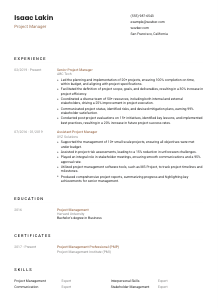
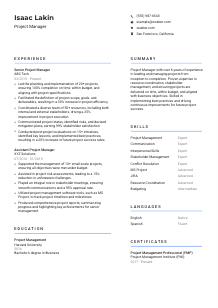
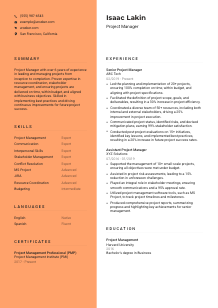
Leading projects, but your resume seems off-track? Check out this Project Manager resume example, created with Wozber free resume builder. Learn how to outline your leadership milestones to match job beacons, propelling your career trajectory in the right direction!
Project managers are brought in to move work from kickoff to close without losing control of scope, budget, timelines, or stakeholder trust. Resumes for this field often go wrong when they stay at the task level and never show delivery ownership, cross-functional coordination, or the business results behind the plan.
A tailored project manager resume quickly shows whether your background matches the delivery environment behind the opening, such as software implementation, resource coordination, risk reporting, or executive updates. Wozber's free resume builder helps shape that experience into an ATS-compliant resume with language that reflects the job description, so hiring teams can more easily see how you run projects, manage tradeoffs, and keep outcomes on track.
This section is simple, but it still carries screening value. For project management roles, clean contact details and the right location cues prevent avoidable friction before anyone gets to your delivery history or stakeholder work.
Use your full name as the most prominent text on the page. Keep it easy to scan and professional, since this is the identifier that follows your application through interviews, scheduling, and internal hiring notes.
Place "Project Manager" directly under your name when that is the role you are pursuing. This helps frame the rest of the resume around project delivery, planning, risk management, and coordination rather than leaving the reader to infer your direction.
List a current phone number and a professional email address. Project managers are expected to communicate clearly and reliably, so even basic details should reflect that standard. Check for typos the same way you would review a status report before sending it to stakeholders.
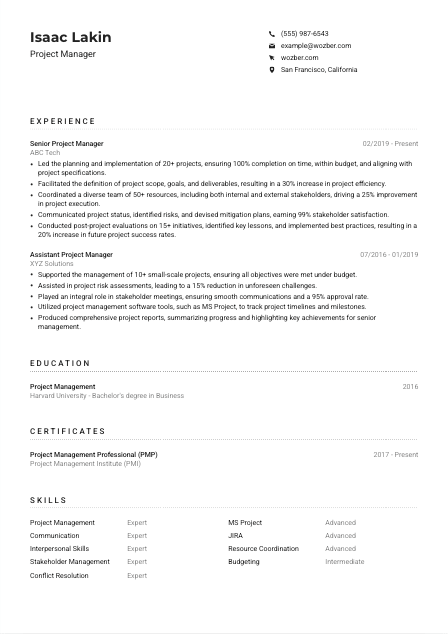
If the posting calls for a specific location, reflect that clearly in your personal details. Here, San Francisco, California is part of the requirement, so listing it removes a common question early. Treat location as a tailoring choice tied to the posting, not something every project manager resume needs to emphasize.
Include LinkedIn or a professional website only if the content is current and supports your resume. For project managers, that might mean a profile that confirms your titles, certifications, tools, and scope of work across initiatives or delivery teams.
Keep personal details clean, current, and aligned with the posting. The section should make it easy to contact you and remove simple screening doubts before your project work is reviewed.




This is the section hiring teams study most closely for project management roles. They want to see the scale of projects you handled, how you managed scope and resources, what you reported upward, and whether your work actually improved delivery outcomes.
Read the job description like a project brief. Mark the priorities that shape the role, such as end-to-end planning, implementation, scope definition, resource coordination, stakeholder communication, and post-project review. If the employer works in technology or software development, make sure your bullets reflect that operating environment where relevant.
Start with your most recent project management work and move backward. Each entry should clearly show your title, employer, and dates so the reader can follow your progression from supporting delivery to owning larger programs, budgets, teams, or stakeholder groups.
Write bullets around what you led, improved, or completed, not around generic responsibilities. The sample resume does this well with points such as leading 20+ projects, defining scope and deliverables, and coordinating 50+ internal and external resources. That kind of phrasing shows operational ownership instead of listing routine PM activities.
Project management is measured through outcomes, so quantify delivery whenever you can. Timeliness, budget adherence, project count, team size, stakeholder satisfaction, efficiency gains, risk reduction, and post-project improvement rates all give hiring managers a clearer picture of your execution. Numbers like "100% on-time completion" or a "30% increase in project efficiency" work because they tie PM actions to results.
Trim accomplishments that do not support your case for managing projects. Prioritize bullets that show planning, scheduling, issue resolution, reporting cadence, vendor or cross-functional coordination, budget control, and lessons learned. The closer your examples are to the delivery model in the posting, the easier it is to picture you in the role.
Your experience section should read like a record of projects delivered, risks managed, and stakeholders kept aligned. Make the scale, tools, and outcomes clear enough that the reader can understand your management range in a few bullets.
Education is often a straightforward check in project management hiring, especially when the posting names a degree requirement. Present it clearly so the reader can confirm the foundation and move on to the delivery experience that carries more weight.
When a posting asks for a bachelor's degree in Business, Project Management, or a related field, make sure that qualification is easy to find. If your degree maps directly, say so clearly. In the example, a Bachelor's degree in Business with a Project Management focus aligns well with the requirement.
List the degree, field of study, school, and graduation year in a consistent order. Recruiters and hiring managers do not need a long explanation here. They need a fast, accurate read on your academic background.
If your coursework, concentration, or field of study connects directly to project planning, operations, business analysis, or technology delivery, make that visible. This helps when your degree title is broad but your academic training supports PM work.
Relevant coursework can help early-career candidates or anyone pivoting into a more specialized project environment. For example, courses in project scheduling, systems analysis, budgeting, or organizational behavior may add context, but only include them if they sharpen the role match.
Honors, leadership roles, or academic projects are worth mentioning if they reinforce planning, coordination, or business execution skills. For experienced project managers, keep this brief and let certifications and delivery history carry more of the application.
Make the degree requirement easy to confirm and keep the layout clean. Once that baseline is clear, the resume can stay focused on how you run projects in practice.
Certifications matter in project management because they signal formal training in delivery frameworks, risk control, stakeholder management, and governance. They are especially useful when an employer mentions PMP or similar credentials as a plus.
If the employer references PMP, Agile, Scrum, or another credential, list matching certifications prominently. In this case, PMP is specifically mentioned, so it deserves clear placement because it directly supports the hiring criteria.
List certifications that reinforce your ability to run projects, manage delivery frameworks, or work in the employer's environment. A short, targeted list is stronger than a long catalog of unrelated training modules.
Add earned dates and renewal windows for certifications that are current or time-sensitive. That gives employers a clear view of whether your credential is active and how recently you invested in professional development.
Project work changes with tools, delivery models, and reporting expectations. Keeping certifications current or adding training in areas such as Agile delivery, software project workflows, or risk management shows that your methods continue to evolve with the work.
Use certifications to reinforce delivery discipline and professional credibility. They work best when they directly support the kind of projects, governance, or methodology the job calls for.
A project manager skills section should show both execution tools and leadership range. Hiring teams want to see whether you can work through schedules, risks, dependencies, and stakeholder communication without separating the technical side of delivery from the people side.
Start with the skills the posting names directly, then add closely related ones you genuinely use. Here that includes project management software such as MS Project or JIRA, along with leadership, communication, and interpersonal strength. Those are core operating skills, not filler terms.
Combine platform knowledge with the capabilities that keep projects moving. For project managers, that usually means items such as scheduling, budgeting, resource coordination, stakeholder management, risk mitigation, conflict resolution, and status reporting. The sample list does this well by pairing tools like MS Project and JIRA with communication and stakeholder management.
Place the most role-critical skills first so the section mirrors the opening's priorities. If the role centers on software or technology delivery, move project tracking tools and cross-functional coordination higher. If it emphasizes executive communication or post-project improvement, give those capabilities more visibility.
Keep the skills list focused on the tools, coordination strengths, and delivery habits that matter in project work. A recruiter should be able to see your operating toolkit at a glance.
Language ability matters most when it affects communication flow. For project managers, that usually shows up in meetings, status updates, vendor coordination, executive reporting, and cross-functional collaboration across teams or regions.
If the posting requires fluency in a specific language, list it clearly. This role asks for effective English communication, so English should appear prominently because it directly affects stakeholder updates, risk escalation, and day-to-day coordination.
Order languages by practical value for the job. If English is the working language, place it at the top, then list other languages that may support collaboration with clients, vendors, or distributed teams.
Additional languages can strengthen your profile when projects involve multicultural teams or international stakeholders. They are not always essential, but they can support communication coverage, especially in client-facing or multi-region environments.
Use straightforward labels such as "Native," "Fluent," or "Intermediate." Project managers are often the communication hub on an initiative, so overstating fluency can become obvious quickly in interviews or on the job.
Include languages that support the type of projects you manage. If a language helps with vendor meetings, stakeholder workshops, or regional rollout communication, it adds practical value. If not, keep the section concise and relevant.
List languages with honesty and in the right order of importance. For project management roles, the key question is whether you can support clear communication across the people involved in delivery.
The summary sets the direction for everything that follows. For project managers, it should quickly establish your level of experience, the type of initiatives you manage, and the outcomes you are trusted to deliver.
Before writing, isolate the themes that define the opening. In this case, they include planning and implementation, scope and deliverables, technology or software experience, stakeholder communication, and lessons learned after project close. Those themes should shape the summary language.
Start with a concise statement of your experience and project management focus. The sample summary works because it immediately places the candidate as a project manager with more than 6 years of experience leading work from inception to completion.
Use the next sentence to name the strengths that matter most for the target role, such as resource coordination, stakeholder management, budget control, risk mitigation, or continuous improvement. Keep this grounded in how project work is actually run, not in vague leadership claims.
Aim for a short paragraph that can be read in seconds. Strong summaries sound like an accurate brief for the projects you lead, the environments you work in, and the results you influence. If every line could apply to any office role, rewrite it until it reflects project delivery.
Your summary should give the reader a quick, credible view of the projects you manage and the outcomes you drive. When it matches the posting's delivery priorities, the rest of the resume lands with more force.
A project manager resume works when it makes your planning discipline, coordination range, and delivery outcomes easy to understand. Focus each section on the work that matters most in hiring for PM roles: scope control, execution, stakeholder communication, risk handling, and measurable results.
Use Wozber's AI resume builder and ATS resume scanner to align your wording with the job description, strengthen section-level targeting, and present everything in an ATS-friendly resume format. The final document should make one thing clear right away: you can lead projects from kickoff through close with control and accountability.




