



Use Wozber and land your dream job
Create Resume
No registration required
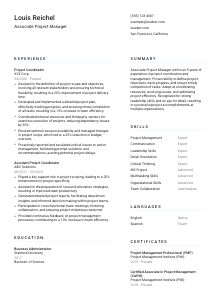
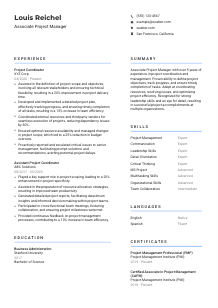
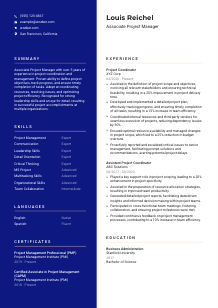
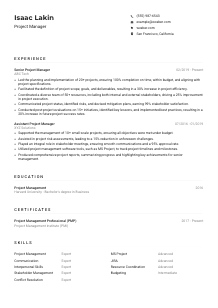
Coordinating endeavors, but your resume doesn't quite align? Navigate through this Associate Project Manager resume example, created with Wozber free resume builder. Learn how to steer your project coordination skills to match job benchmarks, ensuring your career sails smoothly in the right direction!
Associate Project Managers sit where plans meet execution. Hiring teams look for candidates who can keep timelines moving, coordinate across stakeholders and vendors, surface risks early, and maintain control when scope or resource assumptions shift. Your resume needs to show that you have already supported that kind of delivery rhythm, not just that you were present on a project team.
When the resume is tailored well, the first scan quickly connects your background to project planning, progress tracking, resource coordination, and issue escalation. Wozber's free resume builder helps turn that experience into an ATS-compliant resume by aligning your wording with the posting's project language, so the hiring team can quickly see where you can step into delivery support and add structure from day one.
This section should answer the practical questions before a hiring manager reaches your experience. For Associate Project Manager roles, that usually means clear identity, direct contact details, and any location detail that affects eligibility for the role.
Your name should be the clearest element in the header. Use a professional font, keep formatting simple, and give it slightly more visual weight than the rest of the contact details so it anchors the page immediately.
Place "Associate Project Manager" under your name if that matches the role you are pursuing. This helps frame the resume around project coordination, planning support, stakeholder communication, and delivery tracking from the first line.
List one phone number and one professional email address that you check regularly. Accuracy matters here. A small typo in your contact information undercuts the detail control that project roles depend on every day.
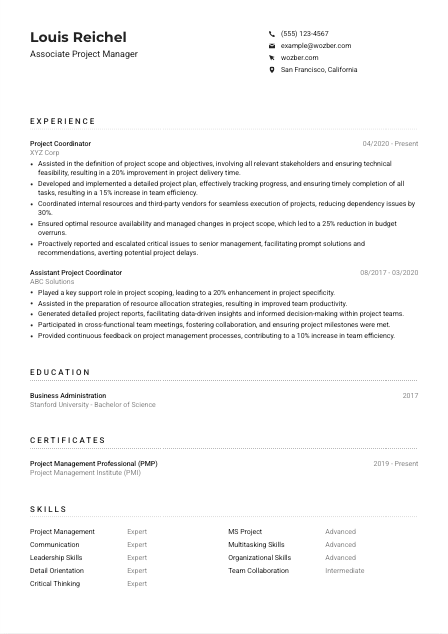
If a posting specifies a location requirement, reflect that in your header. Here, listing "San Francisco, California" directly addresses the employer's stated need and removes doubt about local availability.
A LinkedIn profile or professional website can strengthen this section if it supports your project work with consistent titles, timelines, and certifications. Keep it current so it reinforces your resume rather than creating questions.
For project roles, the top of the resume should read like a clean handoff. If your name, title, contact details, and required location are easy to confirm, the reader can move straight to your delivery experience.




Experience is where Associate Project Manager candidates separate themselves. Hiring teams want to see how you contributed to planning, coordination, reporting, and issue management, and whether your work improved delivery speed, efficiency, budget control, or team execution.
Read the posting closely and note the operational verbs. For this role, phrases such as "define project scope," "develop a detailed project plan," "track progress," "coordinate internal resources and vendors," and "report and escalate issues" should shape how you present your work history. That language reflects how the employer organizes project delivery.
Start with your most recent position and include job title, company, and dates. For project careers, chronology helps the reader see whether you moved from coordination support into broader ownership, such as taking on planning, reporting, or vendor-facing responsibilities over time.
Bullet points should show what you handled and what changed because of it. Instead of writing that you "supported projects," describe the actual work: built project plans, tracked milestones, coordinated stakeholders, managed scope updates, or escalated blockers. The sample resume does this well by tying tasks like project planning and vendor coordination to outcomes such as faster delivery and fewer dependency issues.
Project resumes gain credibility when results are measurable. Include improvements in delivery time, team efficiency, budget variance, resource utilization, milestone completion, or issue resolution speed where you can support them. In the example, percentages tied to delivery time, budget overruns, and dependency reduction make the scope of contribution much easier to understand.
Prioritize roles where you worked with timelines, stakeholders, resource planning, status reporting, or cross-functional execution. You do not need to include every earlier job if it does not strengthen your case for an Associate Project Manager opening. Relevance is especially important when the posting asks for 3+ years in project coordination or management.
By the end of this section, the reader should understand the size of the work you supported, how you kept projects moving, and where you improved execution. That is the core proof for an Associate Project Manager resume.
For many Associate Project Manager openings, education is a threshold check before the reader gets deeper into your experience. Present it clearly, especially when the posting asks for a bachelor's degree in business, project management, or a related field.
Lead with your highest relevant degree and make sure the wording is easy to connect to the posting. A bachelor's in Business Administration, Project Management, or a related field should be easy to spot without the reader having to interpret it.
List degree, field of study, school, and graduation year in a clean sequence. Straightforward formatting works best here because this section is usually reviewed quickly alongside the role's minimum requirements.
Write your degree as it appears on your academic record. If your background aligns closely with the posting, that direct wording helps. In the example, "Bachelor of Science" in "Business Administration" makes the educational match clear right away.
If you are earlier in your career or your degree title is broad, selected coursework in project planning, operations, business analysis, organizational behavior, or leadership can help connect your academics to project work. Skip this if your experience already carries the weight.
Honors, project-based coursework, student leadership, or capstone work can be useful if they reflect planning, team coordination, or stakeholder communication. Keep them only if they strengthen your story for project delivery rather than distract from your professional experience.
This section does not need much space, but it does need precision. If your degree meets the requirement and is easy to verify, the reader can stay focused on your project results and coordination experience.
Certifications matter in project hiring because they signal formal grounding in planning methods, delivery discipline, and professional standards. They are especially useful when a posting prefers PMP or values candidates who have invested in project management training.
If the employer references a certification, give it priority. Here, PMP is preferred rather than required, so candidates who hold it should place it prominently because it supports readiness for scope, schedule, and stakeholder management work.
Focus on credentials tied to project delivery, methodology, or coordination. PMP and CAPM are obvious examples for this career path. Avoid filling the section with unrelated certificates that do not strengthen your case for planning and execution responsibilities.
Show the certification date or active period, especially for credentials that require ongoing maintenance. This reassures the employer that your training is current and still part of your professional toolkit.
Associate Project Manager roles often grow into larger delivery ownership. Continuing education in Agile practices, risk management, scheduling, or stakeholder communication can support that progression and make your resume stronger for future roles as well.
Certifications help connect your experience to recognized project standards. When they line up with the posting, they add another clear reason to trust you with planning, coordination, and controlled execution.
A project management skills section should read like the operating toolkit behind your experience. For an Associate Project Manager, that means balancing planning tools, coordination skills, communication strengths, and the practical habits that keep projects on track.
Start with the skills the employer actually named. In this case, that includes project management software, organization, multitasking, attention to detail, communication, interpersonal ability, and leadership. Those terms should appear naturally if they reflect your real strengths.
Project roles need both systems knowledge and people coordination. Pair hard skills such as MS Project with skills like progress tracking, resource coordination, meeting facilitation, risk escalation, and stakeholder communication. The sample skills list works best where it combines software proficiency with project-relevant execution strengths.
Put the most job-relevant skills first rather than listing everything evenly. If the posting emphasizes scheduling, communication, and detail control, those should appear before more general traits. A concise, targeted list is easier for both ATS matching and human review.
Your skills section should reinforce what the experience section already proves. If a hiring manager sees MS Project, resource coordination, and communication here, they should find those same capabilities reflected in your project bullets.
Associate Project Managers spend a large share of their time in meetings, status updates, written follow-ups, and issue communication. Language proficiency matters when the job depends on clear project documentation and reliable communication across teams.
If the posting specifies a language requirement, list it first. Here, fluent English speaking and writing are explicitly required, so English should appear prominently with an accurate proficiency level.
Put the language needed for the role first, then list additional languages that may support collaboration with broader teams, clients, or vendors. This keeps the section practical rather than decorative.
Additional languages can strengthen your resume when projects involve distributed teams, external partners, or multilingual stakeholders. They are not a substitute for project experience, but they can add flexibility to your profile.
Stick to clear levels such as Native, Fluent, Intermediate, or Basic. Project work relies on precision in calls, summaries, and escalation notes, so overstating proficiency can create problems later.
If the role includes vendor management, regional coordination, or international collaboration, extra languages may matter more. If not, keep the section brief and centered on the employer's stated communication needs.
For project management roles, language skills matter when they support status reporting, stakeholder communication, and clear written follow-through. Present them with the same precision you would use in a project update.
Your summary should quickly place you in the project environment the employer is hiring for. In a few lines, show your level of experience, the kind of delivery work you support, and the outcomes or strengths that make your background relevant.
Before writing, identify the few requirements that matter most in the posting. For this job, that includes project coordination experience, planning and tracking, stakeholder support, resource coordination, and strong communication. Those points should shape the summary instead of generic career language.
Your first line should establish where you sit professionally. A phrase like "Associate Project Manager with over 5 years of experience in project coordination and management" works because it gives immediate context and aligns with the employer's requirement for 3+ years of relevant experience.
Use the next lines to mention the work you consistently handle well, such as building project plans, tracking milestones, coordinating internal and external teams, or resolving blockers before they affect delivery. The example summary succeeds because it connects coordination work with efficiency and project outcomes instead of relying on broad adjectives.
Aim for 3 to 5 lines. This section should be quick to scan and tightly aligned with the opening's priorities. Save detailed metrics and examples for the experience section, where they carry more weight.
A focused summary tells the reader what kind of project professional they are about to review. For an Associate Project Manager, it should make clear that you can support planning, coordination, communication, and issue management in a live delivery environment.
Your resume should now make three things easy to judge: whether you meet the baseline requirements, whether you have hands-on project coordination experience, and whether your work has improved delivery in measurable ways.
Use Wozber's free resume builder to tighten structure, align your language with the posting, and produce an ATS-friendly resume format that reflects real project work clearly. With Wozber's ATS resume scanner and AI resume builder features, you can refine terminology, surface missing requirements, and strengthen section-by-section alignment before you apply.
When the document is finished, a hiring team should be able to see how you plan, coordinate, communicate, and escalate in the flow of a project. That clarity is what moves an Associate Project Manager resume forward.




