



Use Wozber and land your dream job
Create Resume
No registration required
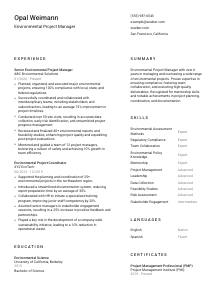
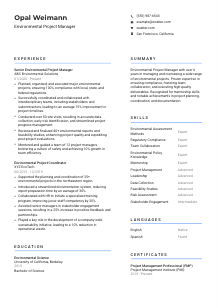
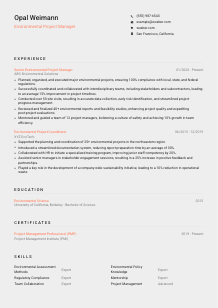
Driving green initiatives, but your resume feels stuck in the trash heap? Check out this Environmental Project Manager resume example, created with Wozber free resume builder. It shows how to shape your eco-minded leadership to match job prerequisites, planting a career as fruitful as an organic garden!
Environmental project management sits at the intersection of fieldwork, regulation, and delivery. Hiring teams need to see that you can keep projects moving while managing permits, documentation, site risks, and cross-functional coordination without letting compliance slip. Your resume should make that operational control visible, not just list environmental titles and responsibilities.
When the resume is tailored well, it quickly separates candidates who have truly run environmental projects from those with adjacent coordination experience. Wozber's free resume builder helps you shape that story into an ATS-compliant resume by aligning your wording with the posting's language around environmental assessments, reporting, and project execution, so your background reads clearly as project leadership in a regulated setting.
This section is short, but it still carries screening value. For an Environmental Project Manager, the header should immediately confirm who you are, what role you are targeting, and whether practical requirements such as location and contact access are already covered.
Use your full name at the top in a clean, readable format. Keep it more prominent than the rest of the header so a hiring manager can identify your application quickly when reviewing multiple candidates for project-based roles.
Place "Environmental Project Manager" directly under your name if that is the role you are pursuing. This creates an immediate match with the posting and frames the rest of the resume around project planning, compliance oversight, reporting, and stakeholder coordination rather than a broader environmental background.
Include a reliable phone number and a professional email address. If you add a website or LinkedIn profile, make sure it supports the resume with relevant project history, environmental expertise, certifications, or leadership experience instead of generic online activity.
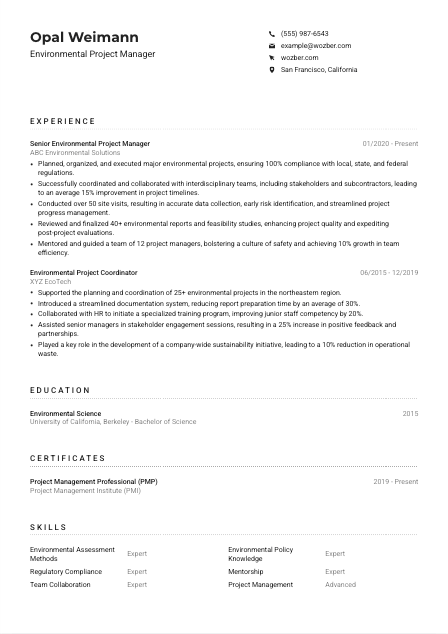
Some environmental project roles involve regular site visits, local regulatory coordination, or client-facing work tied to a specific region. In the example, San Francisco, California is stated directly in the header, which quickly answers a location filter in the job ad. Use the same approach when a posting specifies where you must live or relocate.
A digital profile can help if it shows environmental project scope, published reports, professional affiliations, or certifications such as PMP or CEP. Leave it out if it is sparse or unrelated. Every line in the header should support your candidacy for regulated, deadline-driven project work.
Your personal details do not need personality flourishes. They need to remove friction, confirm role alignment, and make it easy to contact you for work that depends on organization, responsiveness, and local project availability.




This is where hiring teams look for project scope, regulatory discipline, and delivery results. Environmental Project Manager experience should show how you planned work, coordinated stakeholders, handled field realities, and produced compliant documentation under deadlines.
Read the posting closely and mark the verbs and deliverables that define the work. Here, that includes planning, organizing, executing, coordinating with stakeholders and subcontractors, conducting site visits, reviewing reports, and mentoring staff. Use those same ideas when they reflect your actual background so the employer can immediately connect your experience to their project workflow.
Prioritize positions where you managed or materially supported environmental projects, especially if they involved assessments, compliance documentation, risk review, field coordination, or post-project evaluation. The example resume does this well by opening with a Senior Environmental Project Manager role and then showing an earlier coordinator role that supports a clear progression into leadership.
Bullet points should show what changed because of your work. In this field, useful metrics include compliance rates, timeline improvements, number of site visits, reporting volume, subcontractor coordination, budget scale, permit turnaround, or team productivity. "Ensured 100% compliance" and "improved project timelines by 15%" are strong because they translate environmental management into delivery results.
Environmental project management resumes should stay anchored in project execution, regulatory knowledge, field oversight, and documentation quality. If an accomplishment does not support those themes, cut it or reframe it. A bullet about streamlining report preparation time by 30%, for example, matters because it improves project delivery and documentation workflow, not because it sounds generally efficient.
Sequence your experience so the reader can see increasing responsibility. That can mean moving from coordination into full project ownership, handling more complex regulatory environments, managing larger teams, or mentoring junior staff. The sample's progression from project coordination to managing major environmental projects and mentoring 12 project managers gives a clear picture of readiness for higher-level oversight.
A hiring team should be able to scan your experience and understand the kind of projects you ran, how you kept them compliant, and what results you delivered. That is the standard this section needs to meet.
Environmental Project Manager roles often have a clear degree requirement because the work depends on technical judgment, regulatory literacy, and credible reporting. Your education section should confirm that foundation quickly and without clutter.
If the posting asks for a bachelor's degree in Environmental Science, Engineering, or a related field, make sure your degree title and field are written clearly. In the example, "Bachelor of Science in Environmental Science" directly satisfies the requirement and removes doubt about academic fit.
List your degree, school, and graduation year in a consistent order. Keep this section easy to scan. For most mid-career Environmental Project Managers, there is no need to overbuild it if your work history already carries the heavier proof of project execution.
If your studies closely align with the work, let that alignment speak for itself through accurate naming. Environmental Science, Environmental Engineering, geology, ecology, or similar fields all help frame your technical background for site assessments, feasibility studies, and environmental documentation.
Relevant academic detail can help if you are earlier in your career or if a project directly supports the role, such as environmental impact assessment, remediation planning, GIS analysis, hydrology, or regulatory policy work. Keep it selective and tied to the kind of environmental project work you want next.
Honors, research work, or leadership in environmental organizations can be worth listing when they reinforce technical credibility or early project leadership. If you already have more than 5 years of relevant experience, these details should stay secondary to your delivery record in the field.
This section does not need to do all the persuasion. It needs to confirm that you have the academic grounding for environmental analysis, reporting, and project decisions, then get out of the way of your experience.
Certifications matter in environmental project management because they can reinforce formal project discipline, regulatory professionalism, and continued development. They are especially useful when a posting calls out a credential such as PMP as a preferred qualification.
When a job posting says PMP or a related project management certification is highly desired, list that credential prominently if you have it. The example resume places PMP first, which is the right move because it maps directly to the employer's preference and supports the candidate's leadership profile.
Choose certifications that strengthen your case for environmental project execution, compliance oversight, or technical judgment. PMP, CEP, environmental auditing, safety training, or discipline-specific credentials can all be relevant depending on the projects you manage. Skip unrelated certificates that add noise without improving your fit for the role.
Name the certification, the issuing organization, and the active date range or year earned. That level of detail makes it easier for employers to understand whether your credential is current, especially for certifications that require renewal or continuing education.
Environmental regulations, project controls, and reporting standards evolve. An updated certification section shows that you keep your professional toolkit current, whether that is through formal project management training or environmental credentials tied to compliance, stewardship, or technical practice.
Well-chosen certifications add weight when they support how the role is actually performed. For Environmental Project Manager positions, they should strengthen your case as someone who can lead projects with structure, accountability, and environmental rigor.
The skills section should reflect how environmental projects actually get delivered. That means a mix of technical knowledge, regulatory capability, field judgment, and people management, presented in the language the employer already uses.
Pull skill terms directly from the posting when they match your experience. In this case, environmental assessment methods, applicable regulations, documentation, communication, team collaboration, and leadership are all worth featuring. This helps both human reviewers and ATS systems connect your resume to the role's core demands.
A useful skill mix for this profession includes both technical and management capabilities. Environmental assessment methods, regulatory compliance, data collection, feasibility studies, and risk assessment belong alongside leadership, stakeholder engagement, mentorship, and project management. The example resume gets this balance right by combining field and compliance skills with team leadership strengths.
Keep the list selective and role-focused. If the work involves site visits, reporting, subcontractor coordination, and regulatory review, those capabilities deserve space before generic software or broad interpersonal labels. A tighter list reads as more credible and helps the employer picture you in the day-to-day work of the role.
Your skills section should read like the toolkit of someone who can run environmental projects from assessment through closeout. If each skill supports compliance, coordination, field execution, or reporting quality, the section is doing its job.
Language skills are usually a supporting section, but they can still matter in environmental project management. Public meetings, site coordination, community communication, and subcontractor collaboration can all benefit from clear language ability, especially when the posting names a proficiency requirement.
If the employer asks for a high level of English proficiency, list English clearly and use an honest proficiency label. That requirement matters in roles involving regulatory reports, feasibility studies, stakeholder communication, and written project updates.
Put the language most important to the role first. In many U.S.-based environmental roles, English belongs at the top because it supports reporting, compliance documentation, and cross-functional coordination. Additional languages can follow in descending relevance.
Extra language capability can be valuable when projects involve local communities, multilingual field teams, or public-facing environmental initiatives. In the example, Spanish is listed as fluent, which can be a practical advantage in some California-based project environments, though it is not a universal requirement for every Environmental Project Manager role.
Use clear levels such as Native, Fluent, Advanced, or Conversational. Avoid vague labels. Accuracy matters because language ability may affect client calls, site briefings, public engagement, or document review responsibilities.
If a language helped you manage stakeholder relationships, support field operations, or communicate across teams, that can reinforce its relevance elsewhere in the resume. Keep the language section itself simple, then let the experience section show where it mattered in practice.
List languages when they improve your ability to manage reports, stakeholders, teams, or communities. Clear proficiency labels are enough. The value comes from how those skills support environmental project delivery.
The summary should give a hiring manager a quick, accurate read on your level, project background, and the kind of value you bring. For Environmental Project Manager roles, that usually means combining years of experience with compliance strength, delivery results, and team leadership.
Lead with your title and years of relevant experience. A line such as "Environmental Project Manager with 6+ years managing environmental projects" immediately places you in the right hiring bracket and tells the reader your work is grounded in project ownership, not adjacent support work.
Use the summary to highlight the capabilities the employer cares about most. For this posting, that includes project execution, regulatory compliance, environmental documentation, stakeholder coordination, and leadership. The sample summary handles this well by emphasizing compliance, collaboration, and high-quality deliverables.
Aim for a short paragraph of 3 to 5 lines. Include the details that help a reviewer understand your background fast, such as years of experience, project focus, and one or two standout strengths. Avoid broad statements that could fit any project role.
Choose one theme that makes you memorable and relevant, such as leading complex environmental projects, improving reporting processes, managing regulated site work, or mentoring junior staff. In the example, mentorship is a smart inclusion because the job description specifically calls for guidance and team development.
By the time someone finishes your summary, they should already understand your level of environmental project experience, your comfort with regulated work, and the kind of teams or deliverables you can lead. That gives the rest of the resume a clear frame.
A well-tailored Environmental Project Manager resume should show far more than environmental interest. It should demonstrate that you can run workstreams, manage compliance risk, coordinate people in the field and in the office, and deliver reports and evaluations that hold up under review.
Use Wozber's free resume builder to structure that experience in an ATS-friendly resume format, then refine it with the ATS resume scanner and AI-powered tailoring tools so the language of your projects, certifications, and skills matches the role you are targeting. The result should make your readiness for environmental project leadership easy to judge.




