



Use Wozber and land your dream job
Create Resume
No registration required
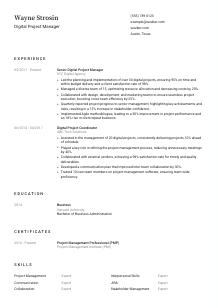
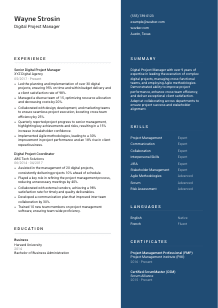
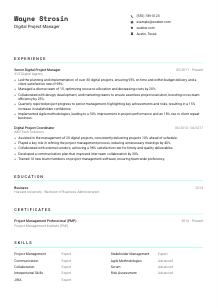
Navigating digital landscapes, but your resume feels like a website with broken links? Explore this Digital Project Manager resume example, created with Wozber free resume builder. Learn how to smoothly align your digital direction with job coordinates, propelling your career to the forefront of the virtual revolution!
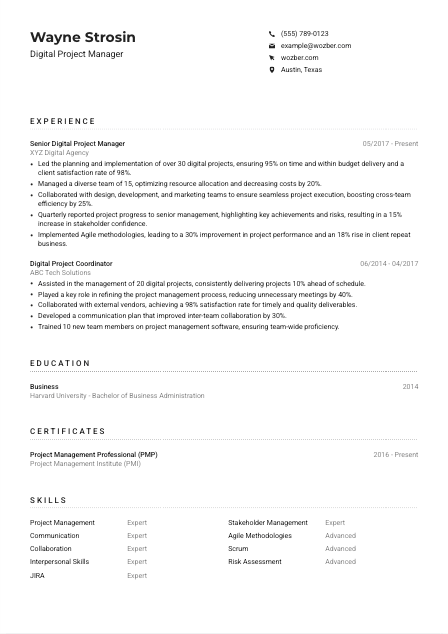
Digital project management gets reviewed through delivery. Hiring teams want to see whether you can move work from kickoff to launch without losing control of scope, timeline, budget, or communication across design, development, and marketing. Your resume should make that operating range visible quickly, especially through project outcomes, team coordination, and the way you handle risk and reporting.
When the resume is tailored well, the first read becomes much simpler. Wozber's free resume builder helps you align your wording with the role's priorities and keep the document in an ATS-friendly resume format, so terms like Agile, stakeholder reporting, and budget management are easy to find where they matter. That gives the employer a cleaner view of whether you can run digital delivery with consistency and accountability.
This section is short, but it still does practical work. For a Digital Project Manager, it should confirm who you are, how to reach you, and whether any basic logistics could affect hiring decisions. Keep it clean, current, and aligned with the posting.
Use your full name as the most visible text on the page. A simple, readable presentation works best because Digital Project Manager hiring is usually fast-moving, and the resume should be easy to scan during an initial review or stakeholder share-out.
Place "Digital Project Manager" directly under your name when that is the role you are pursuing. This keeps your positioning clear, especially if your previous titles include variations like Project Coordinator, Product Manager, or Delivery Manager. It helps the reader place your background in the right lane immediately.
Include one phone number and one professional email address, and make sure both are current. If a hiring manager wants to discuss your experience with budgets, timelines, or cross-functional delivery, they should not have to hunt for the right contact information or question whether the resume is current.
If the job asks for a specific location or relocation willingness, say so here. In this example, listing Austin, Texas removes a common screening question early. If you are relocating, state that clearly rather than leaving the employer to guess.
Include a LinkedIn profile or personal site only if it supports your candidacy. For Digital Project Managers, that might mean a polished profile with clear role progression, tool familiarity, certification details, or project portfolio context. Make sure it matches the dates, titles, and scope shown on your resume.
Your personal details should remove friction, not add style for its own sake. Once this section confirms identity, contact path, and any required location detail, the reader can move straight to your delivery track record.




This section carries the most weight for a Digital Project Manager. Employers look here for proof that you can run digital work across multiple teams, keep delivery on track, and communicate trade-offs before small issues become project risk. Focus on scope, results, and the way you operated.
Before you edit any bullets, mark the responsibilities that show how the role is measured. For this posting, that includes planning and implementation, timeline and budget control, collaboration across design, development, and marketing, regular stakeholder reporting, and process improvement. Your experience bullets should answer those points directly with real examples from your work.
List positions in reverse chronological order and emphasize jobs where you owned project execution, resource planning, client communication, sprint coordination, or launch delivery. If your earlier title was more junior, such as Digital Project Coordinator, show how it built toward fuller ownership through scheduling, vendor coordination, tool administration, or status reporting.
Each bullet should show what you managed and what changed because of your work. Metrics are especially persuasive in digital project management because they show control over delivery. The sample resume does this well with results like 95% on-time, within-budget delivery, a 20% cost reduction, and a 25% gain in cross-team efficiency. Use your own numbers where possible, including project volume, budget size, team size, launch speed, repeat business, or client satisfaction.
Keep the section focused on work that supports digital execution. A bullet about a general administrative task or unrelated leadership activity can weaken the story if it pushes out stronger examples of sprint planning, dependency management, issue escalation, roadmap coordination, or stakeholder updates. Every line should help the reader understand how you run digital projects.
If Agile, Scrum, JIRA, Asana, Trello, Monday.com, or other delivery tools are part of your real workflow, mention them naturally in context. Do not just drop tool names into a list of duties. Tie them to outcomes, such as improving sprint cadence, reducing meeting overhead, increasing visibility into blockers, or raising on-time delivery. In the example, Agile implementation is linked to a 30% improvement in project performance, which is much stronger than simply saying "used Agile."
A hiring manager should be able to read this section and understand your delivery style, your level of ownership, and the results you produce. When your bullets connect planning, execution, reporting, and improvement, your experience reads like digital project management rather than general operations.
Education is usually a straightforward section, but it still helps confirm baseline qualification for the role. For a Digital Project Manager, it should show that you meet the degree requirement without taking space away from more decisive experience and results.
If the posting asks for a bachelor's degree in Marketing, Business, or a related field, make sure your degree is easy to identify. A Bachelor of Business Administration, marketing degree, communications degree, or similar field should be written clearly so the requirement is easy to confirm during screening.
List your degree, field of study, school, and graduation year or date in a consistent order. This section should be easy to scan in a few seconds, especially when the reader is checking minimum qualifications before moving back to your project history.
Write the full degree title rather than abbreviating too aggressively if that could create ambiguity. For example, showing "Bachelor of Business Administration" gives more useful context than a shortened line with missing field information, especially when business education directly supports planning, budgeting, and stakeholder management work.
Relevant coursework can help if you are earlier in your career or moving into digital project management from an adjacent path. Courses in marketing strategy, product development, analytics, operations, or information systems can support the transition. If you already have 5+ years of delivery experience, this detail is usually optional.
Honors, leadership roles, or substantial academic projects belong here only if they add something relevant, such as team leadership, campaign planning, research, or process work. For experienced Digital Project Managers, keep this section lean and let your project outcomes carry more weight.
Education should confirm qualification quickly and stay tidy. When the degree is clear and relevant, the reader can move on to the parts of the resume that show how you deliver digital work in practice.
Certifications matter most when they strengthen your credibility in delivery methods, governance, or team leadership. In digital project management, they are especially useful when the role mentions structured project management or Agile practice.
If the posting mentions PMP as a plus, give it visible placement if you have it. Other relevant certifications, such as Certified ScrumMaster, Agile, product, or platform-specific credentials, can also support your candidacy when they connect to the job's delivery model.
Choose certifications that reinforce how you manage projects, teams, and execution. A shorter list of directly relevant credentials is stronger than a long list of unrelated learning. For this role, project governance, Agile delivery, and workflow management matter more than generic online course completions.
Add the year earned or validity range so the employer can see whether the credential is current. This matters in project work where methodology standards, reporting practices, and tool ecosystems continue to evolve.
Use certifications to show that you keep sharpening the parts of the job that affect delivery quality. That could mean formal training in Agile, Scrum, stakeholder management, process improvement, or digital product workflows. In the sample, PMP and CSM together reinforce both structured project oversight and iterative delivery fluency.
Certifications work best when they back up the experience section. They should strengthen the case that you can manage digital projects with discipline, adapt your method to the team, and communicate progress in a way stakeholders trust.
A Digital Project Manager skills section should read like the toolkit behind your project results. It needs a clear mix of delivery methods, collaboration strengths, and software fluency that matches the language of the job description without becoming a keyword dump.
Start with the capabilities named in the job ad, then keep only the ones you genuinely use. Here, that includes project management, communication, collaboration, interpersonal skills, project management software, and Agile methodologies. If a tool like JIRA appears in your background, it belongs here because it supports the role's day-to-day workflow.
Put the most role-critical skills first. For Digital Project Managers, that usually means project delivery, stakeholder management, Agile or Scrum, risk assessment, resource planning, and communication across technical and non-technical teams. This ordering helps both ATS parsing and human review land on the right capabilities first.
If your skills list is getting long, group it logically. One cluster can cover execution skills such as budgeting, timeline management, and risk control. Another can cover tools and frameworks such as JIRA, Scrum, Kanban, or reporting platforms. That makes the section easier to read and more useful than an undifferentiated list.
The best skills lists help the reader connect your methods to your outcomes. When your skills reflect how digital projects actually get planned, tracked, escalated, and delivered, the section supports the rest of the resume instead of repeating it.
Language ability matters when communication is central to the role. Digital Project Managers spend a large part of the job translating priorities between clients, leadership, designers, developers, and marketers, so language entries should be accurate and useful.
If the posting calls for strong English, list English first and state your level clearly, such as Native or Fluent. That helps confirm you can run meetings, write status updates, document risks, and manage stakeholder communication in the required language.
Other languages can add value, especially in agency, global, or distributed-team environments. They matter most when they help with client communication, vendor coordination, or cross-border project work. A second language is a support point, not a replacement for core project delivery credentials.
Choose levels you can defend in real work situations. If you list a language as Fluent, be prepared to lead calls, write updates, or handle project discussion in that language. Accuracy matters because communication is a core part of project leadership.
For this profession, language skill is useful because it helps reduce friction across teams and stakeholders. If you manage international partners, multilingual clients, or distributed teams, language ability can make status reporting, issue resolution, and expectation setting much smoother.
Unless multilingual communication is a major part of the target role, keep this section brief. Lead with the required working language, then list any additional languages that genuinely support your professional reach.
Handled well, this section adds practical context to your collaboration strengths. It should confirm that you can communicate clearly in the required language and, where relevant, operate effectively across broader client or team environments.
Your summary should frame you as a Digital Project Manager in a few lines, with enough specificity to make the reader want the details underneath. Focus on delivery scope, operating style, and the kinds of results you are known for.
Start with your title, years of experience, and the area you manage. For example, "Digital Project Manager with 9 years of experience leading web, product, or marketing delivery" tells the reader much more than a vague opening about being results-driven.
Choose results that reflect how you manage projects. Useful examples include improving on-time delivery, increasing client satisfaction, reducing delivery cost, improving sprint performance, or making cross-functional execution more efficient. The sample summary works because it points to project performance, team efficiency, and stakeholder alignment rather than broad claims.
Bring in the specific themes emphasized in the posting if they are true to your background. For this role, that means digital project execution, Agile methodologies, collaboration across departments, and progress reporting. This helps both the hiring team and ATS systems connect your profile to the vacancy quickly.
Aim for a short paragraph, not a mini cover letter. Every sentence should carry role-specific information such as years of experience, delivery scope, methods used, and measurable outcomes. Cut generic phrases that could belong to almost any manager.
A strong summary should tell the reader, within a few seconds, what kind of digital projects you manage and how you perform under delivery pressure. If it does that well, the rest of the resume has a clear frame.
A Digital Project Manager resume works when it makes your execution style easy to understand. The hiring team should be able to see how you plan work, coordinate teams, manage risk, report progress, and deliver outcomes that matter to clients or leadership.
Use Wozber's free resume builder to sharpen that alignment, keep the structure ATS-compliant, and refine your language with the help of ATS resume scanner insights and role-matched phrasing. The final resume should make one thing clear: you can run digital projects with control, transparency, and dependable results.




