



Use Wozber and land your dream job
Create Resume
No registration required
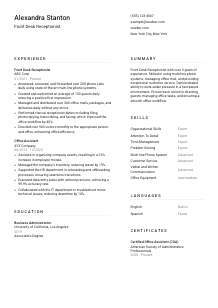
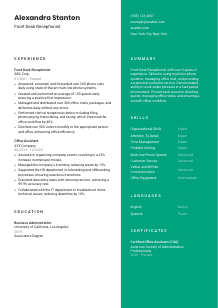
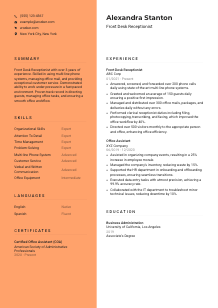
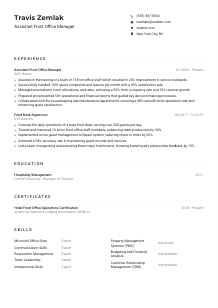
Greeting guests, but your resume seems unwelcome? Check out this Front Desk Receptionist resume example, created with Wozber free resume builder. Learn how to showcase your hospitality and coordination skills to match job standards, ensuring your career journey has a splendid entry point!
A front desk resume has to show more than a pleasant demeanor. Employers are hiring someone who can keep the office entry point organized while calls stack up, visitors arrive at once, deliveries need logging, and small clerical tasks cannot be missed. Your resume should make that pace visible through clear examples of customer-facing service, phone handling, and day-to-day office coordination.
When those details are tailored to the job posting, hiring teams can quickly see whether you have handled the same mix of reception traffic, communication, and administrative support they need. Wozber's free resume builder helps you shape that experience into an ATS-compliant resume with job-matched wording, so your background reads clearly in both an ATS and a hiring manager's first review.
Reception work starts with how you present yourself. The Personal Details section should be clean, current, and professional, because this role often sits at the first point of contact for visitors, callers, and internal staff alike.
Place your name at the top in a slightly larger, readable font so it anchors the page immediately. For a front desk role, polished presentation matters, and a cluttered heading can undermine that before your experience is even read.
Add "Front Desk Receptionist" beneath your name when that is the role you are applying for. This keeps your positioning direct and helps the employer connect your resume to the opening without guessing whether you are targeting reception, general administration, or another office support path.
Your phone number and email should be accurate and easy to review, because communication reliability is part of the job. If you miss a callback due to an outdated number or use an unprofessional email address, that creates the wrong impression for a role built around responsiveness.
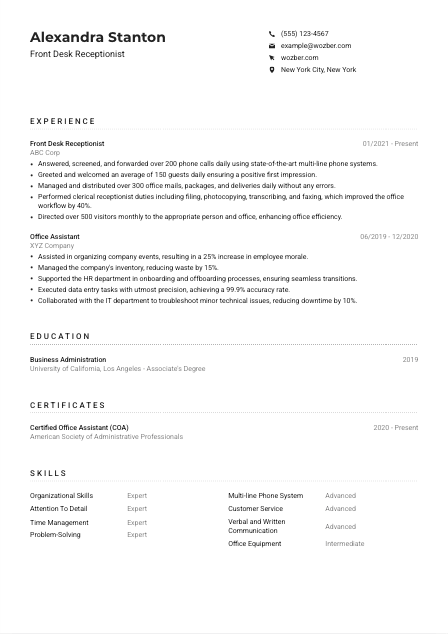
If the employer wants someone already based in New York City, list New York City, New York in your contact details. That immediately removes a practical concern about commute or relocation. In the example resume, this detail supports the posting's location requirement without taking up unnecessary space.
If you have a LinkedIn profile or professional website, include it only when it strengthens your application. For front desk candidates, this is useful when it reinforces office support experience, customer service work, or administrative skills rather than acting as a placeholder link.
Do not include age, marital status, photo, or other personal details unless a local standard requires them. Front desk hiring should focus on your communication, organization, phone handling, and ability to manage a busy office flow.
This header area should confirm who you are, how to reach you, and whether you meet practical basics such as location. Keep it neat and businesslike, the same way a well-run reception desk feels the moment someone walks in.




Front desk experience is strongest when it shows volume, pace, and consistency. Hiring teams want to see how you handled visitors, incoming calls, deliveries, and clerical duties in a live office setting, especially when several demands competed for your attention at once.
Read the job description and mark the recurring operational tasks: greeting guests, directing visitors, screening calls, handling mail and packages, and supporting clerical work. Then shape your bullets so those functions appear in your own work history using the same terminology when it accurately reflects your background.
Start with your most recent position and present the basics cleanly so the reader can follow your track record in office support. For reception and administrative work, job title progression matters because it shows how much direct responsibility you had at the front desk versus behind-the-scenes support.
A hiring manager already knows a receptionist answers phones and greets visitors. What matters is how well you handled those duties, how much traffic you managed, and whether your work kept the office running smoothly. The example resume does this well by turning standard duties into concrete achievements tied to office efficiency and service volume.
Metrics are especially effective here because reception work is often measured by call volume, visitor traffic, mail handling accuracy, and administrative turnaround. Figures like "200 phone calls daily," "150 guests daily," or "300 deliveries managed without errors" give immediate scale and show that you can perform under pressure in a fast-paced office.
Keep the section centered on customer service, communication, organization, and clerical execution. If you have unrelated experience, either shorten it or highlight the transferable parts such as scheduling, data entry accuracy, or handling internal requests under time pressure. That keeps the resume aligned with reception work instead of reading like a general office profile.
Your experience section should leave little doubt that you can handle the front desk rhythm of calls, guests, deliveries, and admin tasks without losing professionalism or accuracy. That is the standard this section needs to meet.
Education is usually a supporting section for front desk hiring, but it still adds context. It can reinforce business familiarity, communication skills, or general office knowledge, especially when your degree or coursework connects naturally to administrative or customer-facing work.
Some receptionist jobs do not require a specific degree, while others prefer coursework in business, communications, or office administration. If the posting is flexible, include your education cleanly and let experience carry more weight.
Use a straightforward format that covers the essentials without overexplaining. This section should be quick to read, especially for roles where employers are spending more time on work history, phone skills, and customer service experience.
If your studies involved business administration, communication, recordkeeping, or customer service, that is worth surfacing because those areas connect directly to reception work. In the example, an Associate's Degree in Business Administration supports the candidate's office-facing background without overstating the role of education.
Relevant coursework can help if you are earlier in your career or if your classes directly connect to office procedures, business communication, or administrative systems. If you already have solid front desk experience, keep coursework brief or leave it out to preserve space for stronger professional detail.
Honors, leadership roles, or campus office responsibilities can add value when they show dependability, service orientation, or administrative organization. If those details do not connect to the kind of office support work you are targeting, they are optional rather than essential.
This section should quietly support your candidacy, not compete with your experience. A concise education entry works best when it adds credible background and leaves room for the office skills employers are really hiring for.
Certifications are not always required for front desk work, but the right one can strengthen your profile. They are most useful when they point to office administration, customer service, communication, or professional office standards that matter in a reception setting.
Look at the posting for clues about what kind of extra training would be relevant. In a front desk role, that usually means administrative support, office procedures, communication, or customer service rather than broad credentials that do not connect to daily reception duties.
List certifications that sharpen your value for a reception desk environment. The sample's Certified Office Assistant credential is a good illustration because it aligns with clerical support, organization, and office workflow rather than adding unrelated coursework.
If a certification is active, recently earned, or periodically renewed, include the date. That helps the employer see that your office knowledge is current, especially if the credential relates to present-day administrative practices or customer service standards.
Short courses in business communication, office software, scheduling tools, or customer service can be worthwhile additions over time. Choose learning that helps you perform real front desk tasks more smoothly, not just fill space on the page.
A certificate helps when it supports the actual work of greeting visitors, managing information, and handling office tasks accurately. Keep this section focused on training that strengthens your practical contribution at the front desk.
For a Front Desk Receptionist, the skills section should read like the operating toolkit behind a smooth office welcome. It should balance customer-facing strengths with practical office abilities, because this job depends on both service and steady administrative execution.
Pull skills directly from the posting and group them by how the role is actually performed. Here, that means a mix of multi-line phone systems, office equipment use, organization, communication, multitasking, and attention to detail under pressure.
Reception hiring often looks for both operational and interpersonal capability, so include both. Technical skills might cover multi-line phone systems, faxing, photocopying, filing, and basic office equipment, while professional strengths can include customer service, time management, and verbal communication. The example resume reflects this balance well.
Lead with the skills that map most closely to the job description rather than listing everything you can do. If the employer stresses fast-paced front desk work, prioritize phone handling, visitor coordination, communication, and organization before broader or less critical abilities.
This section should make it easy to picture you managing a busy front desk with accuracy, composure, and a professional tone. Focus on the abilities that support that daily reality.
Language ability matters most in front desk work when it improves communication with visitors, callers, and internal staff. Even when only English is required, listing languages correctly can strengthen your profile for offices that serve a diverse client or employee base.
If the posting says strong English is essential, list English clearly and use an accurate proficiency label. For a receptionist, spoken clarity and written communication matter because you may be greeting guests, relaying information, taking messages, and responding to routine inquiries throughout the day.
Use labels such as Native, Fluent, Advanced, or Intermediate so the employer can quickly understand your communication level. Keep the wording consistent across all languages and avoid vague descriptions.
Additional languages can be a real asset when the office serves a multilingual community or frequent visitors from different backgrounds. In the example, Spanish strengthens the candidate's customer-facing profile, though it is an added advantage rather than a stated requirement in this posting.
Do not overstate your level. A front desk role depends on smooth live communication, so employers will notice quickly whether you can actually hold conversations, answer questions, or transfer information with confidence.
If you are applying to a busy urban office, medical practice, legal office, or hospitality-linked setting, extra language ability can support visitor service and reduce communication friction. Include it when it genuinely helps you serve guests and callers more effectively.
List languages when they strengthen your ability to communicate clearly and courteously in the workplace. For this kind of role, that practical service value matters more than simply having an extra line on the resume.
Your summary should quickly establish the kind of receptionist you are. In three to four lines, it should cover your experience level, the office-facing work you handle confidently, and the strengths that help you stay organized and professional when the front desk gets busy.
Before writing the summary, note the few requirements that matter most in the opening lines of your resume. For this posting, that includes front desk or customer service experience, multi-line phone systems, multitasking in a fast-paced environment, and strong communication.
Start with a clear professional label and the amount of experience you bring. A line such as "Front Desk Receptionist with 3+ years of experience" works because it immediately places you within the hiring range and sets up the rest of the summary with credibility.
Mention the parts of your background that map closely to the work, such as handling high call volume, welcoming visitors, managing deliveries, and supporting office workflow. The example summary works because it stays focused on reception-specific tasks rather than drifting into generic soft skills.
Aim for a compact paragraph that can be read in seconds. Skip broad claims and use precise wording that reflects real front desk work, so the summary feels like a credible preview of the experience section instead of a set of empty descriptors.
By the end of the summary, the reader should already understand your reception background, your comfort with a busy office environment, and the specific strengths you would bring to the front desk on day one.
You now have a clear framework for presenting front desk experience in a way that speaks to office managers and hiring teams. Focus each section on the work that matters most in this profession: greeting visitors professionally, managing phone traffic, handling office support tasks accurately, and staying composed when the pace picks up.
Use Wozber's free resume builder to organize your content in an ATS-friendly resume format, then review it with an ATS resume scanner to tighten alignment with the job description. When your wording, structure, and examples reflect the actual flow of front desk work, your resume makes it much easier to judge your readiness for the role.




