



Use Wozber and land your dream job
Create Resume
No registration required
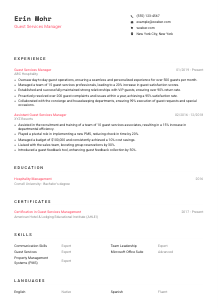
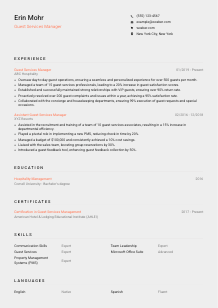
Rolling out the red carpet, but your resume isn't getting the invite? Check out this Guest Services Manager resume example, created with Wozber free resume builder. It shows how to showcase your hospitality skills to match job expectations, placing your career at the forefront of service excellence!
Guest services management sits where daily operations and guest perception meet. Hiring teams look for people who can keep arrivals, requests, complaints, and special touches moving smoothly while leading a front-facing team that stays composed under pressure. Your resume should make that operating standard visible through guest satisfaction results, team leadership, and examples of how you handled service issues in real hospitality settings.
A tailored resume changes how quickly your background reads against the role's priorities. When the language around guest operations, team supervision, complaint resolution, and cross-department coordination matches the posting, an employer can see faster whether you've managed the kind of service floor they run. Wozber's free resume builder helps shape that into an ATS-compliant resume, so both the ATS and the hiring manager can quickly recognize your hospitality leadership experience.
For a Guest Services Manager, the top of the resume should feel organized, polished, and easy to act on. This section is simple, but it still carries hiring value because it confirms who you are, what role you are targeting, and whether you meet practical requirements such as location and contact availability.
Place your name at the top in a clean, readable format. In hospitality management, presentation matters, and a cluttered heading creates the wrong impression before the employer reaches your operations or guest service results. Keep it professional and visually clear rather than decorative.
Include "Guest Services Manager" directly under your name if that is the role you are pursuing. Matching the title from the posting helps with ATS optimization and immediately frames your background around guest operations, team supervision, and service recovery instead of a broader hospitality profile.
Add a reliable phone number and a professional email address. If you include a LinkedIn profile or personal website, make sure it supports your candidacy with hospitality leadership experience, property background, service achievements, or recommendations rather than generic social presence.
If the employer specifies a location requirement, show it clearly in your header. In the example posting, being based in New York City, New York is a stated requirement, so listing New York City, New York removes an early logistical question and keeps the focus on your qualifications.
Do not use space on details such as age, marital status, photo, or other personal identifiers unless local norms require them. Guest services hiring is centered on leadership presence, communication, guest handling, and operational consistency, so keep the header focused on information the employer actually uses.
Your header should confirm role target, contact access, and any practical requirement the employer raised. Once that is clear, the rest of the resume can stay focused on guest experience, team management, and service outcomes.




Experience carries the most weight for this role because employers want proof that you have already handled live guest environments. They are looking for scale, service standards, team oversight, complaint resolution, and coordination with departments such as housekeeping, concierge, and sales.
Start with your most relevant positions and give priority to work that involved front-of-house operations, guest relations, or service leadership. The posting asks for more than 3 years in a guest-facing role and at least 2 years in supervision or management, so your job titles and dates should make that progression easy to follow.
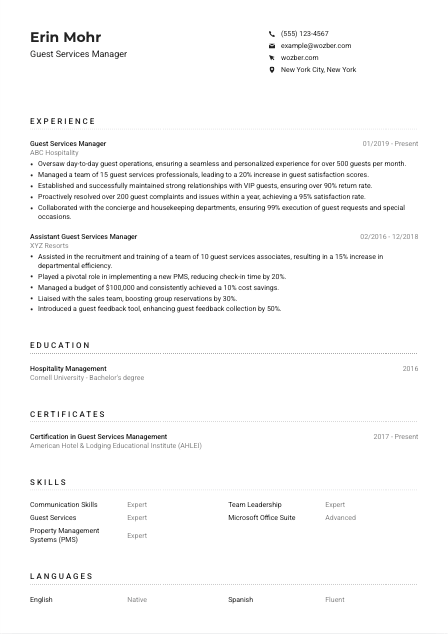
Shape each role around the work this profession is hired to do: overseeing guest operations, leading staff, building guest relationships, resolving complaints, and coordinating service delivery. The example resume does this well by stating responsibility in practical terms, such as overseeing day-to-day guest operations for more than 500 guests per month.
Guest services performance is often judged through guest satisfaction scores, return rates, complaint resolution rates, check-in efficiency, service accuracy, and team productivity. Metrics like a 20% increase in guest satisfaction, a 95% complaint resolution satisfaction rate, or a 20% reduction in check-in time tell a hiring manager far more than broad claims about excellent service.
You do not need to describe every hospitality duty you have ever handled. Prioritize the work that shows leadership in guest experience, staff training, service recovery, VIP handling, and coordination across departments. If you have older or less relevant roles, reduce them to a shorter format so your strongest hospitality management work gets the space.
Choose verbs that show you led, improved, solved, and coordinated. Words like "oversaw," "managed," "trained," "resolved," "implemented," and "collaborated" fit this role because they point to real operational control. Pair them with results, so the employer sees not just activity, but how your leadership affected guest satisfaction, efficiency, or retention.
By the end of this section, the employer should be able to picture you running a guest services operation, guiding the team, and stepping in when service issues need quick resolution. That is the level of clarity this role calls for.
Education matters here because the posting specifically asks for a bachelor's degree in Hospitality Management or a related field. For an experienced Guest Services Manager, this section is usually brief, but it still needs to confirm that you meet the stated educational baseline.
List your degree, school, field of study, and graduation year clearly. If you hold a bachelor's degree in Hospitality Management, place that wording exactly as earned. In the example, "Bachelor's degree" and "Hospitality Management" from Cornell University immediately align with the employer's requirement.
Hiring teams do not need a long academic narrative for this role unless you are early in your career. A straightforward entry with institution, degree, field, and date is enough to confirm you meet the requirement and lets your operations experience stay in the spotlight.
If you are newer to hospitality leadership, you can include coursework, projects, or student leadership related to hotel operations, guest relations, event service, or hospitality management systems. For experienced candidates, those details are usually less important than guest satisfaction, team results, and service delivery metrics.
Academic honors, leadership roles, or hospitality-related activities can help if they reinforce professionalism or leadership potential. Keep them short and relevant. Once you have several years managing guest-facing teams, this section should support the resume rather than compete with your experience section.
If you have continued training in hospitality operations, guest experience, conflict resolution, or management development, mention it where appropriate. Formal certifications belong in the certificates section, but education can still reflect that you take service quality and leadership development seriously.
This section does not need much space, but it does need to answer the employer's degree requirement without effort. Once that box is checked, your resume can return to the operational and leadership results that matter most.
Certifications are a supporting section for this role, not the main story. They help most when they confirm professional training in hospitality management, guest relations, service standards, or leadership development that complements your on-the-job results.
When an employer mentions hospitality certification as a plus, list credentials that clearly connect to guest services, hotel operations, or hospitality leadership. This keeps the section aligned with the job rather than turning it into a list of unrelated training.
A few relevant certifications do more for you than a long list of generic courses. In the example, "Certification in Guest Services Management" and "Certified Hospitality Manager (CHM)" both strengthen the candidate's profile because they support the leadership and guest experience focus of the role.
Show the year or validity range when it helps the employer understand that your training is current. This is especially useful for credentials tied to active membership, ongoing standards, or recent management development in a service-driven environment.
If you are developing toward larger hotel, resort, or luxury-property leadership roles, look for training in service recovery, team management, conflict handling, guest loyalty, and hospitality systems. New certifications should fill a real gap or strengthen a target direction, not just add lines to the page.
Use this section to confirm continued professional development in hospitality. The best entries strengthen what your experience already shows: that you can lead service teams and maintain high guest standards.
The skills section should reflect how Guest Services Managers actually work. That means balancing service leadership and communication with the systems and coordination tools needed to keep operations running smoothly across shifts and departments.
Start with the terms the employer chose. For this posting, that includes interpersonal communication, written and verbal communication, property management systems, Microsoft Office Suite, and team leadership. Mirroring that language improves ATS alignment and keeps the section relevant to real job needs.
Guest services management depends on both people skills and process control. Pair skills like guest relations, complaint resolution, and staff coaching with technical strengths such as PMS use, reporting, scheduling, and Office proficiency. That combination shows you can manage the guest experience and the systems behind it.
Do not overload this section with every hospitality buzzword you have seen. Choose the skills that are central to the role and supported by your experience bullets. If your resume says you improved check-in speed after a PMS rollout, for example, then advanced PMS proficiency belongs here with confidence.
A well-built skills section makes your hospitality profile easier to read quickly. It should confirm that you can lead guest-facing teams, use the right systems, and communicate effectively across the property.
Language skills can be valuable in hospitality because they shape how comfortably guests can ask for help, explain an issue, or feel welcomed during their stay. For a Guest Services Manager, they are most useful when they support clear communication with the guest mix the property actually serves.
If the job requires English fluency, state your level clearly and place English at the top of the section. This posting names English fluency as a prerequisite, so your resume should answer that requirement directly with wording such as "Native" or "Fluent," depending on your actual proficiency.
Additional languages can strengthen your profile, especially in hotels, resorts, and urban properties serving international travelers. The example resume lists Spanish as fluent, which is useful because it suggests stronger service coverage for a broader guest base without overstating its role in every property.
Be precise about what you can do in each language. Terms like native, fluent, conversational, or basic set realistic expectations for guest interaction, issue handling, and team communication. Accuracy matters here because language ability may be tested in the hiring process or on the job.
If you know the property serves particular traveler groups, move the most relevant languages higher. That is a tailoring decision, not a universal rule. A luxury city hotel, airport property, or resort may value different language coverage depending on its guest mix and service model.
Languages matter when they improve real guest interactions, from smoother check-ins to better complaint handling and more personalized service. Present them as a practical advantage that supports guest satisfaction and team coordination rather than as a general extra.
This section works best when it clearly confirms required fluency and adds any language strengths that could improve service for the property's guests. Keep it accurate, relevant, and easy to scan.
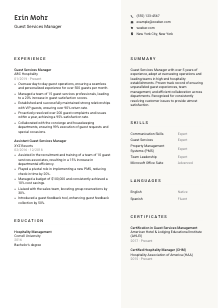
The summary sits at the top of the resume, so it should quickly establish your level, property-facing strengths, and leadership scope. For a Guest Services Manager, that usually means years of guest-facing experience, management responsibility, and a short snapshot of service and team outcomes.
Start with a direct line that names your title or hospitality leadership profile and your years of relevant experience. The example summary does this effectively by positioning the candidate as a Guest Services Manager with over 5 years of experience in high-end hospitality settings.
Use the next sentence to highlight the capabilities the employer is hiring for, such as overseeing guest operations, leading teams, resolving issues, and collaborating across departments. Borrow the language pattern from the posting where it reflects your actual background, especially around personalized guest experience and service execution.
Aim for 3 to 5 lines that combine scope and outcome. Avoid generic phrases about passion or dedication unless they are backed by real hospitality context. A concise summary with guest satisfaction, team leadership, and operational control reads much better than a soft introduction without specifics.
Close by pointing to the standard you maintain or the result you consistently deliver, such as stronger guest satisfaction, reliable complaint resolution, or smoother coordination during high-volume service. That ending should leave the employer with a clear sense of how you operate, not just that you are interested.
When this section is doing its job, the employer can understand your level and your hospitality management strengths before reading the first job entry. Make those first lines count toward guest service credibility and leadership scope.
A Guest Services Manager resume should show more than hospitality exposure. It should make your service leadership visible through guest satisfaction metrics, complaint resolution, team oversight, and coordination across departments that affect the guest stay.
With Wozber's free resume builder, ATS-friendly resume templates, and ATS resume scanner, you can tailor each section around the employer's language and build an ATS-friendly resume format that stays clear under review. The finished resume should make it easy to judge one thing fast: whether you can lead a guest services team and keep the guest experience running smoothly.




