



Use Wozber and land your dream job
Create Resume
No registration required
Welcoming visitors, but your resume feels like it's lingering in the waiting area? Check out this Receptionist resume example, created with Wozber free resume builder. Learn how to match your front desk finesse to the job details, so your career gets the VIP treatment it deserves!
Reception work is visible from the first minute of the day. You are often the first person a guest, client, vendor, or employee meets, and the role quickly shifts between answering calls, coordinating schedules, handling correspondence, and keeping the front office running smoothly. A receptionist resume needs to show that you can manage that flow with poise, accuracy, and strong communication.
When the resume is tailored well, hiring teams can immediately see whether your background matches the pace and scope of the desk they need covered, from multi-line phone handling to appointment coordination and visitor support. Wozber's free resume builder helps you shape that experience into an ATS-compliant resume that uses the right front-office language, so the document reads clearly both in screening systems and to the people deciding who gets interviewed.
Receptionists are expected to be polished, reachable, and organized before the interview even starts. Your personal details section should reflect that same standard with clean formatting, accurate information, and only the details that support the application.
Your name should be the most visible text on the resume, set in a clean font and slightly larger than the rest. For a receptionist, presentation matters. If the page looks cluttered or inconsistent at the top, it undercuts the professional first impression the role depends on.
Place "Receptionist" directly under your name when that is the position you are pursuing. This keeps the target role unmistakable and helps ATS optimization when the employer is searching for that exact title. If your background includes related titles such as Administrative Assistant, keep the headline focused on the receptionist role you want now.
Recruiters need to know they can reach you quickly for interview scheduling, follow-up questions, or next steps. Double-check every detail, especially for roles where responsiveness and accuracy are part of the day-to-day job.
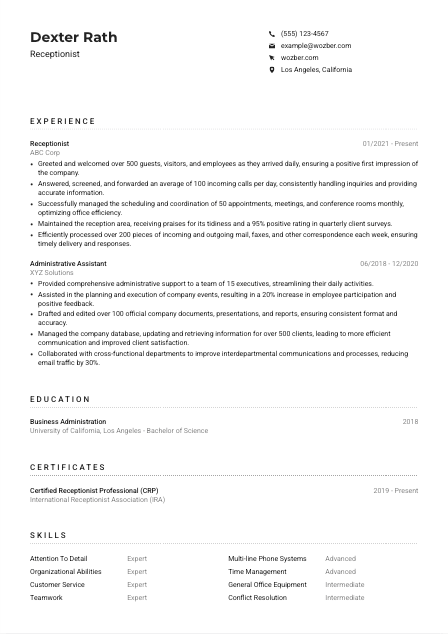
If the employer wants someone based in a specific area, include your city and state. In the example, listing Los Angeles, California directly supports the posted local requirement. Do not add a full street address. A clear city and state line is enough to confirm geography without giving unnecessary personal detail.
If you include LinkedIn or a professional website, make sure the content aligns with your resume. A receptionist profile should reinforce customer-facing experience, office coordination, communication skills, and administrative support rather than act as an unrelated social presence. If the profile is outdated, leave it off until it is fixed.
This section should quietly communicate the same qualities the front desk role requires every day: professionalism, order, and responsiveness. If your contact details are polished and accurate, the rest of the resume starts on solid ground.




For receptionist hiring, experience carries the most weight when it shows volume, coordination, and consistency. Employers want to see how you handled calls, visitors, schedules, mail flow, and day-to-day office support, not just that you sat at the front desk.
Read the posting closely and underline the actual work: greeting visitors, answering and forwarding calls, scheduling appointments, managing conference rooms, maintaining the reception area, and processing correspondence. Then make sure those functions appear in your experience using language that matches the role naturally. If you have done similar work under an administrative support title, translate it into front-office terms the employer will recognize immediately.
List your jobs in reverse chronological order with job title, company, and dates. Reception and administrative work often looks transferable across industries, so clear chronology helps the employer quickly spot whether you have the required 2+ years of recent, relevant experience. Keep the structure simple so the attention stays on your day-to-day scope and results.
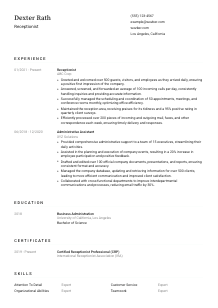
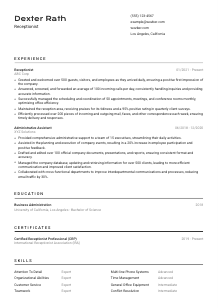
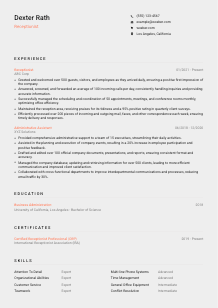
Do not stop at generic phrases like "answered phones" or "greeted visitors." Show scale and consistency. The example does this well by stating "Greeted and welcomed over 500 guests" and "Answered, screened, and forwarded an average of 100 incoming calls per day." Those numbers make front desk workload visible and show that the candidate can handle a busy office environment.
Receptionist work is often measured through smooth scheduling, accurate call routing, organized visitor flow, tidy facilities, and timely handling of mail or documents. Use numbers where they fit, such as appointments coordinated per month, calls handled per day, or correspondence processed per week. Even small process improvements count if they reduced delays, improved office efficiency, or supported client experience.
If you have held broader administrative roles, keep the bullets that connect most clearly to receptionist hiring. Calendar support, document handling, client communication, and office coordination all belong. Less relevant accomplishments can stay in the background. For example, event planning or database work is worth mentioning only when it supports the picture of someone who can stay organized, communicate clearly, and manage multiple moving parts at once.
A hiring manager should be able to imagine you handling the desk after reading this section. Focus on visitor volume, call management, scheduling, correspondence, and office coordination, and use job description language where it reflects your real experience. That combination strengthens both ATS alignment and human review.
Education is rarely the main hiring factor for a receptionist, but it still adds context. It can show business familiarity, communication training, or the discipline that supports reliable office work, especially when your experience is already closely aligned with front desk responsibilities.
Some receptionist jobs ask for a diploma, some prefer college coursework, and others focus almost entirely on experience. Start by identifying what the employer actually mentions. If no specific degree is required, present your education clearly without overexplaining it.
Include school name, degree, field of study, and graduation year or completion date. Keep the formatting plain and easy to scan. For administrative and front-office roles, readability matters more than extra academic detail unless the education directly supports the job.
Fields such as business administration, communications, office management, or customer service can reinforce your suitability because they connect naturally to scheduling, correspondence, and professional interaction. In the example, a Business Administration degree supports the office coordination side of reception work without needing a long explanation.
If you are early in your career or your degree is less directly related, a short mention of relevant coursework can help. Classes in business communication, records management, office software, or organizational behavior can strengthen the link to receptionist duties. If you already have several years of strong front-desk experience, this is usually optional.
Honors, leadership roles, or campus responsibilities are useful when they show service, communication, or coordination. Student organization leadership, event logistics, or office assistant roles can support your profile. Keep these details brief and only include them if they strengthen the same story your experience section tells.
This section works best when it adds credibility without taking space from stronger front-desk experience. Keep it concise, accurate, and tied to the office skills that matter for the job.
Certifications are not required for every receptionist job, but they can help when an employer mentions them directly or when you want to show extra training in customer service, front-office procedures, or administrative support. Used well, this section shows commitment to the profession rather than generic credential collecting.
If the employer mentions a credential such as Certified Receptionist Professional, place it prominently. That kind of direct match is easy for hiring teams to notice and useful for ATS keyword alignment. In the example, listing the CRP immediately reinforces the posted "plus" qualification without overstating its importance for every receptionist role.
Choose certifications that connect to receptionist work, administrative coordination, office systems, customer interaction, or communication. Skip unrelated credentials that do not support the front desk story. A short, targeted list is more persuasive than a long list with weak relevance.
Add the issue date and, if applicable, the renewal or expiration window. This matters most for credentials tied to ongoing professional standards or continuing education. Clear dates show that your training is current and maintained.
Reception work changes with office tools, communication expectations, and customer service standards. Recent training in reception procedures, business communication, conflict handling, or office technology shows that you take the role seriously and stay current with how modern offices operate.
A relevant certificate can add weight quickly, especially when the posting mentions it outright. Keep this section focused on front-office credibility and current training, and it will support the rest of your resume without distracting from your experience.
Receptionist skills need to reflect both people-facing work and office execution. Hiring teams usually look for a combination of communication, organization, multitasking, phone handling, scheduling, and comfort with standard office equipment or systems.
Pull required skills directly from the job description first. For this role, that includes multi-line phone systems, general office equipment, strong verbal and written English, attention to detail, organization, and the ability to manage multiple tasks at once. These belong near the top because they map directly to the work being hired for.
Then include the strengths that shape your performance in a busy reception setting. Customer service, time management, conflict resolution, teamwork, calendar coordination, and visitor communication are all useful if they are grounded in your real experience. The example skill list works because it balances technical front-desk skills with service and organization.
Do not turn this into a complete inventory of everything you can do. A receptionist resume reads better when the skills section is selective and grouped around what matters most in the role. If you use proficiency levels, apply them consistently and reserve the highest ratings for capabilities you have demonstrated repeatedly in past jobs.
Every skill listed here should connect back to visible receptionist work: handling calls, coordinating schedules, communicating clearly, staying organized, and supporting a professional office environment. That is what makes the section useful in both ATS screening and manager review.
Language ability matters for reception work because the role often sits at the intersection of guest service, internal coordination, and phone communication. English proficiency is frequently non-negotiable, and additional languages can be valuable in offices that serve diverse clients or communities.
If the posting specifies strong verbal and written English, make that easy to find. List English clearly with an honest proficiency level. For a receptionist, this is more than a checkbox. It affects greeting visitors, taking messages accurately, writing correspondence, and handling calls without confusion.
Start with the language most important to the job, then add others that could help in daily interaction. In many front desk settings, a second language can improve guest experience and reduce friction during check-in, phone routing, or basic information requests.
Extra languages are worth listing when they would realistically help in your target environment. In a large city office, healthcare setting, school, or client-facing business, being able to greet, guide, or answer simple questions in another language can be a useful advantage. The example's fluent Spanish is a strong addition for that reason, even though English is the stated requirement.
Choose clear levels such as Native, Fluent, Intermediate, or Basic, and do not overstate your ability. A receptionist may need to switch quickly between spoken and written communication, so accuracy matters. If you can greet visitors but not manage detailed calls, label that appropriately.
Language skills matter most when they support real tasks like greeting guests, answering questions, routing calls, or helping visitors feel comfortable. Frame them as a practical service asset, not just an extra credential. That keeps the section grounded in how receptionist work is actually performed.
For receptionist roles, language skills should help explain how you communicate with visitors, callers, and colleagues. Keep the section honest and relevant, and it becomes another clear sign that you can represent the office well.
The summary is your chance to establish professional identity quickly. For a receptionist resume, it should communicate experience level, front-office scope, and a few high-value strengths such as call handling, guest interaction, scheduling, or office coordination.
Review the posting and identify the few themes that appear throughout it. For this job, the repeated priorities are guest welcome, phone handling, scheduling, organization, and communication. Build your summary around those themes so the opening lines match what the employer needs most.
Lead with a direct introduction such as "Receptionist with 5+ years of experience" or, if your path is mixed, "Administrative support professional with 3+ years of front-desk experience." This quickly positions you without forcing the reader to infer whether you meet the baseline requirement.
Mention the capabilities that define your value at the desk. That might include managing high call volumes, coordinating appointments, maintaining a professional reception area, or supporting staff and visitors with strong communication. The sample summary works because it stays close to real receptionist responsibilities instead of relying on vague traits alone.
Aim for three to five sentences. That is enough space to establish your experience, your core front-office strengths, and the type of environment you support well. Avoid broad claims that could fit any office role. Use wording that makes the reader expect to see visitor support, call management, scheduling, and administrative reliability in the experience section below.
A well-written summary should make your receptionist background feel immediate and credible within a few lines. Keep it focused on the work you actually do best, and the rest of the resume will read with much stronger context.
A receptionist resume works best when it shows how you handle the steady flow of office life: welcoming visitors, managing calls, coordinating schedules, processing correspondence, and keeping the front area professional at all times. When each section supports that picture, the application feels grounded in the real work rather than padded with generic claims.
Use Wozber's free resume builder to shape your content into an ATS-friendly resume template, refine wording with role-specific terminology, and check alignment with the posting through the ATS resume scanner. The finished resume should make one thing easy to judge: whether you can step into the front desk and keep communication, organization, and guest experience running smoothly from day one.




