



Use Wozber and land your dream job
Create Resume
No registration required
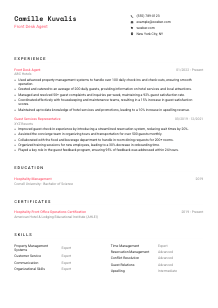
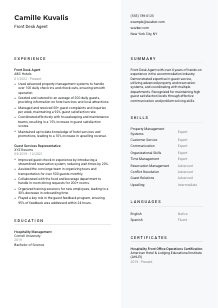
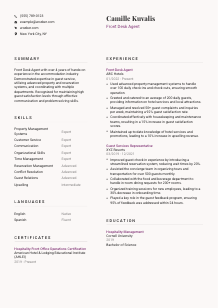
Welcoming faces, but your resume feels checked out? Check out this Front Desk Agent resume example, created with Wozber free resume builder. It shows how easily you can match your greeting skills to job specifics, making your career check-in as smooth as your guest check-ins!
Front desk work is judged in real time. Guests notice how quickly you check them in, how calmly you handle a complaint, and whether you can keep the shift moving while coordinating with housekeeping or maintenance behind the scenes. Your resume should reflect that same operational steadiness by showing guest volume, service quality, and the systems you use to keep the desk running smoothly.
For this role, a tailored resume quickly separates general customer service experience from true front office work. Wozber's free resume builder helps you shape an ATS-compliant resume around the language hotels use, from reservation systems to guest satisfaction and check-in procedures, so hiring teams can immediately see that you can manage the desk, the guest flow, and the service standard the property expects.
At the front desk, first impressions matter fast, and your contact section works the same way. Keep it clean, professional, and aligned with the practical details a hotel needs before moving you forward.
Place your name at the top in a clear, readable size. A hiring manager scanning several hospitality resumes should be able to identify you instantly, just as a guest should immediately know who is assisting them at the desk.
Add
Use a phone number you answer consistently and a professional email address based on your name. Hotels often move quickly when scheduling interviews for front office roles, especially when shifts need coverage or staffing changes happen close to opening dates.
If the employer wants someone based in a specific city, note your location clearly. In the example, New York City, NY is relevant because the posting asks for local availability or willingness to relocate. Mentioning this up front removes a practical hiring question immediately.
Include LinkedIn or a professional website only if it supports your application. For a Front Desk Agent, that usually means a profile with consistent job titles, hospitality employers, customer service achievements, or certifications that reinforce your front office background.
Do not include age, marital status, photo, or other personal details unless a local standard specifically requires them. Hotels need to see service experience, system familiarity, communication skills, and availability, not information unrelated to guest operations.
This section should read like an efficient front desk handoff. Clear contact details, the right title, and any location requirement give the employer what they need without slowing down the rest of your resume.




Hotels hire for experience that holds up during busy check-in windows, guest issues, and daily coordination across departments. Your work history should show how you handled guest volume, solved problems, used hotel systems, and supported service standards that affect reviews, revenue, and repeat stays.
Review the posting and pull out the work that overlaps most with your background. For a Front Desk Agent, that usually means check-in and check-out procedures, guest requests, complaint handling, reservation or property management systems, and coordination with housekeeping or maintenance. If your previous title was broader, like Guest Services Representative, use the bullets to make the front office relevance unmistakable.
List jobs in reverse chronological order and make each entry easy to scan. Include your title, employer, and dates, then use bullets to show what you handled at that property. Hospitality hiring managers often review resumes quickly, so a clean timeline helps them understand your progression from general guest service to direct front desk responsibility.
Do not stop at
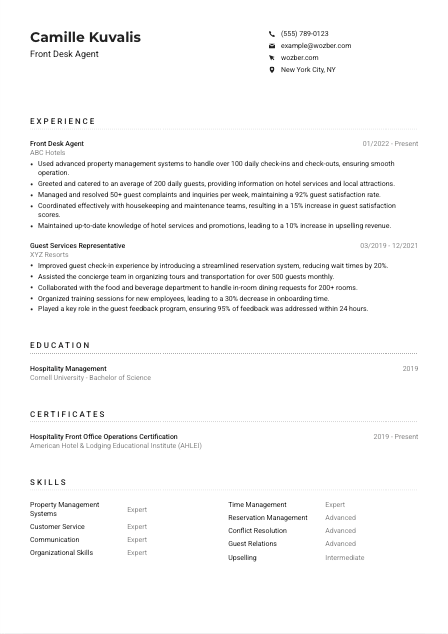
Numbers help a hotel picture your pace and impact. Good Front Desk Agent metrics include daily guest volume, check-ins processed, complaint resolution volume, satisfaction scores, wait-time reductions, upselling revenue, or response time to guest issues. The sample resume works well here by tying front office work to 100+ daily check-ins, a 92% guest satisfaction rate, and a 10% upselling lift.
Keep the experience section focused on work that supports guest operations. If an older role does not connect to customer service, reservations, issue resolution, or cross-team coordination, trim it or reduce detail. The strongest version of this section makes it easy to see that you can step into a hotel lobby, manage the desk, and maintain service quality under pressure.
A hiring manager should finish this section knowing how you work during real hotel operations. Prioritize guest-facing scope, system use, service recovery, and measurable results that show you can handle the front desk with confidence.
Education is usually straightforward for front desk hiring, but it still needs to answer the posting cleanly. Start with the required credential, then include hospitality-focused study when it strengthens your understanding of guest service, hotel operations, or front office standards.
If the posting asks for a high school diploma or equivalent, make sure your education section clearly satisfies that requirement. If you also have a college degree, list the higher credential prominently, but do not assume the basic requirement is irrelevant when an employer has stated it directly.
Use a simple structure with degree or diploma, school name, and graduation year if appropriate. Hiring teams are usually looking for a quick confirmation here, not a long academic profile, so present the information in a way that is easy to verify at a glance.
If you studied hospitality management, tourism, business, or another service-oriented field, include that detail clearly. In the example, a Bachelor of Science in Hospitality Management adds useful context because it supports the candidate's front office background with formal industry knowledge.
Relevant courses can be useful when you are early in your career or your studies connect directly to hotel operations. Topics like guest relations, lodging operations, reservation management, or service recovery are more helpful here than broad coursework that does not connect to the desk or guest experience.
Include honors, hospitality society involvement, or service-related achievements only if they strengthen your profile. Keep them brief and relevant. For experienced candidates, this section should support your application without competing with your work history.
This section should confirm that you meet the requirement and, when applicable, show added hospitality training. Once that is clear, let your front desk experience carry the heavier weight.
Certifications can strengthen a Front Desk Agent resume when they point to practical front office knowledge, service standards, or hospitality training. They are especially useful when the employer lists a preferred credential or when you want to show focused development beyond general customer service experience.
List credentials that connect directly to the desk, guest handling, reservations, or hotel operations. For this opening, Hospitality Front Office Operations is especially relevant because the employer names it as a preference, making it an easy way to show closer alignment.
A short, targeted certification section works better than a broad list of unrelated training. Front desk hiring managers care more about credentials that support guest service delivery, system use, and hospitality standards than certificates with little connection to hotel operations.
Show the name of the certificate, the issuing organization, and the date earned or active period if applicable. That gives the employer immediate context and helps distinguish a current hospitality credential from older training that may no longer reflect your present skill level.
If you are building your hospitality career, certifications can help reinforce your commitment to front office practice. Training in complaint resolution, hospitality operations, service excellence, or reservation workflows can add weight, especially when paired with hands-on desk experience.
When chosen carefully, certifications reinforce that your experience is backed by formal front office training. They are most effective when they directly support the guest service and operational demands of the role.
A Front Desk Agent needs a mix of systems knowledge, guest communication, and shift-level organization. Your skills section should reflect how the desk actually runs, with room for both technical tools and service abilities that affect guest satisfaction during check-in, issue resolution, and daily coordination.
Start with the exact abilities the employer names. Here, that includes reservation and property management systems, communication, interpersonal strength, and organization. Mirroring that language helps with ATS optimization and also shows that you understand the operational demands of front office work.
Lead with skills that matter most on shift, such as property management systems, guest relations, reservation management, conflict resolution, and time management. The example resume does this well by pairing technical capability with service skills instead of listing only broad traits like
Group skills in a way that is easy to scan and avoid padding the section with vague items. A concise list of hotel-relevant skills is stronger than a long inventory. If you use proficiency levels, make sure they match your actual experience, especially for systems you may be asked to use early in training or on day one.
Anyone reading this section should be able to picture you working the desk, using the system, handling guest requests, and staying organized during a busy shift. That is the standard to aim for.
Language ability matters at the front desk because every shift involves directions, requests, service recovery, and local recommendations. In a high-traffic hospitality setting, clear English is essential, and additional languages can make you more useful with international or multilingual guests.
If the posting states that English is essential, list it clearly with your proficiency level. This is a core operating requirement in front office work because it affects check-in accuracy, guest explanations, complaint handling, and coordination with internal teams.
Include additional languages when you can use them confidently in real guest interactions. Even conversational ability can be useful in hospitality, but place the strongest and most practical languages first based on the type of guests the property is likely to serve.
A second or third language is not always required, yet it can strengthen your profile in hotels, resorts, and tourist-heavy markets. In the example, Spanish adds value because it expands the candidate's ability to assist a wider range of guests beyond the minimum English requirement.
Use honest labels such as Native, Fluent, Advanced, Intermediate, or Basic. Front desk roles involve live conversation, not just written comprehension, so overrating your level can create problems in interviews or on the job when guests need immediate help.
If you know the hotel serves international travelers, business guests, or a multilingual local market, prioritize the languages most likely to matter there. Keep this practical. The point is to show stronger guest communication capacity, not to turn the section into a language inventory.
For a Front Desk Agent, language skills are valuable when they improve communication at the desk. Lead with required English proficiency, then add other languages that would genuinely help you serve guests more effectively.
Your summary should quickly establish the kind of front office support you can provide. In a few lines, show your years of experience, the hotel-facing work you know well, and the service outcomes or systems background that make you credible for the role.
Read the posting closely and pull in the priorities that define the job. For a Front Desk Agent, that often means guest check-in and check-out, reservation systems, complaint handling, communication, and coordination across departments. Build your summary around the areas where your experience overlaps most clearly.
Start with your title and amount of relevant experience, such as 2+ years or 4+ years in front desk, guest services, or hospitality operations. That gives immediate context and helps distinguish you from candidates with general retail or customer support backgrounds.
Use the next sentence to show what you do well in operational terms. You might mention managing high guest volume, maintaining strong satisfaction scores, resolving complaints efficiently, or using property management systems with confidence. The sample summary is effective because it combines years of experience with guest service expertise, system use, and cross-department coordination.
Aim for a short paragraph, usually three to four sentences. Skip soft claims that are not backed by the rest of the resume. A hotel should come away understanding your front office range, your service style, and the kind of daily desk environment you can handle.
Your summary should tell the employer, within a few seconds, that you know front desk operations and can support the guest experience from the first interaction. Keep it concise, specific, and grounded in real hospitality work.
Once your resume reflects guest handling, system familiarity, complaint resolution, and coordination with hotel teams, it starts reading like a front office resume rather than a general customer service document. Wozber's free resume builder can help you organize those details into an ATS-friendly resume that stays aligned with the language employers use in hospitality postings.
Before applying, review the resume against the target job and tighten anything that feels generic. Wozber's ATS resume scanner and ATS-friendly resume templates can help you refine phrasing, structure, and role alignment so the final version makes it easy to judge your readiness for a busy front desk environment.




