



Use Wozber and land your dream job
Create Resume
No registration required
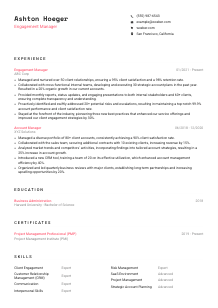
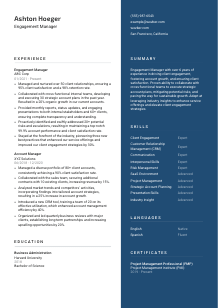
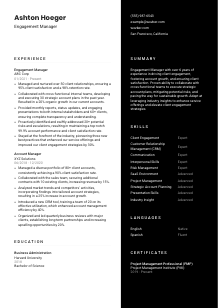
Leading projects, but your resume isn't getting click-throughs? Check out this Engagement Manager resume example, created with Wozber free resume builder. It shows how to align your leadership journey with job specs, keeping your career narrative as engaging as the projects you oversee!
Engagement Managers sit at the center of the client relationship once the deal is live. Hiring teams want to see whether you can keep accounts healthy, coordinate internal delivery, surface risks early, and turn day-to-day account management into retention and expansion. Your resume should make that operating range visible, not bury it under generic relationship language.
When an Engagement Manager resume is tailored well, the first scan quickly shows account scope, retention results, reporting cadence, and the tools behind your client work. Wozber's free resume builder helps shape that into an ATS-compliant resume by aligning your wording with the posting and keeping the structure clean, so the hiring team can quickly see whether you can manage client satisfaction and grow existing accounts.
For an Engagement Manager, the personal details section should remove friction immediately. Hiring teams do not need decoration here. They need accurate contact information, the target title, and, when the posting asks for it, a clear location match.
Set your name in a clean, readable style so it is easy to find at the top of the page. This role depends on professional presence and clear communication, and your header should reflect that from the first line.
Place "Engagement Manager" directly under your name if that is the role you are targeting. Matching the posted title helps frame the rest of the resume around client engagement, account planning, retention, and cross-functional coordination instead of leaving the reader to guess where you fit.
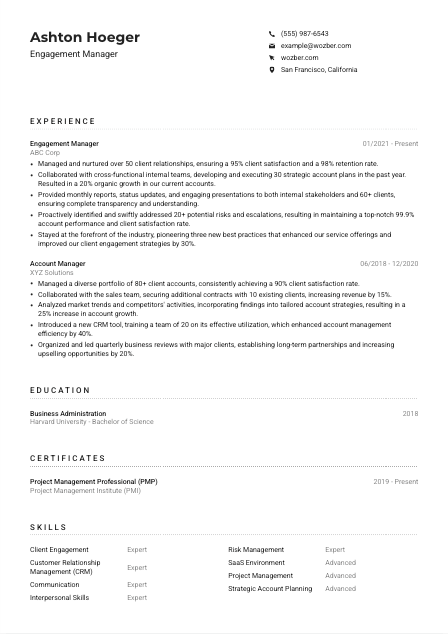
If a role specifies a city, include it clearly. Here, listing "San Francisco, California" directly supports a stated requirement and removes questions about relocation or local availability. Keep location mentions to this section unless the role truly requires more context.
A LinkedIn profile or professional website can reinforce your client-facing background, account portfolio, and recommendations from stakeholders. Make sure the roles, dates, and performance metrics there match what appears on your resume.
Your contact block should confirm three things at a glance: who you are, which role you are pursuing, and how to reach you without delay. For a client-facing position, that level of clarity matters.




This is the section most likely to decide whether you move forward. Engagement Manager hiring usually turns on real account outcomes: client satisfaction, retention, expansion, reporting ownership, and how you handled issues before they turned into escalations.
Read the posting for the work patterns behind the title. Here, the priorities include nurturing client relationships, building strategic account plans, giving regular updates, and managing risks or escalations. Those themes should appear in your bullets through actual results, not copied wording.
List roles in reverse chronological order and include title, company, and dates for each one. For engagement and account-facing careers, progression from account management into broader client ownership tells an important story about trust, portfolio complexity, and stakeholder range.
Each bullet should show what you managed, what you did, and what changed because of it. Metrics are especially effective in this field because client work is often measured through retention, satisfaction, account growth, renewal health, or delivery stability. The sample resume does this well with figures like 95% client satisfaction, 98% retention, and 20% organic growth from strategic account plans.
Numbers help hiring teams understand scope fast. Include details such as number of accounts, size of portfolio, frequency of reporting, renewal results, QBR ownership, upsell impact, or count of risks resolved. A line about "providing updates" is weak on its own. A line about delivering monthly reports and presentations to 60+ clients shows cadence, audience, and responsibility.
Keep bullets focused on client retention, executive communication, expansion planning, service improvement, CRM adoption, and cross-functional coordination with delivery, sales, or success teams. If you have broader management experience, pull forward the parts that show relationship ownership and account performance. Even the sample's earlier Account Manager role works because it highlights portfolio growth, CRM implementation, and quarterly business reviews.
By the end of this section, a reader should understand the size of the accounts you handled, the quality of the relationships you maintained, and the commercial or operational results you influenced. That is the core of Engagement Manager credibility.
Education rarely carries the resume for an experienced Engagement Manager, but it still matters when the posting names a degree requirement. Present it clearly, then let your account results do the heavier lifting.
If the employer requests a Bachelor's degree in Business, Marketing, or a related field, make sure that information is easy to spot. A degree such as Business Administration lines up naturally with account strategy, client communication, and commercial decision-making.
Include degree, field of study, school, and graduation year in a clean order. This section should be quick to scan, especially when recruiters are moving between education, certifications, and recent experience.
If your field of study directly supports the role, say so through precise naming rather than extra explanation. In the provided example, "Bachelor of Science" in "Business Administration" already supports the business and client-management side of the job without any added filler.
Early-career candidates can include relevant coursework, student consulting projects, leadership roles, or client-facing extracurriculars. If you already have 5+ years in account management or SaaS, keep this section lean unless a distinction or specialized program genuinely strengthens your case.
If you have project management training, executive education, or customer success coursework, list those in the certificates section rather than crowding your education entry. That keeps the degree clear while still showing continued growth in areas tied to stakeholder management and delivery oversight.
This section should confirm that you meet the academic requirement and, when relevant, show a business foundation for client-facing work. After that, your resume should return quickly to account results and relationship leadership.
Certifications can add real weight for Engagement Managers when they connect to project delivery, stakeholder coordination, or structured account planning. They are most useful when they support how you manage clients, timelines, and internal execution.
If the employer mentions PMP or another project management credential, move it to the top. That is especially relevant for Engagement Managers who coordinate internal teams, track risks, and keep client work moving against milestones and expectations.
Choose certifications that support client engagement, SaaS delivery, project management, customer success, account growth, or communication with executive stakeholders. A shorter list tied to the work is more persuasive than a long inventory of unrelated badges.
Show the year earned and, if applicable, the active period or renewal status. Certifications with ongoing validity, such as PMP, signal that your methods and terminology are current rather than outdated.
Engagement roles change with new delivery models, CRM practices, and customer lifecycle expectations. Recent coursework or active certification paths can reinforce that you stay current on project structure, risk management, and client communication standards.
A certification will not replace account results, but it can strengthen your case when the role involves structured planning, escalations, and cross-functional execution. Present it as added proof of how you manage complex client work.
The skills section should read like the toolkit of someone who can manage client health, coordinate internal teams, and keep an account plan moving. For this role, that means balancing relationship skills with operational tools and commercial awareness.
Start with the skills the employer actually names, including CRM software, project management tools, communication, interpersonal strength, and account planning. These terms support ATS optimization when they reflect real experience and also help frame the rest of your resume in the language used by the employer.
Prioritize capabilities such as client engagement, customer relationship management, strategic account planning, risk management, presentation delivery, stakeholder communication, and collaboration with sales or delivery teams. In SaaS or professional services settings, these are the skills that connect directly to renewals, expansions, and service quality.
Avoid turning this into a dumping ground of every business skill you have used. A tighter list with the right mix of relationship, planning, reporting, and tool-based skills is easier to trust. The sample resume works because it combines client-facing strengths with practical capabilities like CRM, project management, and industry insight.
When someone reads this section, they should immediately recognize a professional who can manage accounts with both empathy and structure. That combination is central to Engagement Manager work.
Language fluency matters most when it affects day-to-day client communication, reporting, and stakeholder confidence. For Engagement Managers, the priority is to make required business communication ability unmistakable and keep the rest accurate.
If the posting asks for a high level of fluency in English, state it clearly. Use labels such as "Native" or "Fluent" only if they are accurate, since client calls, presentations, and written updates quickly test that claim.
List English first when it is a stated requirement, then add any other languages that could support client relationships or cross-regional collaboration. This keeps the section practical and easy to read.
Extra languages are worth mentioning even when they are not required, especially in account-facing roles with diverse clients or internal teams. For example, Spanish on the sample resume adds range without distracting from the required English fluency.
Choose labels you can defend in a business setting. If you say you are fluent, you should be comfortable handling meetings, follow-up emails, and client-facing conversations in that language.
Language skills carry more weight when the role involves multicultural clients, distributed teams, or international accounts. If that applies to your background, support the language entry elsewhere in the resume through relevant experience or market exposure.
This section should quickly confirm that you can communicate at the level the role requires. Anything beyond that is a bonus when it supports stronger client relationships or broader account coverage.
An Engagement Manager summary should quickly establish the kind of accounts you handle and the results you produce. A vague profile about being relationship-driven will not do much here. Lead with scope, outcomes, and the style of client work you know best.
Before writing, identify the central thread in the posting. Here, that thread is long-term client engagement paired with strategic account growth and steady stakeholder communication. Let that shape the opening lines of your summary.
Open with your title and years of experience, then anchor it in the environment you know, such as SaaS, professional services, enterprise accounts, or portfolio management. The example summary does this effectively by stating more than 6 years of experience in client engagement, account growth, and satisfaction.
Use the next sentence to highlight the strengths most relevant to the target role, such as strategic account planning, cross-functional collaboration, risk mitigation, executive reporting, or retention work. Keep these tied to how you operate, not as a loose list of buzzwords.
Aim for 3 to 5 lines that a hiring manager can absorb in seconds. Strong summaries usually combine experience level, account focus, and one or two business outcomes. If you can mention retention, growth, or service improvement naturally, do it without overloading the paragraph.
Your summary should make it easy to place you in the interview pile quickly: someone who can protect client relationships, coordinate execution, and grow existing accounts. If those themes are clear in four lines, the section is doing its job.
When each section reflects real account work, your resume becomes much easier to read as an Engagement Manager application. The hiring team should be able to see client scope, retention performance, reporting habits, and how you manage cross-functional execution without hunting for it.
Use the job description to shape your language, borrow proven structure from the example where it helps, and keep every bullet grounded in actual outcomes. Wozber's free resume builder, ATS-friendly resume templates, and ATS resume scanner can help you tighten that alignment, improve ATS optimization, and present your experience in a clean format that supports fast review.
Before you apply, check one final thing: does your resume make it obvious that you can keep clients satisfied, accounts growing, and issues under control. That is the standard this role needs to see.




