



Use Wozber and land your dream job
Create Resume
No registration required
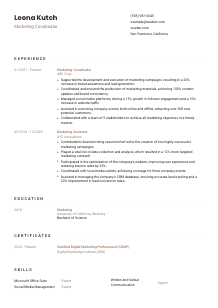
Weaving brand stories, but your resume feels like a forgotten tagline? Follow this Marketing Coordinator resume example, created with Wozber free resume builder. Learn how to spotlight your coordinating strengths to match marketing plans, making sure your career narrative always grabs attention!
Marketing Coordinator hiring usually turns on execution. Teams need someone who can keep campaigns moving, update assets without losing brand consistency, coordinate social posts and events, and follow through with vendors and internal partners when deadlines tighten. Your resume should make that operational reliability visible, not bury it under generic marketing language.
When the resume is tailored to the posting, hiring teams can quickly see whether your background matches the mix of campaign support, content coordination, social management, and reporting they need. Wozber's free resume builder helps you shape that experience into an ATS-compliant resume with language that matches the role, so your application reads clearly as marketing execution strength rather than general admin support.
This section is short, but it still does real work in a Marketing Coordinator application. It should present you as organized, easy to contact, and available for the role without adding clutter that distracts from your campaign and content experience.
Use your full name in a larger, readable font so it anchors the page immediately. Marketing roles value presentation, and a clear header signals that you understand how to structure information for fast scanning.
Place "Marketing Coordinator" directly under your name when that is the role you are applying for. Matching the posted title helps recruiters and ATS systems connect your resume to the opening right away, especially when the role sits between assistant, coordinator, and specialist-level marketing work.
List a current phone number and a professional email address. Keep this area simple and error-free. For a coordinator role that involves follow-up, scheduling, and cross-team communication, small mistakes in contact info create the wrong impression fast.
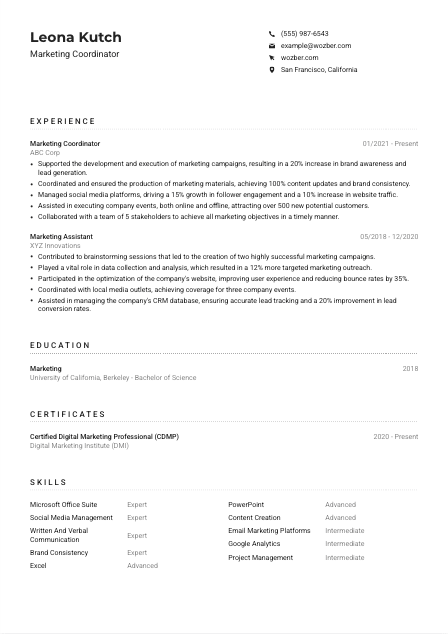
If the employer asks candidates to be in a specific market, show your city and state clearly. Here, San Francisco, California matters because the posting names it directly. If you are relocating, make that plain so location does not become an unnecessary screening issue.
A LinkedIn profile, portfolio, or personal site can help when it shows relevant work such as campaign assets, event promotion, social content, or writing samples. Make sure anything you link supports the same story as the resume and reflects current tools, achievements, and branding work.
Your personal details should answer the basic practical questions immediately: who you are, what role you are targeting, how to reach you, and whether you meet any stated location requirement. That keeps the focus where it belongs, on your marketing execution.




For Marketing Coordinators, experience is usually reviewed through the lens of delivery. Hiring managers want to see what you helped launch, what you kept on schedule, how you supported lead generation or brand visibility, and whether you can work across content, social, events, and stakeholder coordination.
Read the posting and identify the recurring work, not just the keywords. In this case, the important threads are campaign execution, marketing material updates, social media management, event support, and coordination with stakeholders and vendors. Use those workstreams to decide which bullets deserve space on your resume.
For each position, include your title, company name, and dates in a simple structure. Marketing hiring teams often review several adjacent profiles, so a clean timeline helps them quickly understand your progression from assistant-level support into more independent campaign coordination.
Your bullets should connect the work you handled to a result the business cared about. A line such as "supported the development and execution of marketing campaigns, resulting in a 20% increase in brand awareness and lead generation" works because it ties coordination work to measurable marketing performance. Use that same pattern for email sends, social calendars, asset production, event promotion, or CRM support when those are part of your background.
Numbers make your contribution easier to understand when they reflect marketing reality. Strong examples include engagement growth, web traffic, lead volume, event attendance, conversion improvement, asset turnaround, or campaign response rates. The sample resume does this well with figures like 15% follower engagement growth and 500 new potential customers from events.
Trim bullets that do not help prove you can coordinate marketing activity. General office support only earns space if it affected campaign delivery, reporting, scheduling, or communication with agencies and vendors. The closer each bullet stays to campaign operations and brand execution, the stronger the section reads.
A hiring team should be able to scan your experience and understand the kinds of campaigns, channels, and coordination tasks you can handle from day one. Make the section concrete enough that they can picture you managing assets, timelines, and follow-up inside a real marketing workflow.
Education is usually a straightforward check for this role, but it still matters because many Marketing Coordinator postings call for a bachelor's degree in Marketing, Business, or a related field. Present it clearly so reviewers can confirm the requirement in seconds and move on to your practical experience.
If you have a bachelor's degree in Marketing, Business, communications, or a closely related area, make that easy to spot. When the job description states the degree requirement directly, there is no advantage in burying it behind extra detail.
List your degree, field of study, school, and graduation year in a consistent format. Clean formatting helps ATS parsing and keeps the education section easy to verify alongside the rest of your resume.
When your academic background lines up exactly, say so plainly. "Bachelor of Science in Marketing" immediately supports the requirement and reinforces your foundation in campaign planning, consumer behavior, and brand communication.
Most experienced coordinators can keep this section brief, but recent graduates may benefit from mentioning coursework or projects tied to digital marketing, content strategy, analytics, market research, or event promotion. Include it only when it adds useful context to limited work experience.
Academic honors, scholarships, or leadership roles can help if they relate to communication, analysis, or project ownership. If you already have solid marketing experience, keep the section lean and let campaign results carry more weight.
Education does not need elaborate treatment here. It needs to confirm that you meet the baseline academic requirement and support the rest of your profile as someone ready to contribute in a working marketing team.
Certifications are optional for many Marketing Coordinator roles, but the right ones can strengthen your profile, especially when they connect to digital channels, email tools, analytics, or content execution. Use them to show current knowledge, not to pad the page.
Start with credentials that relate to the channels and tools in the posting. For this kind of role, certifications in digital marketing, email marketing, social media, analytics, or content marketing are more useful than broad unrelated coursework. A credential like the CDMP works because it supports day-to-day marketing coordination rather than sounding generic.
List the certifications that strengthen your case for campaign support, content production, or channel management. Two or three relevant credentials are more persuasive than a long list of low-value course completions.
Marketing tools and platform practices change quickly, so dates can help show recency. If a certification is current or recently completed, include the date to show that your knowledge reflects current channel standards and reporting expectations.
Review this section regularly as your work evolves. If your target roles increasingly emphasize email automation, analytics, or paid social support, newer certifications in those areas may add more value than older general marketing credentials.
A certificate will not replace hands-on campaign work, but it can sharpen your profile when it connects directly to the channels, tools, and coordination tasks the employer needs covered.
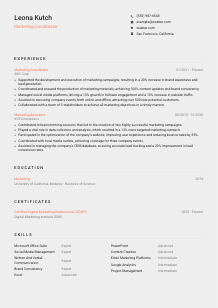
A Marketing Coordinator skills section should read like the toolkit behind campaign delivery. The most useful lists combine platform familiarity, communication strength, content support, reporting ability, and the practical tools that keep projects moving across teams.
Start with the skills the employer names or clearly implies. Here that includes Microsoft Office, especially Excel and PowerPoint, plus social media management, content creation, email marketing platforms, and strong written and verbal communication. Mirror that language when it reflects your real background, because it improves ATS optimization and makes your fit easier to spot.
Lead with the skills most central to the role's day-to-day work. For this posting, tools and capabilities tied to campaign coordination, social scheduling, presentation support, and content updates deserve stronger placement than broad traits. The sample resume handles this well by surfacing Microsoft Office Suite, social media management, and communication early.
Group or order skills in a way that feels practical. You might lead with marketing tools and channels, then add communication and project coordination skills. This creates a clearer picture than a random mix and helps hiring teams understand whether you can support content calendars, reports, event logistics, and stakeholder communication without heavy onboarding.
Your skills list should quickly confirm that you can handle the software, channel tasks, and coordination demands behind the posting. Keep it specific, accurate, and close to the language of the job.
Marketing Coordinators spend a lot of time writing, presenting updates, handling internal communication, and publishing brand-facing content. If the posting calls out language ability, treat that as a practical requirement rather than a minor detail.
Some marketing roles only imply communication skills, while others state language proficiency directly. In this posting, proficient English speaking and listening skills are specifically required, so English should appear clearly on the resume.
List English at the top with an accurate level such as "Native" or "Fluent." That removes any doubt for a role involving written content, stakeholder coordination, and possibly event or social media communication.
Additional languages can strengthen your profile when they support audience engagement, event communication, community outreach, or collaboration with diverse customer groups. Spanish, for example, may be useful in some markets even when it is not listed as a requirement.
Use straightforward labels such as "Native," "Fluent," "Intermediate," or "Basic." Marketing teams may rely on language skills for live communication, copy review, or community interaction, so overstatement can create immediate problems later in the process.
If the employer serves multilingual audiences or runs events across varied communities, extra language capability becomes more relevant. Include it when it adds real context to your ability to support outreach and communication, not just because it fills space.
For a coordinator role built around communication, language ability should help clarify how confidently you can write, respond, and represent the brand across channels and conversations.
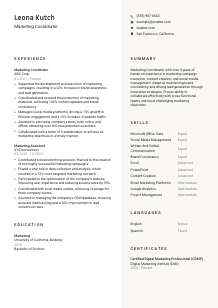
The summary is often the first substantial content a hiring manager reads, so it needs to establish your level fast. For a Marketing Coordinator, that usually means showing your years of experience, your main execution areas, and the outcomes or channel strengths that make you useful immediately.
Before writing the summary, identify the two or three themes the posting emphasizes most. Here, that means campaign execution, content and social coordination, and support for brand awareness or lead generation. Let those themes shape the opening lines.
Begin with a direct statement of who you are professionally and how long you have worked in marketing. A line like "Marketing Coordinator with over 4 years of hands-on experience" works because it quickly places you at the right level for a role seeking at least 2 years in marketing support or coordination.
Use the middle of the summary to name the work you actually handle well, such as social media management, content creation, campaign execution, email support, or brand consistency. If you mention impact, keep it believable and tied to marketing outcomes like lead generation, engagement, or traffic growth rather than vague claims.
Aim for three to five lines with no filler. The best summaries read like a compact version of your working value: the kind of marketer you are, the channels or coordination tasks you know well, and the business results your support has helped drive.
Your summary should make the reader expect a candidate who can organize campaigns, support content across channels, and contribute to measurable marketing activity. Once that frame is clear, the rest of the resume has a much easier job.
A Marketing Coordinator resume works when it shows real execution: campaigns supported, assets managed, channels updated, events coordinated, and results tracked in terms a marketing team recognizes. Keep the language close to the posting, use metrics where they reflect real outcomes, and make each section easy to scan.
Wozber's free resume builder can help you turn that experience into an ATS-friendly resume format, refine wording with AI support, and check alignment with an ATS resume scanner so the final version is ready for both screening systems and human review. The finished resume should make one thing clear quickly: you can keep marketing work moving.




