



Use Wozber and land your dream job
Create Resume
No registration required
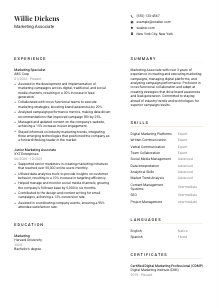
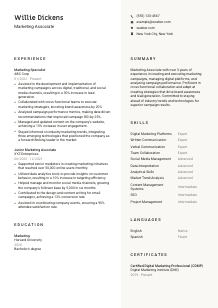
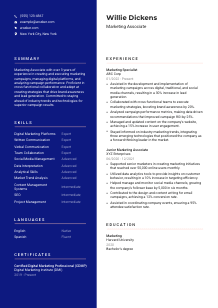
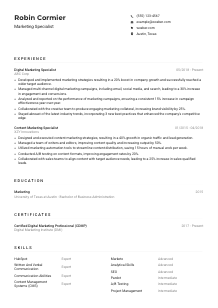
Crafting campaigns, but your resume isn't clicking? Check out this Marketing Associate resume example, created with Wozber free resume builder. Learn how to blend your branding brilliance with job specs, setting your career trajectory as captivating as your campaigns!
Marketing Associate hiring usually moves quickly because the work itself is fast-moving. Teams need someone who can support campaigns across channels, keep website and social content current, read performance data without getting lost in it, and work smoothly with designers, sales, and other stakeholders. Your resume should make that operating range visible right away, with proof that you can contribute to campaign execution and improve results.
For this role, the first screen often comes down to whether your background clearly connects campaign work, digital platform use, and measurable outcomes. Wozber's free resume builder helps you shape that story into an ATS-compliant resume by aligning your wording with the posting and keeping the structure easy to scan. That makes it easier for a hiring team to see where you've already supported lead generation, brand awareness, content updates, or performance reporting.
Marketing roles live in public-facing channels, but your resume header should stay practical. This section needs to confirm who you are, how to reach you, and, when the posting requires it, whether your location matches the role. For a Marketing Associate opening with an on-site or city-specific requirement, that small detail can affect whether the application moves forward.
Use your full name in a clean, readable format at the top of the page. No taglines, no extra descriptors. In marketing, presentation matters, and a cluttered header can make the resume feel less polished before the reviewer even gets to your campaign work.
Place "Marketing Associate" directly under your name if that is the role you are pursuing. Matching the posted title helps frame your experience correctly, especially if your past titles were broader or slightly different, such as "Marketing Specialist" or "Junior Marketing Associate."
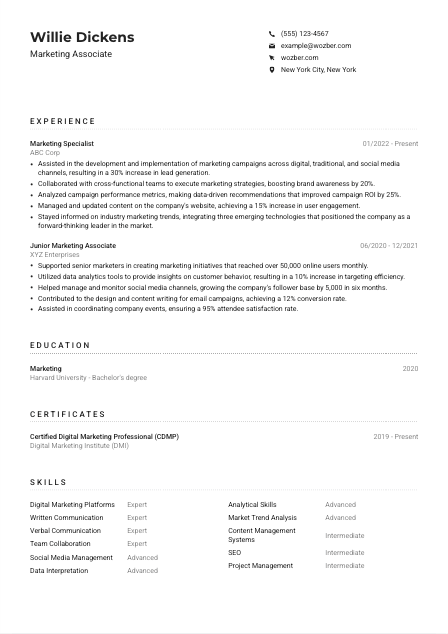
Include a professional email address and a phone number you actually answer. If the employer specifies a location, add your city and state. In the example, listing "New York City, New York" directly answers a stated requirement and removes a common point of uncertainty early.
If you include LinkedIn or a personal website, make sure it supports your resume with consistent titles, recent experience, and relevant work such as campaign samples, content pieces, or portfolio projects. Broken links or outdated profiles create friction where you want confidence.
Skip age, marital status, photo, and other private details unless local norms specifically require them. Marketing hiring teams care about channel experience, writing quality, platform familiarity, and results, not information unrelated to your ability to run campaigns or support growth.
Your header should answer the practical questions fast: who you are, how to contact you, and whether you meet any location requirement tied to the role. Then the reader can move straight to your marketing experience.




This is the section most likely to decide whether a Marketing Associate resume gets serious attention. Hiring teams want to see campaign involvement, channel exposure, collaboration with other functions, and numbers that show your work moved something forward, whether that was lead volume, engagement, conversion rate, ROI, or audience growth.
Read the posting closely and mirror the actual work in your experience section. For a Marketing Associate role, that often means campaign execution, digital and social channels, website content updates, analytics, and cross-functional coordination. The sample resume does this well by reflecting phrases like campaign implementation, brand awareness, lead generation, and content management without sounding copied.
Start with your most recent position and list the company, title, and dates in a format that is easy to scan. This matters when your growth shows increasing ownership, such as moving from a junior support role into broader campaign execution or performance analysis. An ATS-friendly structure also helps keep those details readable during parsing.
Generic bullets like "assisted with marketing campaigns" do not say enough. Show what changed because of your work. Metrics that fit this profession include lead generation, engagement, ROI, conversion rate, follower growth, reach, open rate, or traffic. In the example, a 30% increase in lead generation and a 25% improvement in campaign ROI tell a much clearer story than task-only bullets ever could.
If you have worked in events, communications, sales support, or another adjacent area, keep the bullets that connect to marketing execution. Highlight work with social media, CMS updates, email campaigns, analytics tools, and campaign reporting before less relevant duties. For this kind of role, relevance comes from showing how you helped deliver campaigns and improve performance across channels.
Marketing interviews often drill into campaign details. Be ready to explain the channel, audience, KPI, and your actual contribution behind each bullet. If you say you improved targeting efficiency by 10% or increased engagement by 15%, you should be able to describe the data source, optimization step, or content change that drove it.
Your experience section should show a marketer who can contribute across execution, reporting, and optimization. When the bullets connect channels to outcomes, the resume reads like someone who can step into live campaign work rather than someone who has only observed it.
For many Marketing Associate roles, education is a checkpoint rather than the main selling point. Still, the degree listed in the posting matters, especially early in your career. Present it clearly so the reviewer can confirm your academic background and move on to the campaign, content, and analytics experience that will carry more weight.
If the employer asks for a Bachelor's degree in Marketing, Business, or a related field, list that information directly and clearly. A Marketing degree, like the one in the example, immediately satisfies the educational requirement without forcing the recruiter to search for it.
Include degree, field of study, school name, and graduation year or dates attended. Avoid over-formatting. Education sections in marketing resumes should be quick to scan so more room can stay available for campaign results, platform experience, and channel-specific achievements.
If you are early in your career, include coursework, projects, or capstones tied to branding, consumer behavior, digital marketing, analytics, market research, or content strategy. This is especially useful when you need to show hands-on exposure to campaign planning or performance analysis before you built a long work history.
Student organizations, case competitions, event promotion, newsletter work, and campaign projects can add value if they demonstrate audience growth, copywriting, social media management, or collaboration with sponsors and campus teams. Keep only the activities that show practical marketing execution.
Additional coursework in areas like Google Analytics, paid social, SEO, email marketing, or content systems can help if those tools or channels show up in the job description. Use this space selectively. Add learning that sharpens your professional profile, not a long list of unrelated classes.
The education section should confirm that you meet the academic requirement and, if needed, show early marketing foundations. Then let the rest of the resume carry the argument with execution experience and measurable results.
Certifications are rarely the deciding factor for a Marketing Associate role, but they can strengthen your profile when they match the channels or tools used in the job. They work best when they support the story already told by your experience, especially in digital marketing, analytics, content, or platform-specific work.
Choose credentials tied to the responsibilities in the posting, such as digital marketing, analytics, SEO, content, email, or social media. A certification like CDMP fits naturally because it reinforces broad digital marketing knowledge without replacing real campaign experience.
A short, relevant list is stronger than a crowded one. If the role centers on multi-channel campaigns and analytics, prioritize certifications that relate to campaign management, reporting, audience targeting, or content platforms over generic training with little hiring value.
Marketing tools and channel practices change quickly. Recent certifications, renewals, or in-progress learning can suggest that you stay current with platform updates, measurement approaches, and emerging tactics. That matters more than an old credential with no current application.
If you are moving up from a junior marketing role, relevant certifications can help show intentional growth in areas like performance analysis or digital execution. They are especially helpful when the posting emphasizes technology awareness, analytics, or evolving marketing channels.
Use certifications to support your campaign profile, not to distract from it. The best ones tell the reader that your knowledge of platforms, analytics, and digital tactics is active and current.
A Marketing Associate skills section should reflect the tools and abilities you use to execute campaigns, manage content, and interpret results. This is one of the easiest places to align with the posting, but only if the list is specific enough to sound like real working knowledge instead of a stack of broad buzzwords.
Pull the required skills from the posting, then keep only the ones you can support elsewhere in the resume. For this role, that includes digital marketing platforms, social media, content management systems, analytics tools, written communication, verbal communication, and data interpretation. The strongest list mirrors the role while staying honest about your experience.
Front-load the skills that matter most for the job's daily work. For many Marketing Associate openings, that means campaign support, social media management, CMS work, analytics, reporting, content coordination, and collaboration. In the example, digital marketing platforms, social media management, and analytical skills are all positioned in ways that reinforce the experience section.
If you use proficiency levels, keep them believable and easy to scan. Ratings can work when they help distinguish core strengths from developing skills, such as expert-level communication and advanced data interpretation. Just make sure the levels line up with your actual results and tool usage across campaigns.
Your skills list should read like the toolkit of someone who can support campaign execution, content updates, and performance review from day one. Relevance matters more than volume.
Language ability can matter in marketing when audience segments, regional campaigns, customer support coordination, or content localization are part of the work. Even when the role is primarily English-speaking, the posting may still require clear written and verbal proficiency because messaging quality affects brand consistency and campaign performance.
If the job description states English proficiency, list it clearly. For a marketing role, this is not a formality. Strong English supports copywriting, internal coordination, reporting, presentations, and campaign messaging. Marking English as "Native" or "Fluent" gives direct confirmation.
Additional languages can be valuable when a company serves multilingual markets or wants stronger community engagement. Spanish, for example, can be useful in many consumer-facing campaigns, social media efforts, or localized content initiatives, as long as it reflects real working ability.
Use levels such as Native, Fluent, Intermediate, or Basic in a way you can defend in conversation or on the job. If you may be asked to write copy, review content, or speak with partners in that language, accuracy matters more than optimism.
Do not force this section to carry the resume unless multilingual marketing is central to the role. It works best as an added capability that broadens campaign reach, audience understanding, or cross-market collaboration.
If you are actively learning another language, mention it only when the progress is real and relevant. It can suggest adaptability and cultural awareness, but it should not crowd out stronger proof such as campaign results, platform skills, or content experience.
For a Marketing Associate, language skills should clarify communication strength first and market reach second. Keep the section accurate and proportionate to the actual demands of the role.
The summary sits at the top of the resume, so it needs to establish your level, channel exposure, and contribution quickly. For a Marketing Associate, that usually means years of experience, the types of campaigns or platforms you have worked with, and one or two results that show you can support growth rather than just complete tasks.
Start with a direct line that states your title and amount of experience, such as more than 3 years in marketing or campaign support. This helps the reviewer place you immediately, especially when the posting asks for at least 2 years of experience.
Use the summary to name your core working areas, such as campaign execution, digital platforms, social media, website content, analytics, or cross-functional collaboration. The example summary works because it ties together campaign creation, digital platform management, and performance analysis instead of staying vague.
Aim for a short paragraph that gives real information. Avoid broad claims like "results-driven professional" unless you immediately back them up with specifics. A summary should feel like a compressed version of your best fit for the role, not generic personal branding.
A brief line about staying current with marketing trends or emerging technologies can work well here because the role itself asks for that awareness. Keep it tied to execution. The point is to show that you adapt your campaigns and platform use as the market changes.
By the time someone finishes the summary, they should understand your level, your marketing scope, and the kind of outcomes you help produce. That gives the rest of the resume a clear frame.
A Marketing Associate resume should show practical range: campaign support, content execution, platform fluency, and the discipline to learn from performance data. When each section reflects the language of the target posting and backs claims with real outcomes, the application feels grounded and credible.
Use Wozber to tighten that alignment with ATS-friendly resume templates, Wozber's free resume builder, and ATS optimization features such as the ATS resume scanner. The finished resume should make one thing easy to judge: you can step into active marketing work and contribute with clear, measurable value.




