



Use Wozber and land your dream job
Create Resume
No registration required
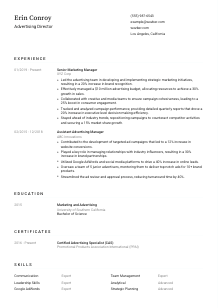
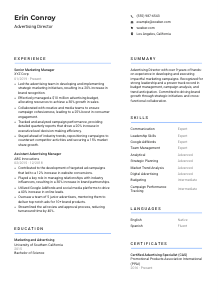
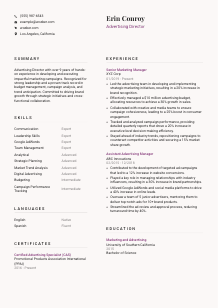
Crafting campaigns, but your resume doesn't click? Swivel through this Advertising Director resume example, created with Wozber free resume builder. Learn how to spotlight your strategic prowess to match ad agency aspirations, positioning your career message as effectively as the brands you promote!
Advertising Director hiring usually turns on one question fast: have you led campaigns that moved the business, not just produced creative. A resume for this level needs to show budget ownership, channel strategy, team leadership, and the ability to turn performance data into better decisions. If those points stay buried under generic marketing language, your experience can read too junior even when the scope is there.
Early screening often separates broad brand marketers from leaders who can run advertising with clear accountability for spend and results. Wozber's free resume builder helps you shape that story into an ATS-compliant resume by aligning your wording with the posting's terminology, from campaign performance tracking to media platform expertise, so hiring teams can quickly see executive-level advertising judgment.
This section is simple, but it still does real work. For an Advertising Director, the header should immediately support a polished, executive-level profile and remove any friction around contactability, title alignment, or location when the employer has stated one.
Use your full name as the clearest identifier on the page, with enough visual emphasis to anchor the resume. At director level, this is not a place for nicknames or crowded formatting. Keep it clean, confident, and consistent with your LinkedIn profile or portfolio site if you include one.
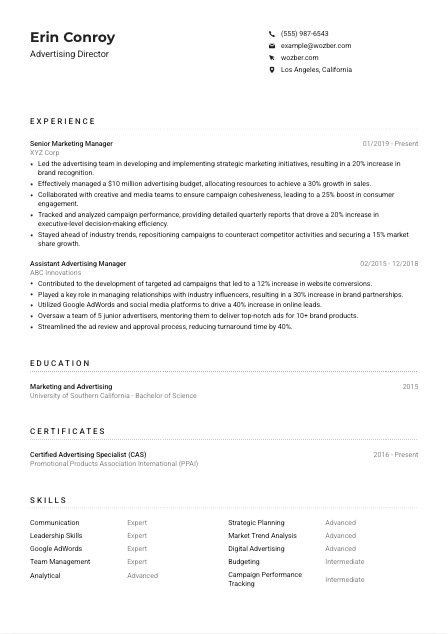
Place "Advertising Director" directly below your name when that is the role you are pursuing. This helps frame the rest of the resume around leadership in campaign strategy, media execution, and budget ownership. In the example, using the exact title makes the resume's intent obvious before the reader reaches the experience section.
If a role requires a specific market, include your city and state in the header. Here, Los Angeles is part of the employer's stated requirement, so "Los Angeles, California" removes an immediate question. Treat that as tailored positioning for this opening, not a rule for every Advertising Director resume.
A LinkedIn profile, portfolio site, or personal website can strengthen your candidacy when it shows campaign work, brand results, thought leadership, or speaking appearances. Make sure the content supports your resume with the same titles, dates, and strategic focus. For advertising leaders, digital presence should reinforce credibility, not create mismatches.
Your personal details should confirm that you are easy to reach, clearly positioned for the role, and aligned with any practical requirement the employer has already named.




This is the section where Advertising Director resumes usually win or lose attention. Hiring teams look for leadership over strategy, spend, channel execution, reporting, and cross-functional delivery. They also want to see whether your campaigns improved revenue, market position, engagement, lead flow, or brand performance in ways that can be measured.
Pull out the operating priorities before you write a single bullet. For this role, that means strategic marketing initiatives, budget management, collaboration with creative and media teams, campaign analysis, and trend awareness. Your experience bullets should answer those needs directly instead of relying on broad claims about being results-driven.
List positions in reverse chronological order and make the progression easy to follow. An Advertising Director resume should show movement toward larger budgets, broader campaign ownership, more senior stakeholders, or bigger teams. The sample resume does this well by moving from Assistant Advertising Manager to Senior Marketing Manager with stronger leadership and planning scope.
Generic statements like "managed advertising campaigns" do not say enough at director level. Focus each bullet on what you led, how you executed it, and what changed because of your work. Strong examples include increasing brand recognition, improving sales, boosting engagement, or streamlining approvals so campaigns moved faster across channels.
Numbers give context to the scale and quality of your decisions. Include budget size, revenue lift, conversion gains, engagement growth, market share change, lead volume, or turnaround time when those measures reflect your actual work. In the example, managing a $10 million budget and driving 30% sales growth instantly tells the reader this candidate has handled meaningful commercial responsibility.
Prioritize experience that shows media planning, campaign execution, digital platform fluency, agency or creative collaboration, and executive reporting. If you have adjacent marketing work, frame it through advertising impact rather than listing every general marketing task. The closer your bullets stay to campaign strategy and measurable outcomes, the easier it is to see your fit for a director seat.
A strong experience section makes it easy to trace your leadership through campaign outcomes, budget decisions, team coordination, and performance analysis.
Education is rarely the headline for a senior advertising candidate, but it still matters. It confirms baseline training in marketing, advertising, consumer behavior, or communications and helps satisfy degree requirements that may be used in screening.
If the posting asks for a bachelor's degree in Marketing, Advertising, or a related field, make that information easy to spot. List the degree, field of study, school, and graduation year. In the example, a Bachelor of Science in Marketing and Advertising directly supports the requirement without needing extra explanation.
Keep the structure simple and consistent so the reader can scan it in seconds. For experienced advertising leaders, the section should confirm qualifications, not compete with campaign achievements. Degree, field, institution, and date are usually enough unless an employer asks for more detail.
Academic distinctions can help when they connect to leadership, analytical strength, or strong performance in relevant programs. If you graduated years ago and already have a substantial record in brand growth and campaign execution, keep this selective. Let your professional results carry the heavier weight.
Coursework is most useful for early-career candidates or career changers who need to show grounding in media planning, market research, consumer psychology, or digital advertising. For established directors, it usually stays off the page unless it fills a clear gap. Include it only when it sharpens your positioning for the target role.
Advertising changes quickly across platforms, analytics, privacy rules, and audience behavior. If you have recent executive education, platform training, or strategy coursework tied to media, analytics, or leadership, include it when relevant. It shows you are still evolving with the market, not relying only on past campaign playbooks.
Keep this section clear and credible. It should reinforce that your strategic and analytical work in advertising sits on the academic background the employer expects.
Certifications are optional in many Advertising Director searches, so they need to earn their space. The best ones strengthen your story around digital platforms, media strategy, analytics, leadership, or specialized advertising expertise rather than filling the page with unrelated credentials.
Prioritize credentials tied to advertising platforms, campaign measurement, digital media, analytics, brand strategy, or leadership. A certificate should deepen the hiring team's understanding of how you run campaigns or lead teams. If it does not connect to channel execution, reporting, or strategic planning, leave it out.
Recent certifications carry more weight because advertising tools, audience targeting options, and platform standards change fast. Ongoing validity dates also help. In the example, listing a certification with an active date range signals continued professional engagement, even if the certificate itself is not the central qualification.
Include the certification name, issuing organization, and date or active period. Clean formatting matters here because platform and professional credentials are often scanned quickly. Make it easy to distinguish between well-known issuer names, specialized associations, and internal company training, which usually does not belong in this section.
The most useful certifications tell a hiring manager that you stay current with media platforms, campaign tools, and changing best practices. That matters for leaders expected to guide spending decisions, advise executives, and respond to competitor movement. Certifications should support that picture of current capability.
A focused certifications section can add credibility around platforms, analytics, or leadership, especially when it complements the campaign results already shown in your experience.
Advertising Director skills need to show more than general marketing strength. The mix should point to campaign leadership, media and platform knowledge, analytical decision-making, team management, and the ability to connect creative work with business outcomes.
Start with the terms the employer is using, then match them to skills you genuinely use. Here, that includes leadership, analytical ability, communication, Google AdWords, and social media advertising platforms. This improves ATS alignment and makes your resume read as tailored rather than recycled.
A director-level list should combine technical and managerial capability. Include tools and channel expertise such as paid search, social advertising, campaign analytics, and budget management alongside skills like team leadership, stakeholder communication, and strategic planning. The sample resume handles this balance by pairing Google AdWords and digital advertising with leadership and team management.
Do not turn the skills section into a full inventory of everything you have touched. Choose the competencies that support campaign execution, performance reporting, and leadership at the level you are targeting. A concise list is easier to scan and gives more weight to the capabilities that matter most for an Advertising Director search.
Your skills section should reflect someone who can lead advertising strategy, work fluently across platforms, and guide teams through performance-driven campaign decisions.
Language skills matter differently depending on the employer, market, and audience mix. For Advertising Director roles, they can support executive communication, client relationships, multicultural campaigns, and regional market reach, but they should be presented with the same clarity as any other qualification.
If the posting names a required language, list it first and show your level clearly. In this case, English fluency is essential, so English should appear at the top of the section. That removes uncertainty for a role involving reporting, cross-functional leadership, and strategic communication.
Use recognizable labels such as Native, Fluent, Advanced, or Conversational. Advertising leaders often work across internal teams, agency partners, media vendors, and executives, so inflated claims can quickly become obvious. Clear proficiency levels are more useful than vague descriptors.
Additional languages can strengthen your profile when they relate to audience segments, regional campaigns, or client communication. In the example, Spanish adds value because it suggests broader market fluency in a major media environment. Treat added languages as an advantage, not as a substitute for core advertising credentials.
Only claim the level you can apply in meetings, presentations, campaign reviews, or market-facing communication. If you can read or write better than you speak, be prepared to explain that. Precision matters more than trying to sound broadly multilingual.
When language ability is genuinely relevant, it can support audience insight, localization, partnership development, and campaign effectiveness across markets. Keep the implication practical. Hiring teams are looking for communication range that supports the work, not a decorative list.
List the languages that matter, define your level honestly, and let the section support the communication demands of the campaigns and teams you lead.
A summary for an Advertising Director should establish leadership level, campaign scope, and measurable outcomes in a few lines. It works best when it sounds specific to advertising strategy and performance management, not like a generic marketing profile pasted at the top of the page.
Before writing, identify the themes that should lead your profile. For this opening, those are successful campaign execution, budget management, analytical reporting, team leadership, and platform familiarity. Those points should shape the summary's wording and keep it anchored in advertising leadership rather than broad brand language.
State your title or close equivalent, then anchor it with years of relevant experience. Phrases like "Advertising Director with 9+ years of experience" or a close variation work because they immediately set level and field. The sample summary does this well by combining tenure with hands-on campaign leadership.
Choose two or three strengths that connect directly to the role, such as budget oversight, campaign analysis, cross-functional leadership, or digital advertising strategy. Keep them tied to business outcomes where possible. For example, mentioning brand growth, stronger engagement, or improved campaign performance says much more than listing broad traits alone.
Aim for a short paragraph that can be read in one pass. Three to four sentences are usually enough to establish seniority, core capability, and results orientation. The best summaries create a clear frame for the experience section that follows, especially when they mirror the language of the target role without sounding copied.
A well-written summary should quickly position you as someone who can lead advertising strategy, manage performance, and report results at the level the role requires.
An Advertising Director resume should leave little doubt about the scale of campaigns you have led, the budgets you have managed, and the business outcomes you influenced. When each section reinforces strategy, execution, reporting, and leadership, the document reads like a candidate ready for director-level accountability.
Wozber's free resume builder, ATS-friendly resume format, and ATS resume scanner can help you align your content with the posting, strengthen ATS optimization, and present your experience in a structure that is easy to review. The finished resume should make one thing clear fast: you know how to turn advertising investment into measurable growth.




