



Use Wozber and land your dream job
Create Resume
No registration required
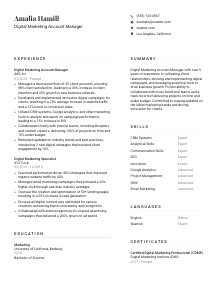
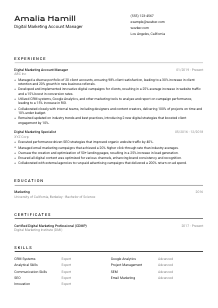
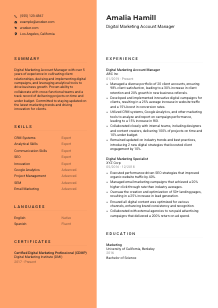
Designing campaigns, but your resume isn't trending? Check out this Digital Marketing Account Manager resume example, created with Wozber free resume builder. Learn how to show off your strategic thinking and results-tracking skills to match job needs, putting your career in the top feed!
Digital Marketing Account Managers sit at the point where client relationships, campaign execution, and performance reporting meet. Hiring teams want to see that you can keep accounts healthy while translating channel activity into business results, whether that means stronger retention, better ROI, cleaner project delivery, or sharper recommendations across SEO, paid search, email, and social.
When the resume mirrors the language of the role, it becomes much easier to connect your client portfolio, campaign scope, and reporting work to the opening in front of you. Wozber's free resume builder helps you shape an ATS-compliant resume around the terms and deliverables that matter here, so both the system and the hiring team can quickly see where you have already managed accounts, improved campaign performance, and coordinated work across creative and marketing teams.
For a client-facing marketing role, the top of the resume should feel reliable and business-ready. Contact details do not need flair. They need to show that you present yourself clearly, are easy to reach, and match any practical requirements the employer has flagged.
Use your full name in the largest text on the page so it is immediately clear whose resume is being reviewed. Keep the styling clean and professional. For a Digital Marketing Account Manager, the impression should be polished and credible, closer to a client presentation than a creative experiment.
Place "Digital Marketing Account Manager" directly beneath your name if that is the role you are applying for. This helps frame your experience from the first line and aligns your resume with the title the employer is searching for. If your current title differs slightly, your experience section can clarify the scope.
List a phone number you answer, a professional email address, and, if relevant, a portfolio site or LinkedIn profile that reflects your current work. This role depends on clear communication with clients and internal teams, so even basic details should reinforce that you are organized and accessible.
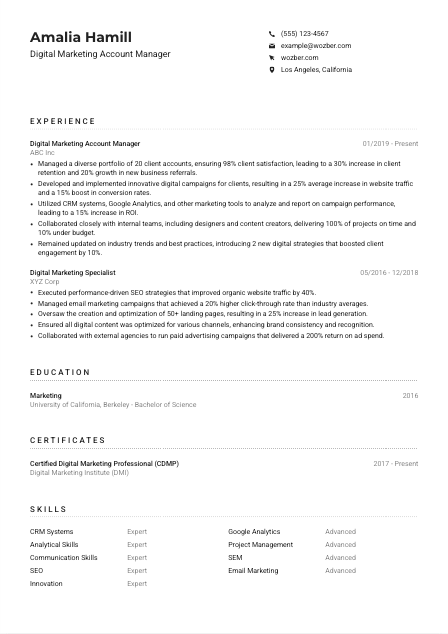
If the employer names a location requirement, show your city and state clearly. Here, Los Angeles, California matters because the posting asks for candidates based there. If you meet a location filter, remove any doubt early instead of leaving recruiters to guess.
A strong LinkedIn profile, portfolio, or personal site can add context for campaign work, client industries, or content strategy. Keep these links only if they strengthen your candidacy. For example, a portfolio with campaign snapshots, reporting examples, or channel results can support the account and performance side of your resume.
Keep this section simple, accurate, and aligned with the role. It should confirm that you are a serious candidate who can step into client communication, internal coordination, and day-to-day account management without friction.




This is the section hiring teams read most closely for a Digital Marketing Account Manager. They want to understand the size of accounts you handled, which channels you oversaw, how you worked with internal teams, and what happened to retention, traffic, conversions, or ROI because of your decisions.
Start by marking the verbs and deliverables in the posting. Here, the focus is on managing client accounts, overseeing digital campaigns, reporting on performance, collaborating with designers and content teams, and improving results through data. Those are the themes your bullets should echo if they reflect your actual work.
Lead with your most recent position and make each entry easy to scan with company name, title, and dates. For this profession, recent work often carries the most weight because platforms, reporting expectations, and channel strategy evolve quickly. Put the freshest campaign and account-management experience first.
Each bullet should show what you owned and what changed because of your work. Good bullets for this role often combine account scope, channel activity, and measurable results. The sample resume does this well by pairing client portfolio management with outcomes such as 98% client satisfaction, 30% higher retention, and stronger referral growth.
Use numbers that make sense for account management and digital performance. That can include retention rate, client satisfaction, referral growth, website traffic, conversion rate, return on ad spend, ROI, budget efficiency, on-time delivery, or campaign volume. Metrics like a 25% traffic increase or 15% improvement in ROI tell a hiring manager far more than "managed campaigns successfully."
Prioritize work that shows account leadership, channel strategy, reporting, stakeholder communication, and cross-functional delivery. If you also handled broader marketing tasks, keep only the ones that support this story. A bullet about optimizing landing pages or coordinating paid media belongs here if it ties back to client results, account growth, or campaign performance.
Your experience section should make it easy to picture you running client accounts, guiding campaign execution, and reporting on results with confidence. When the bullets show both relationship management and measurable marketing performance, the role becomes much easier to award to you.
Education matters here because many openings still use it as an early filter, especially when the posting calls for a bachelor's degree in Marketing, Business, or a related field. Keep the section clean and direct so the requirement is easy to confirm.
List your bachelor's degree clearly if you have one in Marketing, Business, or a related discipline. For this opening, that baseline matters, so do not bury it beneath extra details. A straightforward entry such as "Bachelor of Science, Marketing" checks the requirement immediately.
Include degree, field of study, school name, and graduation year or date. Avoid over-formatting. Hiring teams and ATS tools should be able to read this section without effort, especially when they are quickly confirming core qualifications.
Use the official degree and field names that appear on your transcript or diploma. If your background is closely related rather than an exact match, clarity helps. For example, a Marketing degree aligns directly, while a Business degree may benefit from stronger supporting experience in campaign management, analytics, or client work elsewhere on the resume.
Coursework is most useful if you are early in your career or your degree title is broad. Digital analytics, consumer behavior, marketing strategy, communications, or business research can help connect your education to campaign planning and performance analysis. If you already have several years of relevant experience, keep this brief.
Honors, marketing projects, leadership roles, or student work tied to digital campaigns, brand strategy, or analytics can add value when they reinforce your professional direction. Keep these details selective and role-related rather than turning the section into a full academic profile.
Education should answer the degree requirement quickly and cleanly. Once that box is checked, the rest of your resume can do the heavier work of proving campaign judgment, client management, and business impact.
Certifications are useful in digital marketing because tools, platforms, and channel practices change faster than most job titles do. They can reinforce current knowledge in analytics, automation, paid media, or broader digital strategy, especially when they connect to the kind of client work the role involves.
List certifications that strengthen your credibility in digital marketing, analytics, CRM use, automation, or channel management. A credential such as "Certified Digital Marketing Professional" fits naturally because it supports campaign strategy and digital execution without drifting away from the core job.
A shorter list of current, respected certifications is stronger than a crowded section filled with unrelated courses. Prioritize the credentials that reinforce how you manage campaigns, interpret data, or guide client strategy. Relevance matters more than volume.
Include the issue date, and if applicable, whether the certification is active or renewed. This is especially useful for tools and disciplines that evolve quickly. Current certification dates help show that your knowledge is not stuck in an older version of the marketing landscape.
As your career develops, update certifications to reflect the platforms and disciplines that shape your target roles. New training in analytics, lifecycle marketing, paid media, automation, or project management can sharpen your positioning for account-facing marketing roles.
Used well, this section shows that your marketing knowledge stays current and practical. That matters when employers need someone who can advise clients, work confidently with campaign data, and keep pace with changing digital channels.
The best skills sections for this role read like a summary of how you operate day to day. They should connect account management with channel execution, analytics, communication, and delivery, rather than listing every platform you have touched.
Read beyond the obvious requirements. This opening names marketing automation tools, CRM systems, Google Analytics, analytical ability, project management, and communication. It also implies client relationship management, campaign reporting, channel coordination, and cross-functional collaboration. Those are the capabilities to prioritize if you genuinely have them.
Your skills section should reinforce what appears in your experience, not introduce unsupported claims. If you list CRM systems, SEO, SEM, Google Analytics, email marketing, or project management, your bullets should show how you used them to improve traffic, conversions, client retention, or campaign ROI.
Place the most job-aligned skills first. For a Digital Marketing Account Manager, that often means CRM systems, analytics, campaign strategy, account management, communication, project management, SEO/SEM, email marketing, and reporting tools. The sample resume does this effectively by foregrounding CRM systems, analytical skills, communication, and Google Analytics rather than burying them under generic traits.
A focused skills list helps the reader connect your toolkit to the actual work of managing accounts and improving campaign outcomes. Keep it aligned, specific, and backed up by results elsewhere on the page.
Language proficiency is straightforward, but it still matters in account-facing roles. When a posting specifically asks for clear English communication, treat that as a business requirement, not a minor detail.
If the job specifies English, list it at the top with an accurate proficiency level. Since account managers spend time in client calls, emails, reporting updates, and internal coordination, clear written and verbal English should be easy to spot on the resume.
Additional languages can be useful when agencies or brands serve multilingual audiences or diverse client bases. Include them if they are real strengths. Spanish, for example, can be an added asset in many markets, even when not formally required.
Choose clear levels such as Native, Fluent, Intermediate, or Basic. Overstating language ability creates problems quickly in client-facing work, where meetings, presentations, and campaign feedback often require nuance and speed.
If your target employers work across regions, multilingual ability can support account growth, audience insight, and smoother communication with partners or customers. Keep the emphasis practical. Mention languages that genuinely expand the kind of client work you can handle.
Treat this section as a working capability, not a personality detail. For this role, language skills matter when they support clearer communication, stronger relationships, and smoother execution across teams or markets.
Handled simply and honestly, language skills can strengthen your profile for communication-heavy marketing roles. At minimum, this section should confirm the English proficiency the employer requires.
A resume summary for a Digital Marketing Account Manager should quickly establish your level, your client-facing scope, and the kinds of marketing results you have influenced. This is where you frame the rest of the resume, not where you repeat vague strengths.
Start with the facts that best represent your value for this type of role: years of experience, account management scope, channel coverage, and measurable outcomes. Look for the points that connect client relationships with campaign performance, such as retention gains, stronger ROI, or increased conversions.
Lead with a direct line that identifies you as a Digital Marketing Account Manager or a closely related professional with relevant years of experience. This gives immediate context and helps the reader place the rest of your background before they reach the detailed work history.
Choose two or three specifics that match the target opening. In this case, useful themes include managing client portfolios, running multi-channel campaigns, using Google Analytics or CRM data, and working with internal creative teams to hit deadlines and budgets. The sample summary works because it combines client relationships, campaign execution, collaboration, and business growth in a compact space.
Aim for a summary that can be read in a few seconds without losing substance. Three to five lines is usually enough. Remove filler such as "results-driven" or "dynamic professional" unless the sentence also includes concrete proof like years of experience, tools used, or performance outcomes.
Your summary should quickly tell the reader that you can manage client relationships, lead digital marketing work across channels, and improve performance with data. Once that is clear, the rest of the resume can supply the detail.
A Digital Marketing Account Manager resume should read like someone who can keep clients confident, campaigns moving, and reporting tied to business outcomes. If your sections consistently show account ownership, channel knowledge, analytics fluency, and cross-functional delivery, you are presenting the right story.
Before sending it out, run one last tailoring pass with Wozber's free resume builder to sharpen phrasing, improve ATS optimization, and present your experience in an ATS-friendly resume format that keeps the focus on client growth, campaign execution, and measurable results.




