



Use Wozber and land your dream job
Create Resume
No registration required
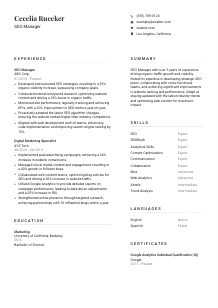
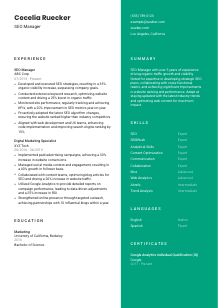
Optimizing websites, but your resume isn't ranking high? Check out this SEO Manager resume example, created with Wozber free resume builder. It shows how to present your search engine expertise so it matches job criteria, boosting your career visibility to the top of the search results!
SEO Manager hiring usually turns on one question fast: can you connect search strategy to measurable business growth. A resume in this field has to show more than familiarity with rankings and keywords. It needs to show the scope of your work across content, technical SEO, reporting, and cross-functional execution, with clear proof that your decisions improved traffic, visibility, or conversion-related performance.
When that story is tailored well, recruiters and ATS filters can quickly see whether your background matches the role's mix of strategy, analytics, and collaboration. Wozber's free resume builder helps you shape that experience into an ATS-compliant resume by aligning your language with the posting and keeping the structure easy to scan. That matters when a hiring team needs to confirm, within seconds, that you can lead SEO work that moves real search performance.
For an SEO Manager, the header should communicate relevance immediately and remove any friction around contactability or location. Keep it clean, accurate, and aligned with the role so the employer can move straight to your search experience and performance history.
Your name should be the most visible element in the header, set in a simple professional style. This section does not need flair. It needs clarity, especially when recruiters are reviewing multiple marketing candidates across SEO, content, and broader digital roles.
Place the job title you are pursuing right under your name. If you are applying for an SEO Manager opening, say "SEO Manager" rather than a broader title like "Digital Marketer." That sharpens positioning for both the recruiter and ATS matching, and it helps distinguish your profile from candidates whose experience leans more toward paid media or general marketing.
Some SEO Manager roles are flexible, while others are tied to a specific office or market. Here, Los Angeles, California is a stated requirement, so listing that location directly supports your application. If you are relocating, make that clear in a straightforward way rather than leaving the employer to guess.
Include a portfolio, LinkedIn profile, or personal site if it supports your SEO background. For this profession, that link can strengthen your case when it shows campaign context, content strategy work, analytics fluency, or examples of organic growth outcomes that reinforce the numbers on your resume.
Your personal details should answer the practical questions first: who you are, what role you are targeting, how to reach you, and whether you meet any stated location requirement. Once that is clear, the reader can focus on your search strategy, reporting discipline, and growth results.




This is the section where SEO managers separate themselves from adjacent digital marketing candidates. Hiring teams want to see what kind of search programs you led, which levers you worked across, what KPIs you tracked, and how your decisions changed organic performance over time.
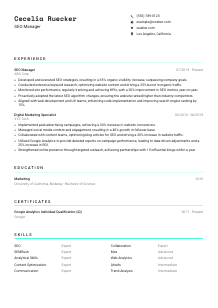
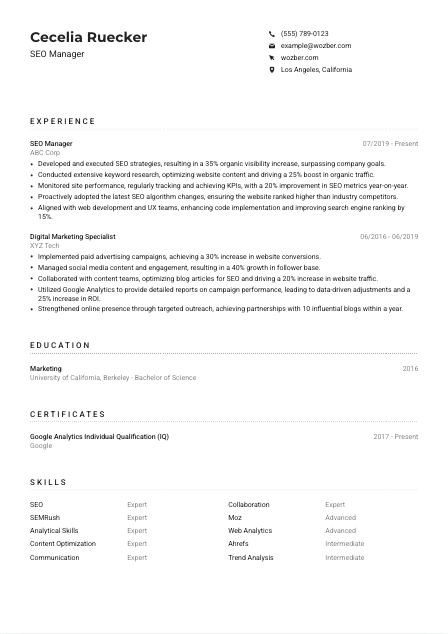
Start by mapping your experience to the responsibilities in the posting. For an SEO Manager role, that usually means SEO strategy, keyword research, content optimization, performance monitoring, trend awareness, and collaboration with developers or UX teams. The sample resume does this well with bullets tied to organic visibility growth, keyword-led content optimization, KPI tracking, algorithm updates, and implementation work with web and UX partners.
List roles in reverse chronological order and include title, company, and dates for each one. That structure helps employers quickly understand your progression from execution-focused work into strategy ownership, team collaboration, or channel leadership. For SEO, career progression matters because it often shows whether you moved from optimization tasks into broader planning, reporting, and stakeholder communication.
SEO hiring responds to results that can be measured. Use metrics tied to traffic growth, visibility, rankings, click-through rate, indexed content performance, or year-over-year improvement in SEO KPIs. "Increased organic traffic by 25%" or "improved search visibility by 35%" says far more than "managed SEO initiatives." The sample resume uses percentage lifts effectively, which gives the reader a clearer view of business impact.
Use the terminology the employer uses when it reflects your real experience. Phrases such as "keyword research," "organic visibility," "site performance," "SEO metrics," and "algorithm changes" help your resume align with how the role is defined. This is part of ATS optimization, but it also matters to hiring managers who want to see whether your background matches the practical work their team is doing.
SEO rarely succeeds in isolation. Your bullets should make clear how you partnered with content, engineering, UX, analytics, or product teams to implement recommendations. In the example, collaboration with web development and UX led to better code implementation and ranking improvement. That kind of detail shows you can move SEO from recommendation to execution, which is a major hiring signal for manager-level roles.
Your experience section should make it easy to see the scale of your SEO responsibility, the channels or teams you influenced, and the growth you delivered. If a recruiter can quickly connect your bullets to organic traffic, visibility, technical execution, and reporting discipline, this section is doing its job.
Education is usually a straightforward check in SEO hiring, but it still matters when the posting names a degree requirement. Present it clearly, and use it to confirm that you meet the academic background expected for the role without crowding out your performance-based experience.
If the job asks for a bachelor's degree in Marketing, Business, or a related field, make sure that information is easy to find. A Bachelor of Science in Marketing, as shown in the example, aligns directly with the requirement and removes any doubt on that point.
List your degree, school, and graduation year in a clean format. Hiring teams do not need a long academic narrative here. They need quick confirmation that your education meets the role's baseline requirement and supports your background in marketing, analytics, or digital strategy.
For SEO Manager roles, the field of study can help reinforce your foundation in audience research, campaign planning, analytics, and business objectives. If your degree directly relates to marketing or business, state that clearly rather than leaving the employer to infer the connection.
Most experienced SEO professionals do not need detailed coursework, but it can help if your degree is broader or less obviously connected to the role. In that case, a short note on digital marketing, analytics, content strategy, or web-related projects can provide useful context.
SEO changes constantly, so employers value professionals who keep learning. If your education section is thin or older, current training in analytics, technical SEO, content strategy, or search tools can reinforce that your knowledge has kept pace with the field. Formal certificates usually belong in the next section, but the broader point is that continued learning matters in search.
For an SEO Manager, education confirms baseline qualifications. It should be easy to scan, factually complete, and secondary to the stronger proof in your experience section. Once the degree box is checked, your resume should move the reader back toward organic growth results and SEO execution.
Certifications are useful in SEO when they reinforce tool fluency, analytics knowledge, or continued engagement with the field. They are usually not the main reason someone gets hired into an SEO Manager role, but they can strengthen the profile when they match the work the role actually involves.
When a posting emphasizes reporting, analysis, or search tools, prioritize certificates that support those capabilities. The Google Analytics Individual Qualification in the example is a strong fit because it backs up the candidate's reporting and performance-analysis claims, which are central to most SEO leadership roles.
A short list of relevant certifications works better than a long catalog of loosely related courses. Pick credentials that strengthen your case in SEO, analytics, technical implementation, content optimization, or adjacent areas that clearly support organic growth work.
SEO and analytics practices change quickly, and certificate dates help employers judge how current your training is. If a certification remains active or has been renewed, show that clearly. It signals that your knowledge has not been left behind by changes in platforms, reporting methods, or search best practices.
Ongoing learning matters in SEO because algorithm changes, SERP features, technical standards, and toolsets evolve constantly. Even when a job does not require certifications, an up-to-date credential list can reinforce your credibility as someone who keeps refining strategy and analysis rather than relying on dated playbooks.
The right certifications strengthen your resume when they connect directly to SEO execution, reporting, or tool proficiency. They should add context to your hands-on experience, not distract from it. Keep them relevant, current, and easy to read.
The skills section should mirror the real mix of capabilities an SEO Manager uses day to day: research, technical judgment, content direction, analytics, and collaboration. It is also one of the fastest places for both ATS systems and hiring teams to confirm whether your background lines up with the posting.
Start with the terms the employer explicitly values. Here, that includes SEO, analytical skills, communication, collaboration, and experience with tools such as SEMRush, Moz, or Ahrefs. If these match your actual background, include them in your skills list so your resume reflects the language of the role accurately.
Lead with the capabilities most central to SEO management, such as SEO strategy, keyword research, content optimization, technical SEO awareness, web analytics, and reporting. Tool names matter, but they should support your core search expertise rather than replace it. The sample resume handles this well by leading with SEO and SEMRush before moving into related strengths.
Organize skills in a way that is easy to scan, whether by category or by priority. A clean structure helps recruiters quickly identify platform knowledge, technical SEO capability, analytical depth, and cross-functional strengths. That is especially useful when your background spans broader digital marketing and you need to make your SEO specialization unmistakable.
By the time someone finishes this section, they should understand the tools you know, the SEO functions you can own, and the collaboration strengths you bring to implementation. Keep it tight, relevant, and clearly tied to the work the role requires.
Language requirements are usually simple on paper, but they can matter in SEO more than candidates expect. Clear language proficiency supports stakeholder communication, reporting, content guidance, and in some cases broader search work across regions or multilingual audiences.
If the job requires English proficiency, list English clearly and use an honest level such as Native or Fluent. Since SEO managers often present findings, explain strategy, and work across content and development teams, language proficiency is part of day-to-day execution, not just a checkbox.
Extra languages can strengthen your profile, especially if you have worked on multilingual content, international keyword research, or region-specific search behavior. In the example, Spanish adds range, but it should be presented as an added capability rather than treated as a universal requirement for SEO management.
Be precise about what you can actually do in each language. Hiring teams may expect you to join meetings, review content, or communicate with stakeholders based on what you list. Overstating proficiency can create problems quickly in a role that depends on clear communication and nuanced language use.
If you understand how search intent, local phrasing, or content performance changes across languages, that can be valuable context to add elsewhere in your resume. Language skills are especially useful when they support international SEO, localization, or content strategy across different audience segments.
Multilingual ability can suggest that you are comfortable working across markets, but keep the claim grounded. The real value comes from how those language skills support keyword research, content review, audience understanding, or market expansion work in SEO.
For SEO Manager roles, languages matter most when they support communication and, in some cases, broader search coverage across markets. State them clearly, rate them honestly, and let them reinforce the scope of work you can handle.
Your summary needs to position you quickly as someone who can own search strategy and deliver measurable organic results. In a few lines, it should connect your years of experience, your strongest SEO capabilities, and the kinds of outcomes you have produced.
Before writing, identify the recurring priorities in the job description. For this opening, those include organic traffic growth, SEO strategy, analytical decision-making, tool proficiency, communication, and collaboration with development and UX teams. Those are the themes your summary should reflect first.
Start with a direct line that states who you are professionally. "SEO Manager with over 5 years of experience driving organic traffic growth and visibility" works because it establishes both seniority and functional focus immediately. That is much more useful than a vague personal statement.
Follow your opener with proof of the kind of SEO impact you deliver. This might be traffic growth, visibility gains, ranking improvements, stronger reporting discipline, or successful cross-functional implementation. The sample summary works because it pairs strategic SEO planning with measurable performance improvement rather than staying abstract.
A summary should not repeat your whole resume. Stay within a few lines and make every phrase earn its place. For SEO Manager roles, that means prioritizing search strategy, analytics, content and technical collaboration, and outcomes that show you can lead organic growth work with confidence.
After reading the summary, the employer should already understand your level, your SEO specialty, and the kind of results you tend to produce. If those points are clear, the rest of the resume can deepen the story with metrics, tools, and execution detail.
A well-tailored SEO Manager resume should show how you turn search strategy into measurable growth, how you work across content and technical teams, and how you track performance with discipline. When each section supports that story, your application reads less like a generic marketing resume and more like a clear case for SEO leadership.
Use Wozber to tighten that alignment, strengthen ATS optimization, and present your experience in an ATS-friendly resume format that keeps the focus on results, tools, and execution. The finished resume should make it easy to judge one thing quickly: whether you can lead organic search performance with confidence.