



Use Wozber and land your dream job
Create Resume
No registration required
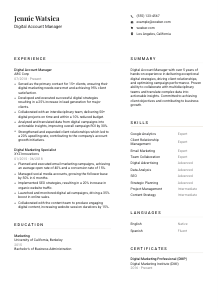
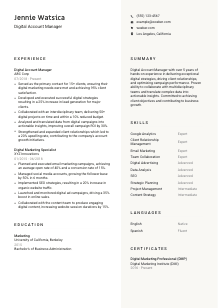
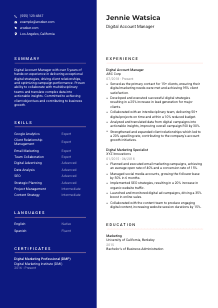
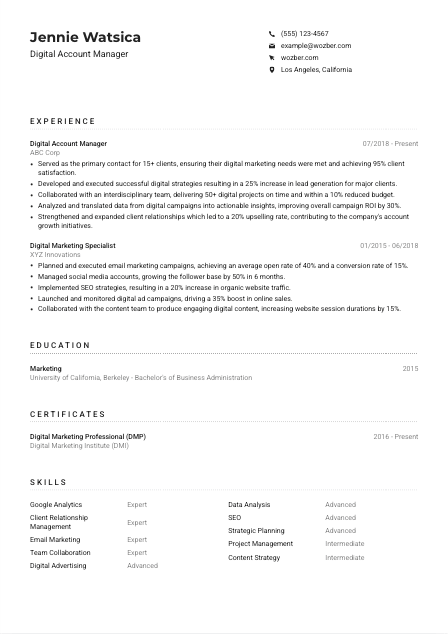
Juggling campaigns, but your resume feels pixelated? Check out this Digital Account Manager resume example, created with Wozber free resume builder. Learn how to align your digital dexterity with job specifications, ensuring your career metrics are always trending upward!
Digital Account Managers sit at the point where client expectations meet campaign delivery. Hiring teams want to see that you can keep accounts steady, turn performance data into recommendations, and coordinate creative, media, and analytics work without losing sight of commercial goals. Your resume should make that operating range visible early.
When the resume mirrors the language of client management, reporting, campaign performance, and growth, it is easier for both people and software to separate you from generalist marketers or sales-focused account leads. Wozber's free resume builder helps you build an ATS-compliant resume around those role-specific terms so the hiring team can quickly read your experience as account ownership with measurable digital results.
This section is simple, but it still carries hiring value. For a Digital Account Manager, the details at the top should immediately support professional communication, local eligibility when required, and a credible digital presence that fits a client-facing marketing role.
Use your full name as the most prominent text on the page. Keep the styling clean and professional, the same way you would present yourself in a client intro or quarterly review deck. It should be easy to scan, easy to remember, and consistent with your LinkedIn profile or portfolio branding.
Place "Digital Account Manager" directly below your name when that is the role you are targeting. This helps position you correctly from the start, especially when your background includes nearby titles such as Digital Marketing Specialist, Account Executive, or Campaign Manager. If your recent work already includes account ownership, use the target title confidently.
List a phone number and professional email address you check regularly, because client-facing roles often move quickly once interviews start. A simple address in the format of your name works best. Accuracy matters here. A typo in your contact line suggests the same kind of miss that can cause trouble in reporting, client follow-up, or campaign approvals.
If the employer asks for a specific location, add your city and state. In this example, listing Los Angeles, California immediately answers a stated requirement. For other jobs, only include location when it supports the application or removes a practical question about availability.
A LinkedIn profile, portfolio site, or professional website can strengthen this section when it supports your resume with campaign work, case studies, recommendations, or client-facing credibility. Keep the content aligned with your resume. If your profile says you lead paid media strategy and client reporting, the experience section should back that up with delivery scope and performance outcomes.
Keep this section polished and practical. When the basics are accurate and aligned with the role, hiring teams can move straight to the parts that show how you manage accounts, campaigns, and client growth.




For a Digital Account Manager, experience is where the decision usually happens. Titles matter, but the real test is whether your bullets show account ownership, campaign execution, cross-functional coordination, performance analysis, and commercial impact.
Start by marking the responsibilities and repeated terms in the job description. Here, the main themes are acting as the primary client contact, building digital strategies, coordinating delivery, reporting on performance, and growing accounts. Those themes should shape which achievements you keep, expand, or rewrite in your experience section.
For each role, include your job title, company, and dates, then use bullets that show what changed because of your work. Digital Account Managers are expected to manage moving parts and still deliver results. The example resume does this well by tying client ownership to outcomes such as 95% client satisfaction, 25% lead generation growth, and 30% improvement in campaign ROI.
Use numbers that reflect how digital account work is judged: client retention, satisfaction, lead volume, ROI, budget performance, on-time delivery, upsell rate, or campaign growth. Metrics make your scope believable. Managing "multiple clients" is vague. Managing 15+ client accounts while improving satisfaction or revenue shows real control over workload and results.
Choose achievements that connect directly to client strategy and campaign delivery. Earlier digital marketing roles still help if they show channel execution, reporting, optimization, or collaboration with creative and content teams. For example, email performance, SEO traffic growth, and paid campaign sales impact all build a credible path into account management when framed around business results.
Mirror the employer's wording where it matches your real experience. Terms such as "digital strategies," "campaign performance," "client relationships," and "Google Analytics" help your experience read clearly in both human review and ATS screening. Wozber's free resume builder and ATS resume scanner can help you spot missing terms, strengthen phrasing, and keep the section aligned without turning it into a keyword list.
After this section, a hiring manager should be able to see the size of accounts you've handled, the kinds of campaigns you supported, and the business results you influenced. That is the standard this role is hired on.
Education usually will not win a Digital Account Manager role on its own, but it can quickly confirm that you meet the academic requirement and have formal grounding in marketing, business, analytics, or communications. Keep it clear and relevant.
If the posting asks for a bachelor's degree in Marketing, Business, or a related field, list your qualifying degree in a straightforward format. A degree such as a Bachelor's of Business Administration in Marketing directly supports the requirement in this example and helps clear an early screening checkpoint.
Include degree, school, field of study, and graduation year or date. That is usually enough for this profession. Digital account hiring tends to focus far more on campaign performance, client handling, and channel knowledge than on elaborate academic detail, so clarity works better than overexplaining.
When your degree title is broad, use the field or concentration to connect it to the role. Marketing, business, communications, or digital media all make sense depending on the employer. Matching the wording of the job description where accurate can also support ATS alignment.
If you are early in your career, selected coursework or academic projects can help fill out your profile. Focus on subjects that map to the work, such as digital analytics, consumer behavior, media planning, campaign strategy, or marketing research. Once you have solid professional experience, these details usually become optional.
Digital marketing changes quickly across platforms, attribution models, and reporting tools, so recent learning can still matter. If you have completed workshops, short courses, or platform training in analytics, advertising, or client strategy, include them when they strengthen your current positioning.
Use this section to check the academic box cleanly and move the reader back to the parts of your resume that show campaign judgment, client communication, and digital performance.
Certifications are useful in digital account management when they reinforce practical knowledge in analytics, platforms, or digital strategy. They are especially helpful if the job values campaign analysis, channel fluency, or current platform knowledge even when certificates are not formally required.
Start with credentials that connect directly to digital marketing delivery or performance analysis. In this field, that often means certifications tied to digital strategy, analytics, advertising platforms, CRM tools, or inbound marketing. A Digital Marketing Professional credential, like the one in the example, works because it supports the broader account and campaign scope of the role.
A short list of well-chosen credentials is stronger than a crowded section of loosely related badges. Hiring managers are more interested in whether your certifications support client strategy, channel execution, and reporting than in how many courses you completed.
List completion dates or active periods so employers can tell whether the credential is current. This matters most for certifications tied to fast-changing tools or platform standards. Recent dates can also show that your knowledge of analytics or campaign management is up to date.
Digital account work shifts with new ad products, attribution changes, privacy rules, and reporting practices. Revisit this section regularly so it reflects the tools and frameworks you actually use today. Current certifications can support your credibility when competing against candidates with similar years of experience.
Keep the section focused on credentials that make your campaign judgment, analytics fluency, or platform understanding easier to trust. That is where certificates add real value in this profession.
This section should read like the toolset and working strengths behind your results. For a Digital Account Manager, that means balancing platform knowledge with client communication, reporting, and coordination across internal teams.
Use the job description to identify the skill categories that matter most. In this case, Google Analytics, client management, communication, negotiation, digital strategy, and analytical problem-solving deserve priority because they tie directly to the role's responsibilities.
Only include skills you can support elsewhere in the resume. If you list Google Analytics, your experience should show reporting, insight generation, or campaign optimization. If you list client relationship management, your bullets should show account retention, satisfaction, upselling, or primary contact responsibility.
Blend technical and interpersonal skills, but avoid turning the section into a long inventory. Digital Account Managers usually benefit from a concise mix such as analytics tools, paid media or email knowledge, CRM or reporting capability, strategic planning, client communication, and project coordination. Organize the list so the most role-relevant items appear first.
A useful skills section supports the story told in your experience. It should make it easy to see the tools, communication strengths, and analytical abilities behind your client outcomes and campaign performance.
Language ability matters more in digital account roles than candidates sometimes think. Clear communication affects client calls, campaign updates, reporting notes, negotiation, and internal coordination, so language listings should support how you work, not just fill space.
If the posting specifies English communication, list English clearly and use an honest proficiency level. In this job description, effective English is a direct requirement, so make it visible rather than assuming it will be inferred from the rest of the resume.
Order languages by practical value to the role. English should appear first when it is the working language for clients, reporting, and internal collaboration. This keeps the section aligned with how the position operates day to day.
Additional languages can strengthen your profile when they support client communication, regional campaigns, or multicultural audiences. For example, Spanish may be useful in many markets, but it should be presented as an added asset rather than a replacement for the required business language.
Choose standard labels such as Native, Fluent, Advanced, or Conversational. Avoid vague wording. In client-facing work, overstating language ability can create problems quickly once you are expected to present insights, handle objections, or explain campaign results live.
Only keep this section if it adds something relevant. For Digital Account Managers, languages are most valuable when they expand your ability to manage accounts, support international or multilingual campaigns, or communicate smoothly across teams and markets.
When this section is relevant, it should reinforce your communication range in real account work. That includes client conversations, campaign reporting, and collaboration across different audiences.
The summary is your quick positioning statement. In a Digital Account Manager resume, it should connect account leadership with digital marketing results, giving the reader a fast sense of your scope, strengths, and commercial impact.
Read the posting closely before writing this section. If the employer emphasizes client ownership, digital strategy, reporting, and growth, those themes should shape your wording. The example summary works because it ties strategy, client relationships, and campaign optimization together instead of describing general marketing interest.
Begin with your title or closest relevant professional identity and your years of experience. A line such as "Digital Account Manager with 5+ years of experience" immediately gives the reader context. Then follow with the kind of work you handle, such as multi-client digital strategy, campaign reporting, or cross-functional delivery.
Use one or two concrete outcomes or strengths that match how the role is evaluated. Client satisfaction, lead growth, ROI improvement, budget control, or upsell success are all stronger than generic claims about being results-driven. Keep the examples short, but make them specific enough to sound earned.
Aim for 3 to 5 lines. That is enough space to present your experience level, core strengths, and a few role-relevant outcomes without repeating the entire resume. Every sentence should help the reader understand why you can manage accounts, guide digital strategy, and communicate performance clearly to clients.
By the time someone finishes this section, they should already understand your level, your area of digital expertise, and the kind of account results you bring. That makes the rest of the resume easier to read in the right context.
A Digital Account Manager resume works when it shows that you can own client relationships, guide digital strategy, and translate campaign data into actions that improve performance or grow revenue. Keep each section tied to those realities, from contact details that remove friction to achievements that show retention, ROI, lead generation, delivery pace, or upsell contribution.
Wozber's free resume builder can help you organize that story in an ATS-friendly resume format, and its ATS resume scanner can highlight missing keywords, role language, and requirement gaps before you apply. The finished resume should make one thing easy to judge: you can manage digital accounts with both client confidence and measurable results.




