



Use Wozber and land your dream job
Create Resume
No registration required
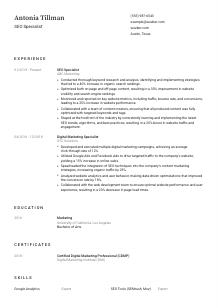
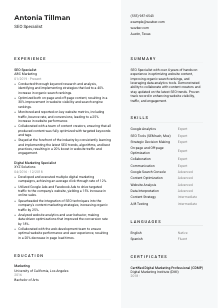
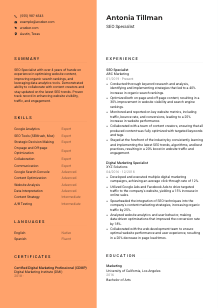
Optimizing online presence, but your resume feels off the SERP? Check out this SEO Specialist resume example, created with Wozber free resume builder. Learn how to navigate search algorithms and show your keyword skills to rank your profile at the top of the hiring "search results"!
SEO work gets judged by what moved in search, not by how many marketing tasks sat on your desk. Hiring teams want to see whether you can spot keyword opportunities, improve on-page and off-page performance, read traffic and conversion data correctly, and turn algorithm changes into practical action. Your resume should make that operating rhythm visible, with enough detail to show how you improved rankings, traffic quality, or site performance.
The first pass on an SEO resume often comes down to whether the document clearly connects tools, tactics, and measurable search results. Wozber's free resume builder helps you shape that into an ATS-compliant resume by aligning your wording with the job description and keeping the structure easy to scan. That matters when a team needs to quickly confirm that your Google Analytics work, Search Console fluency, and content collaboration actually translated into stronger organic performance.
For SEO roles, the personal details section should be clean, credible, and easy to scan. This is not the place for creativity. It should confirm who you are, how to reach you, and any practical requirement the employer has flagged, such as location for a local or hybrid role.
Use your full name in a larger, readable font so it anchors the top of the page. Keep it simple and professional. For a role tied to reporting, analysis, and communication, clarity at the top of the resume already sets the right tone.
Place the role title directly under your name using the same wording as the posting when it fits your background. If you are applying for an "SEO Specialist" opening, use "SEO Specialist" rather than a broader label like "Digital Marketer." That helps both ATS matching and human review, especially when employers are separating SEO-focused candidates from general marketing profiles.
Include a reliable phone number, a professional email address, and, if relevant, a portfolio or LinkedIn profile. Accuracy matters. One typo can cost an interview. For SEO candidates, a portfolio link can be useful if it shows audits, case studies, content optimization work, or traffic growth results.
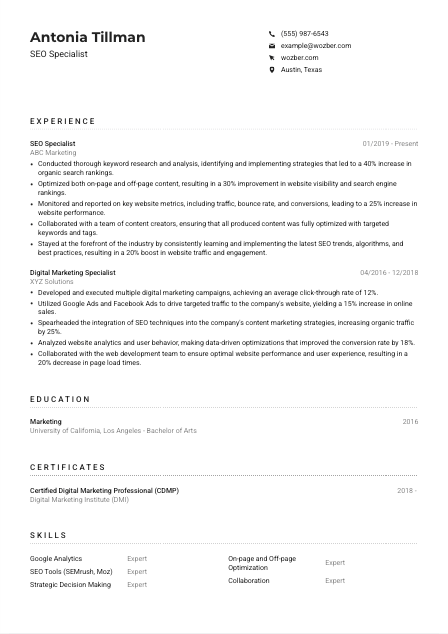
Some SEO positions are flexible, while others need someone based in a specific market for in-office collaboration or local client work. Here, the employer asked for Austin, Texas, so listing Austin, Texas in your personal details directly answers that requirement. If your target role does not mention location as a filter, keep this detail practical rather than overemphasized.
If you include LinkedIn, a personal site, or a portfolio, make sure the content supports your resume instead of repeating it loosely. An SEO-focused profile can reinforce your strengths through campaign snapshots, reporting examples, keyword growth wins, or content optimization projects. Keep job titles, dates, and headline language consistent across platforms.
This section only needs to do a few things, but they matter. Clear contact details, the right title, and any stated location requirement make it easier for the employer to move straight to your SEO experience.




This is the section most SEO hiring managers read first. They want to know what kinds of sites, campaigns, and optimization work you handled, which tools you used, and what changed because of your work. Generic marketing bullets get ignored quickly. Search-focused accomplishments get attention.
Before editing your experience section, identify the work the employer cares about most. For SEO roles, that often includes keyword research, on-page optimization, off-page support, analytics, performance reporting, and collaboration with writers or developers. Bring those themes into your bullets where they reflect real work you have done. In the sample resume, keyword research, content optimization, and reporting all appear early, which lines up well with the posting.
List your most recent role first, then work backward. For each entry, include job title, employer, and dates. That structure helps hiring teams quickly map your SEO growth, whether you moved from broader digital marketing into a dedicated SEO role or built depth within search over several positions. It also supports ATS parsing cleanly.
An SEO Specialist is usually hired to improve rankings, traffic quality, visibility, engagement, or conversions. Your bullets should show what you changed and how you changed it. "Conducted keyword research" is a task. "Conducted keyword research that contributed to a 40% increase in organic rankings" shows business value. The sample experience does this well by pairing common SEO activities with measurable movement in rankings, traffic, and site performance.
SEO is measured. Use numbers that feel native to the work, such as growth in organic traffic, ranking improvements, conversion lift, lower bounce rate, faster page load time, or higher click-through rate. Metrics do not need to appear in every bullet, but the section should give a credible picture of scale and results. Figures like 30% better visibility or 25% stronger website performance help a hiring manager picture the level of contribution.
If you have broader digital marketing experience, keep the parts that strengthen your SEO candidacy. Paid campaigns, content strategy, CRO work, and developer collaboration all belong if they support search growth or site performance. The sample resume includes a Digital Marketing Specialist role, but the strongest bullets are the ones that show SEO integration, analytics-based optimization, and faster page performance. That is the right balance.
A good SEO experience section makes it easy to see your search impact. When your bullets connect tactics, tools, and measurable results, the employer can quickly judge whether you can improve rankings and site performance in their environment.
SEO hiring often leans heavily on practical results, but education still matters when the posting asks for a degree. Keep this section straightforward and relevant. It should confirm the academic background that supports your work in marketing, communications, analytics, or digital content.
Check whether the employer calls for a specific degree or field. In this case, the posting asks for a bachelor's degree in Marketing, Communications, or a related area. If you have that background, make it easy to find. When your degree is adjacent rather than exact, the rest of your resume should reinforce how your coursework and experience connect to SEO work.
List the degree, field of study, school, and graduation year. That is usually enough. Clear formatting helps both ATS systems and human reviewers confirm that you meet the stated education threshold without searching through extra detail.
When your degree directly supports the role, keep the field visible rather than burying it. A degree in Marketing, as shown in the sample resume, speaks naturally to search strategy, content alignment, audience targeting, and campaign analysis. If your degree is in a related field, let the rest of your resume carry the connection through tools and outcomes.
Coursework, honors, or academic projects can help early-career candidates, especially if they relate to content strategy, analytics, market research, or digital communications. If you already have several years of SEO experience, keep this section lean and let your performance metrics carry more weight.
SEO changes constantly, so formal education rarely tells the whole story. If you have current training in analytics, search strategy, technical SEO, or digital marketing, your certifications can strengthen the academic baseline. The sample resume uses a marketing degree plus a professional certification, which creates a stronger picture than the degree alone.
This section does not need much space. It should simply show that you meet the education requirement and that your academic background supports the kind of SEO work described elsewhere in the resume.
Certifications are especially useful in SEO because tools, algorithms, and best practices shift so often. They can show that you keep your knowledge current, especially in analytics, digital marketing, content optimization, or platform-specific workflows.
Not every SEO posting requires certificates, but many candidates benefit from including them. If the role emphasizes analytics, reporting, or broader digital marketing coordination, relevant credentials can add weight. A certification such as Certified Digital Marketing Professional fits naturally because it supports the strategy and execution side of SEO work.
Choose certifications that relate directly to search performance, web analytics, technical optimization, content strategy, or digital marketing execution. A short, relevant list is stronger than a long list of generic courses. Employers care more about whether the certification supports the actual job than about volume.
Add the issue date and, if relevant, the current validity period. In SEO, recency matters because tools and ranking practices change quickly. Dates help the employer see whether your learning is current or several versions behind the market.
The value of this section grows when it supports a broader pattern. If your experience shows reporting, optimization, and collaboration work, and your certifications show continued study in digital marketing or analytics, the resume reads as current and engaged. That is particularly helpful for SEO, where staying updated is part of the job itself.
A well-chosen certification section tells the employer that your SEO knowledge is active, not dated. Keep it focused on credentials that reinforce the tools, decisions, and optimization work your experience already demonstrates.
The skills section should read like the toolkit of someone who can actually run SEO work, interpret search data, and work across content and web teams. Avoid broad filler. Focus on the platforms, optimization areas, and analytical strengths that the role depends on.
Read the job description closely and note both explicit and implied requirements. Here, Google Analytics, Google Search Console, SEO tools, data interpretation, communication, and website optimization all stand out. Those are the terms and capability areas that belong near the top of your list if they reflect your real experience.
Use the language from the posting when it matches your background. That improves ATS alignment and makes the resume easier to compare against the role. For example, listing "Google Analytics" and "Google Search Console" directly is better than hiding them inside a vague phrase like "web reporting platforms." The sample resume also strengthens this by pairing tool names with broader SEO capabilities such as on-page and off-page optimization.
You do not need every marketing skill you have ever used. Prioritize the ones that support search performance. Include a strong mix of technical and analytical skills, then add the collaboration and communication strengths that matter in content-driven SEO work. A list that combines analytics tools, optimization methods, data interpretation, and content collaboration will usually serve this role better than a long generic marketing inventory.
When this section is trimmed to the tools and capabilities that actually drive search performance, it becomes much more useful. It should quickly confirm that you can analyze, optimize, and communicate in an SEO environment.
SEO work often includes writing recommendations, reviewing content, explaining ranking changes, and coordinating with writers, marketers, or clients. If the posting names a language requirement, address it directly. Additional languages can help, especially for multilingual content or international search work, but relevance comes first.
Some roles mention language fluency because the work includes content review, reporting, or cross-functional communication. This posting asks for a high level of fluency in English, so your resume should make that visible rather than leaving it implied.
List English prominently and rate it honestly as "Native" or "Fluent," depending on your background. That gives the employer a quick answer on a required qualification. In the sample resume, placing English first with a native proficiency level handles this cleanly.
Extra languages can strengthen your profile when the work touches multilingual SEO, international content, or diverse audiences. Spanish, for example, may be useful in some markets or content environments, but it should sit behind the required language rather than distract from it.
Use clear levels such as Native, Fluent, Advanced, Intermediate, or Basic. Avoid inflating your ability. In SEO and content collaboration, language accuracy matters because your work may involve reviewing copy, metadata, outreach communication, or performance reporting.
For an SEO Specialist opening that mainly requires strong English communication, this section should stay brief. Its job is to confirm communication readiness and, where relevant, hint at added market reach. It does not need to become a centerpiece unless multilingual search is part of the role.
This section is most useful when it answers the employer's stated language requirement quickly. If you also bring additional language capability, include it as added value, especially when it could support broader audience reach.
Your summary sits at the top of the resume, so it should immediately place you in the SEO conversation. Keep it short, specific, and tied to the kind of outcomes the role cares about. This is where you connect years of experience, core strengths, and search results in a few direct lines.
Start with your professional identity and level of experience. For this role, a line like "SEO Specialist with over 4 years of experience" works because it quickly anchors your background in search rather than general marketing. Keep the wording tight and factual.
Your summary should reflect the work the employer needs help with. If the role centers on keyword research, website optimization, analytics, and collaboration with content teams, bring those themes into your opening lines. The sample summary does this by mentioning content optimization, organic rankings, analytics tools, and content creator collaboration without turning into a keyword dump.
A summary is short, so you do not need a full list of metrics. Still, it should hint at performance. Phrases about improving visibility, traffic, rankings, or engagement work well when they are supported by the experience section underneath. That creates a consistent story from top to bottom.
Aim for 3 to 5 lines that sound like an experienced SEO professional, not a generic marketing candidate. Focus on search growth, analytical decision-making, and cross-functional execution. Once the summary clearly frames your niche, the rest of the resume can provide the proof through tools, bullet points, and outcomes.
A strong summary tells the reader, within seconds, what kind of SEO professional you are and what results tend to follow your work. That makes the rest of the resume easier to read in the right frame.
An SEO Specialist resume should show how you improve organic performance, use analytics to guide decisions, and work with content or web teams to turn recommendations into measurable gains. When each section supports that story, the employer can quickly see whether your background matches the demands of the role.
Wozber's free resume builder can help you organize that story in an ATS-friendly resume format, while its ATS resume scanner and AI resume builder features help align your language with the posting and surface gaps worth fixing. The final result should make one thing easy to judge: whether you can deliver search growth in the role you are targeting.




