



Use Wozber and land your dream job
Create Resume
No registration required
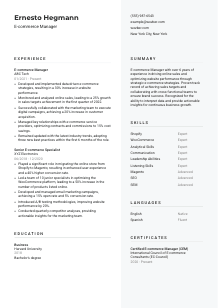
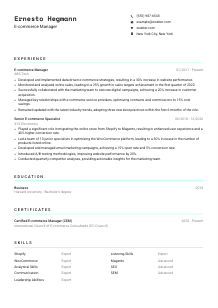
Driving online sales, but your resume feels out of stock? Unpack this E-commerce Manager resume example, created with Wozber free resume builder. Learn how to present your digital retail expertise so it matches job requirements, positioning your career for prime delivery!
E-commerce managers sit at the point where merchandising, digital marketing, site performance, and revenue targets meet. Hiring teams want to see whether you can turn traffic into sales, improve the customer journey, and make sound decisions from conversion, retention, and campaign data. Your resume should make that commercial ownership visible early.
A tailored resume helps separate broad digital marketing experience from hands-on e-commerce leadership. Using Wozber's free resume builder to align your wording with the job description and keep an ATS-compliant resume structure makes it easier to surface platform expertise, sales analysis, and cross-functional execution that matter first for this kind of role.
For an E-commerce Manager, the header should confirm role alignment and remove simple screening friction. Keep it clean, professional, and easy to scan so the reader can move quickly to your platform experience, sales results, and commercial scope.
Your name should be the most visible line on the page. Use a clean format that matches the polished, customer-facing nature of e-commerce work, where presentation and clarity matter just as much as operational control.
If you are targeting an E-commerce Manager position, place that title directly under your name when it accurately reflects your background. Matching the target title helps frame the rest of the resume around online sales ownership, site optimization, and channel coordination from the first glance.
List a reliable phone number and a professional email address. Avoid casual handles. This role often involves vendor communication, campaign coordination, and leadership across marketing and operations, so your contact information should look business-ready.
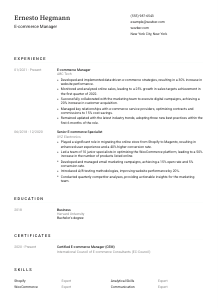
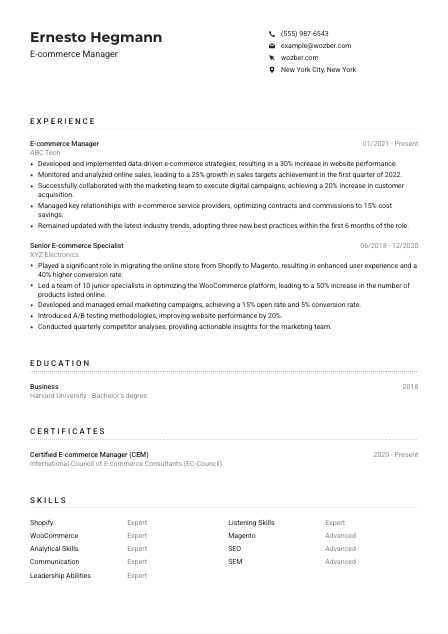
If the employer specifies a location requirement, show that clearly in your header. In the example, listing New York City, New York directly addresses a stated requirement and removes doubt about local eligibility or relocation timing.
Include LinkedIn or a professional website if it reinforces your candidacy. For e-commerce professionals, that can mean a profile that supports your management history, platform work, campaign scope, or portfolio examples tied to online growth and digital execution.
Your personal details should answer the practical basics fast: who you are, what role you are targeting, how to reach you, and whether you meet any stated location requirement. That lets the hiring team move straight to your commercial track record.




This section carries the most weight for an E-commerce Manager because it shows whether you have actually grown online revenue, improved site performance, and coordinated work across platforms, campaigns, and providers. Focus less on task lists and more on the business outcomes you drove.
Start by pulling out the work the employer cares about most. For this kind of role, that usually includes e-commerce strategy, website performance, customer experience, online sales analysis, campaign effectiveness, and vendor management. Your bullets should mirror those themes with examples from your own work rather than broad digital marketing language.
List jobs in reverse chronological order with title, company, and dates. That straightforward structure matters because hiring teams often scan first for managerial progression, years in e-commerce, and whether your background covers the platforms, teams, or commercial scope they need.
Each bullet should show what changed because of your work. Good E-commerce Manager bullets often include gains in conversion rate, revenue, average order value, campaign return, product availability, or site speed. In the sample resume, results such as a 30% increase in website performance and 25% growth in sales target achievement give the role real business weight.
Metrics carry more value when they are tied to a business action. Instead of saying you managed digital campaigns, say what channels you used and what moved, such as customer acquisition, email conversion, ROAS, or cart completion. The example's 20% increase in customer acquisition and 15% cost savings from provider negotiations are strong because they connect action to outcome.
Prioritize work that proves you can run an online channel, not just contribute to one. Platform migrations, A/B testing, SEO or SEM coordination, merchandising improvements, vendor negotiations, and team leadership all belong here when they reflect your real scope. The strongest bullets make it obvious that you influenced revenue and customer experience, not only execution volume.
Your experience section should make your commercial judgment easy to trust. When the bullets show platform fluency, measurable growth, and cross-functional leadership, you read like someone who can own an e-commerce business line rather than support it from the sidelines.
Education is usually not the deciding factor for an experienced E-commerce Manager, but it still helps confirm business grounding. Present it clearly and let it support the more important story told by your platform work, analytics, and revenue results.
List your highest completed degree first, especially if it relates to business, marketing, or a similar field. That directly reflects the educational preference many e-commerce postings include and gives useful context for your commercial and analytical background.
Use a simple structure with degree, field of study, school, and graduation year. Hiring teams do not need a long academic narrative here. They need to confirm the credential quickly and return to your online sales and channel management experience.
When your degree aligns directly with the posting, state it plainly. In the example, a Bachelor's degree in Business maps neatly to the employer's requirement and supports the candidate's credibility in strategy, forecasting, and performance analysis.
If you are earlier in your career or your experience is lighter, selected coursework can help fill in relevant areas such as digital marketing, consumer behavior, analytics, merchandising, or business strategy. For established managers, this is usually optional unless the coursework is especially relevant to the target role.
Honors, awards, or leadership activities are worth listing when they reinforce commercial, analytical, or leadership strengths. Keep them brief and relevant. Once you have several years of e-commerce experience, academic extras should stay secondary to business results.
This section should confirm that you meet the educational baseline without distracting from your stronger qualifications. Clean formatting and a direct match to the posted degree requirement are usually enough.
Certifications can strengthen your resume when they point to current knowledge in e-commerce, digital marketing, analytics, or platform operations. They are especially useful when they support the exact mix of strategy, tools, and commercial oversight the job requires.
Choose certifications that reinforce the work you want to do. For an E-commerce Manager, that may include credentials in e-commerce management, digital marketing, analytics, SEO, paid media, platform operations, or customer experience optimization. Skip certificates that do not deepen the story told by your experience.
A certificate matters most when a hiring team can connect it to the day-to-day role. The sample resume's Certified E-commerce Manager credential works because it directly supports platform strategy, sales growth, and operational knowledge in an online retail setting.
Include the year earned and, if relevant, whether the certification is active. Current dates help show that your knowledge has kept pace with changing platform features, digital acquisition tactics, and e-commerce best practices.
E-commerce changes quickly across search, paid channels, retention, marketplace strategy, and site technology. A current certification list can show that you continue to sharpen the skills that affect conversion, campaign efficiency, and customer experience.
Use this section to reinforce current, relevant expertise. A short list of well-chosen credentials can strengthen your case for roles that blend platform management, marketing coordination, and performance analysis.
The skills section should reflect how e-commerce work is actually done. That means balancing platform knowledge, analytical ability, channel familiarity, and leadership skills instead of filling the space with broad business terms.
Review the posting closely and note both explicit and implied requirements. For an E-commerce Manager, those often include platform expertise such as Shopify, Magento, or WooCommerce, along with sales analysis, campaign planning, SEO or SEM knowledge, vendor management, and communication with cross-functional teams.
Lead with the skills most tied to performance in the role. Platform management, analytics, forecasting, conversion optimization, digital campaign coordination, and leadership should usually appear before more general soft skills. In the example, the mix of Shopify, WooCommerce, Magento, SEO, SEM, analytics, and leadership creates a credible picture of hands-on commercial management.
Group or order skills so the reader can quickly spot technical capability and business judgment. A shorter, targeted list is more persuasive than a long inventory. Every skill should support work you can defend through results in the experience section.
Your skills section should quickly show that you can manage an e-commerce channel with both technical fluency and commercial discipline. Keep it aligned with the job description and consistent with the achievements you claim elsewhere.
Language skills matter in e-commerce when the role involves cross-team communication, customer experience, vendor coordination, or international markets. Present them clearly, with honest proficiency levels, and prioritize any language the employer explicitly requests.
If the posting calls for a specific language, list it first with your actual level. Here, English proficiency is explicitly required, so it should appear prominently. That helps confirm you can handle reporting, meetings, negotiations, and day-to-day communication without ambiguity.
Order languages by business relevance, not personal preference. For many E-commerce Manager roles, English will lead because it supports stakeholder communication, campaign planning, and vendor conversations. If another language supports a target market or supplier base, place it accordingly.
Extra languages can strengthen your profile when they relate to customer service coverage, international growth, marketplace expansion, or cross-border vendor relationships. The value depends on the business model, so include them when they add real context to your candidacy.
Terms like Native, Fluent, Advanced, or Intermediate are more useful than vague claims. Be accurate. Language ability will often be tested quickly in interviews or in written communication during the hiring process.
If the business sells across regions or works with global suppliers, language skills can support smoother coordination and stronger market awareness. They are usually a supporting advantage rather than a core qualification, unless the posting makes multilingual communication central to the job.
Keep this section practical. It should confirm required communication ability first, then show any additional language range that could help with customer, supplier, or market coverage.
Your summary should quickly establish the scale and kind of e-commerce work you handle. In a few lines, show your level, your commercial focus, and the results you tend to deliver across platforms, campaigns, and customer experience.
Before writing, identify the themes the employer emphasizes most. For an E-commerce Manager, that often means online sales growth, site performance, customer experience, campaign coordination, platform knowledge, and data-driven decision-making. Those themes should shape the summary's language.
Begin with your title, years of experience, and main area of strength. A useful opening might position you as an E-commerce Manager with 6+ years of experience growing digital revenue, improving conversion, or leading platform and campaign strategy across online channels.
Choose achievements that match the role's priorities most closely. The example summary works because it points to online sales growth, website performance improvement, and actionable analysis. If you have stronger specifics, include them, such as conversion gains, revenue growth, campaign efficiency, or successful platform migrations.
Aim for a concise paragraph that reads like an executive snapshot, not a biography. Three to five lines is usually enough. Every phrase should support why you can manage an e-commerce operation, guide cross-functional work, and improve business performance.
A good summary should let the reader understand your e-commerce value in seconds: your level, your area of ownership, and the business results you are known for. That sets up the rest of the resume to confirm the claim.
An E-commerce Manager resume works best when every section supports the same message: you know how to grow online sales, improve the site experience, and make data-backed decisions across platforms and channels.
Use Wozber's free resume builder to shape that story into an ATS-friendly resume format, align your wording with the job description, and refine weak spots with the ATS resume scanner. The final version should make your platform fluency, commercial judgment, and leadership easy to recognize.