



Use Wozber and land your dream job
Create Resume
No registration required
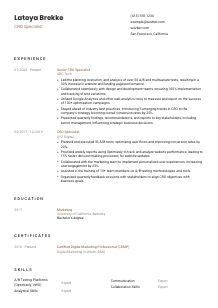
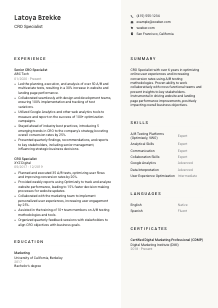
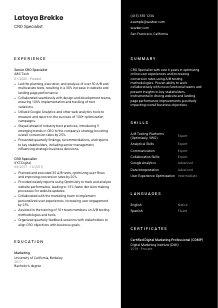
Optimizing conversions, but your resume isn't converting to callbacks? Check out this CRO Specialist resume example, created with Wozber free resume builder. Learn how to align your conversion skills with job requirements, making your career trajectory reach its ultimate click-through rate!
CRO work gets judged through outcomes that can be traced. Hiring teams want to see how you form test hypotheses, run A/B or multivariate experiments, work with design and development on implementation, and turn analytics into measurable gains in conversion rate, engagement, or landing page performance. A vague marketing resume will not carry that. Your resume needs to show a disciplined optimization practice.
The first screen often comes down to whether your background clearly maps to experimentation, analytics, and cross-functional delivery. Using Wozber's free resume builder helps you shape an ATS-compliant resume around the language of the role, so terms like A/B testing, Google Analytics, reporting, and stakeholder presentation are easy to surface. That makes it much easier for a hiring team to see that you can run tests, interpret results, and explain what to do next.
For a CRO Specialist, the header should be clean and practical. This role revolves around reducing friction and improving completion rates, and your contact section should do the same by making essential details immediate and accurate.
Place your full name at the top in a clear, readable style. Keep the formatting simple so the page opens with professional confidence rather than decoration. CRO is a results-driven field, and a cluttered header creates the wrong first impression.
Add the title "CRO Specialist" beneath your name when that matches the role you are pursuing. This helps frame the resume around experimentation, analytics, landing page performance, and conversion work from the first line, while also supporting ATS matching.
Include a reliable phone number and a professional email address. If you use a website or LinkedIn profile, make sure it supports your candidacy with relevant work such as testing case studies, analytics projects, portfolio samples, or digital marketing accomplishments, not unrelated content.
Some CRO roles are open to remote or hybrid candidates, while others filter by location early. Here, the employer asks for San Francisco, California, so listing city and state clearly removes an avoidable objection. Treat this as a tailoring move tied to the posting, not a universal rule for every CRO application.
A link can help when it gives hiring managers more context on your optimization work, such as experiment summaries, dashboards, or marketing projects. Keep those links current and aligned with the story your resume tells about testing, analysis, and business impact.
Your header should confirm who you are, how to reach you, and whether you meet any practical filters tied to the role. Keep it easy to scan, and let the rest of the resume carry the proof of your CRO work.




In CRO hiring, experience matters most when it shows a repeatable testing process and measurable lift. Titles alone are not enough. The resume needs to show what you tested, how you measured success, who you worked with, and what changed because of your recommendations.
Read the posting closely and mark the operating requirements behind it. For this role, that includes planning and analyzing A/B and multivariate tests, using analytics tools, working with design and development, and presenting findings to stakeholders. Those are the themes your experience bullets should reflect if they match your background.
List your positions in reverse chronological order, then give more space to work that involved experimentation, funnel analysis, landing page optimization, user flow improvements, or reporting on conversion performance. If an older marketing role had limited CRO scope, keep it concise and let your stronger optimization work lead.
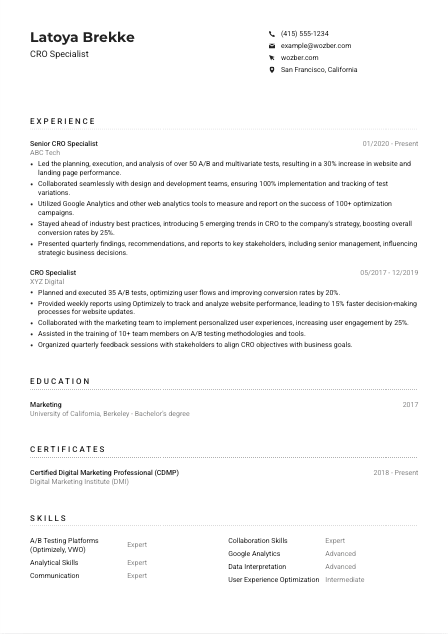
Each bullet should show an action, the method, and the business result. Good CRO bullets often include the type of test, the platform or analytics environment, the page or funnel being improved, and the result. The sample resume does this well with lines such as leading more than 50 A/B and multivariate tests and improving website and landing page performance by 30%.
Use metrics that belong naturally to optimization work: conversion lift, engagement growth, test volume, reporting cadence, implementation rate, decision speed, or campaign performance. Numbers give context to your judgment. A bullet about weekly Optimizely reporting that led to 15% faster decision-making is more useful than saying you "supported optimization efforts."
Your experience section should stay focused on experimentation, analysis, collaboration, and influence. General marketing tasks that do not connect to CRO outcomes can weaken the read. Keep the bullets that show you can move from hypothesis to implementation to reporting, because that is the workflow employers need to see.
When your experience section shows repeated testing, clear measurement, and real collaboration with product, design, development, or marketing teams, hiring managers can picture you running optimization programs instead of just discussing them.
Most CRO roles do not require a long academic section, but they do expect a credible foundation in marketing, business, analytics, or a related field. Keep this section straightforward so the degree requirement is easy to confirm.
If the role asks for a bachelor's degree in Marketing, Business, or a related field, place that information clearly. In the example, a Bachelor's degree in Marketing maps directly to the requirement and helps remove any uncertainty early.
List degree, field of study, school, and graduation year. This is one section where clarity matters more than detail. Recruiters and hiring managers should be able to scan it in seconds and move back to your testing and performance history.
A degree in marketing, business, economics, psychology, statistics, or a related discipline can support a CRO profile because those fields connect to user behavior, experimentation, or commercial decision-making. If your degree is adjacent rather than exact, the rest of the resume should reinforce the analytical side of your background.
Relevant coursework can help if you are earlier in your career or moving into CRO from a related function. Classes in digital marketing, consumer behavior, statistics, web analytics, or UX research can strengthen the story. If you already have several years of conversion work, keep this section lean.
Awards, honors, or leadership roles belong here only if they add something useful and recent enough to matter. For experienced CRO candidates, most hiring decisions will hinge far more on test execution, analytics fluency, and business outcomes than on campus achievements.
This section only needs to confirm that you meet the academic baseline and, if relevant, show a foundation that supports analytical marketing work. Save the real detail for the experience section, where your CRO practice becomes tangible.
Certifications can help in CRO when they support the tools, analytics knowledge, or digital marketing context behind your work. They are rarely the deciding factor, but they can strengthen your profile when they align with experimentation and performance optimization.
List certifications that connect to CRO, analytics, experimentation, digital marketing, UX, or platform expertise. A credential such as Certified Digital Marketing Professional can support your profile because CRO often sits inside broader acquisition, landing page, and funnel performance work.
A short, relevant list reads better than a long collection of unrelated credentials. Prioritize certificates tied to testing platforms, analytics interpretation, optimization strategy, or customer behavior over general business training that does not support the role directly.
Include the earned date and, if applicable, the active period. This is especially useful in fast-moving areas like analytics and digital optimization, where recent study suggests you are staying current with platform changes, reporting methods, and testing best practices.
CRO work changes as tools, tracking practices, privacy constraints, and user behavior evolve. Relevant certifications can show that you continue to build your expertise beyond day-to-day campaign work, especially if your recent role titles do not fully capture that growth.
A well-chosen certificate adds credibility when it strengthens the story already present in your experience and skills. Keep the section tight, current, and clearly connected to optimization work.
A CRO skills section should read like the toolkit of someone who can diagnose performance issues, design valid tests, and communicate results clearly. That means balancing technical tools with the collaboration skills needed to get test variations built, launched, and acted on.
Start with the exact capabilities the employer names, then add closely related skills you genuinely use. Here, the obvious anchors are A/B testing platforms such as Optimizely or VWO, Google Analytics, analytical interpretation, communication, and cross-functional collaboration.
List the platforms, methods, and working strengths that are supported by your experience bullets. If you claim Optimizely, VWO, Google Analytics, hypothesis development, or user experience optimization, make sure your work history shows where you used them and what results followed.
Do not turn this section into a catch-all. CRO hiring teams want to see a practical combination of testing tools, analytics fluency, data interpretation, and stakeholder communication. The sample resume handles this well by pairing platform knowledge with analytical, collaboration, and communication skills instead of listing every marketing skill imaginable.
When the skills section reflects the real mechanics of CRO work, from testing platforms to reporting and cross-team execution, it strengthens every other section of the resume. Keep it specific enough that a hiring manager can picture how you operate.
Language skills play a supporting role on most CRO resumes, but they matter when the job requires strong communication, negotiation, or work across international teams. Keep this section honest and relevant to how the role is actually performed.
If a posting explicitly asks for English proficiency, list English first and state your level clearly. In this case, the role requires the ability to negotiate effectively in English, so your resume should remove doubt about professional fluency.
Use clear levels such as Native, Fluent, Advanced, or Conversational. That gives hiring teams a practical read on how comfortably you can present findings, discuss test tradeoffs, and work with stakeholders in meetings or written reports.
Extra languages can be useful if the role touches global markets, multilingual landing pages, localization testing, or cross-border collaboration. For example, Spanish may be worth including if it supports communication with teams or audience segments relevant to the business.
Do not overstate fluency. CRO roles often involve presenting results, defending recommendations, and discussing data with senior stakeholders, so your stated level should match what you can handle in real conversations and written communication.
When relevant, language ability can support work such as stakeholder presentations, customer research interpretation, or collaboration across regional teams. Keep the emphasis on business usefulness rather than listing languages as a general personal attribute.
For this kind of role, language skills matter most when they support reporting, negotiation, and collaboration. If they do, include them clearly. If not, keep the section brief and factual.
Your summary should quickly place you in the conversion optimization space and show the level at which you work. A hiring manager should be able to tell, within a few lines, whether you run tests, interpret analytics well, and influence decisions across teams.
Start with your title and years of relevant experience, then anchor the summary in actual CRO work. A line such as having 6+ years improving online user experiences and conversion rates gives immediate context if the rest of the resume backs it up.
Mention the abilities most central to the position, such as A/B testing, analytics interpretation, landing page optimization, and cross-functional collaboration. This is the place to establish your operating range without repeating every detail from the skills section.
Aim for a short paragraph that sounds credible and specific. Three to five lines is enough to show your specialization, your methods, and the kind of results you influence. Avoid broad claims about being dynamic or passionate if you can state measurable optimization impact instead.
Use the language of the posting where it matches your experience, especially around A/B testing, web analytics, reporting, and stakeholder communication. The example summary works because it stays close to the role's priorities while still sounding tied to real experience.
A well-written summary gives the reader a fast, accurate sense of your CRO background before they reach the detail. If those opening lines clearly connect experimentation, analytics, and business outcomes, the rest of the resume lands much better.
A CRO Specialist resume works when it shows a clear testing process, comfort with analytics tools, strong collaboration with design and development, and results that matter to the business. That is what helps hiring teams separate true optimization practitioners from general digital marketers.
Use Wozber's free resume builder to organize that experience into an ATS-friendly resume format, then sharpen the wording with Wozber's AI resume builder and ATS resume scanner so your testing platforms, analytics work, and reporting strengths are easy to match to the job description. The final read should make one thing obvious: you know how to run experiments, interpret the data, and turn findings into conversion gains.




