



Use Wozber and land your dream job
Create Resume
No registration required
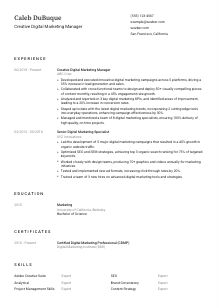
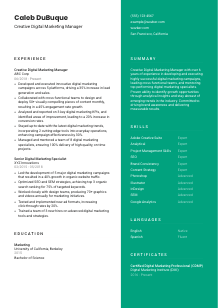
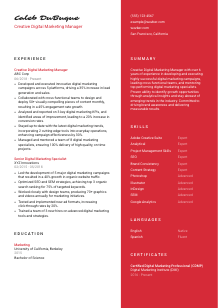
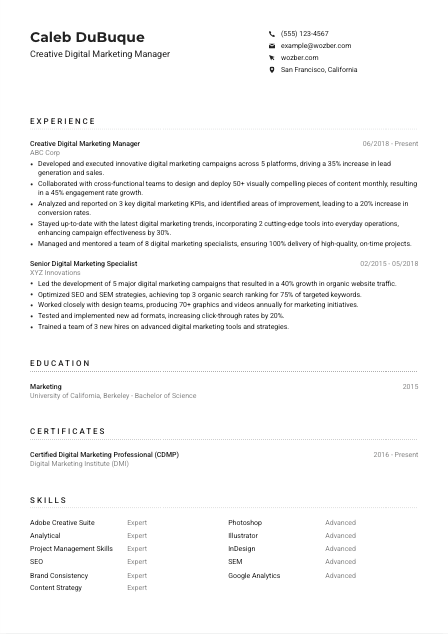
Crafting digital strategies, but feeling lost with your resume? Browse this Creative Digital Marketing Manager example, created with Wozber free resume builder. It shows how to smoothly showcase your marketing mettle online, ensuring your career narrative trends as impressively as your social media campaigns!
Creative Digital Marketing Managers are expected to move between brand storytelling and performance marketing without losing control of either. Hiring teams want to see that you can shape campaigns that look polished, stay on-brand across channels, and still produce measurable gains in traffic, engagement, leads, or revenue. Your resume needs to make that balance visible fast.
A tailored resume helps separate creative marketers from candidates who only list channels and tools. When the language in your experience, skills, and summary reflects campaign execution, KPI analysis, cross-functional content production, and team leadership, reviewers can quickly connect your background to the role. Wozber's free resume builder helps organize that detail into an ATS-compliant resume, so the hiring team can more easily see your creative range and commercial impact.
For a Creative Digital Marketing Manager, the top of the resume should feel clean, current, and easy to scan. This section is not where you show personality through extra detail. It is where you establish professional identity, contact access, and any location requirement the employer has made explicit.
Use your full name in the most prominent text on the page. Keep the styling polished and readable rather than decorative. In a marketing role, presentation matters, but the header should still scan cleanly in both human review and ATS parsing.
Add the job title directly under your name when it matches your background. If you are applying for a Creative Digital Marketing Manager opening, use that wording instead of a broader label like "Marketing Lead" or "Digital Strategist". It immediately frames your experience around campaign ownership, creative direction, and channel performance.
Include a phone number, professional email address, and a relevant portfolio, website, or LinkedIn profile if it supports your candidacy. For this profession, an online presence can help when it shows campaign work, brand content, or leadership credibility. Only link assets that are current and consistent with the resume.
If a posting specifies a location requirement, reflect it clearly in your header. Here, listing "San Francisco, California" directly supports a stated requirement. For other applications, include city and state when proximity or local market knowledge matters, but do not give more personal address detail than necessary.
A website or LinkedIn profile should extend your marketing story, not complicate it. Use it when it shows portfolio samples, campaign snapshots, leadership experience, or endorsements tied to digital strategy, creative production, or paid and organic growth. If the profile is thin or outdated, leave it off until it is ready.
Your header should tell a hiring team who you are, what role you are targeting, how to reach you, and whether you meet any stated location requirement. Keep it sharp and useful, like the opening frame of a well-run campaign.




This section carries the most weight for Creative Digital Marketing Manager roles. Employers want to see how you have planned campaigns, worked with designers and channel specialists, tracked performance, improved results, and managed competing priorities without losing quality or deadlines.
Start by marking the work this employer actually cares about: campaign execution across platforms, visually compelling content, SEO and SEM knowledge, KPI reporting, and team leadership. Then shape your bullets around comparable work from your own background. The sample resume does this well by echoing campaign development, cross-functional collaboration, optimization, and mentoring rather than listing generic marketing duties.
List roles in reverse chronological order and make promotions or scope increases easy to spot. For this kind of position, progression matters. Moving from specialist work into campaign ownership, team management, or broader channel responsibility shows you are operating at manager level, not only executing tasks.
Each bullet should connect your action to a measurable marketing result. Use metrics that belong to digital marketing work, such as lead volume, conversion rate, engagement rate, organic traffic, keyword ranking, click-through rate, or content output. "Developed and executed campaigns across 5 platforms, driving a 35% increase in lead generation and sales" works because it ties platform scope to commercial performance.
Prioritize achievements tied to digital campaigns, creative asset production, analytics, optimization, stakeholder management, and mentoring. Leave out older or unrelated work unless it supports a skill the role clearly needs. Relevance is especially important in marketing resumes, where inflated task lists can bury the evidence of strategic and creative leadership.
This field changes quickly, so make room for recent tools, testing methods, or platform shifts you have adopted. Mention trend awareness only when it led to a useful change such as stronger campaign performance, better production efficiency, or improved reporting. In the sample, adding new tools that boosted campaign effectiveness by 30% is a strong way to show current practice with business value.
By the end of this section, a reviewer should understand the scale of campaigns you have handled, the channels and creative formats you have worked across, the results you improved, and the teams or partners you led. That is what moves a marketing resume from interesting to interview-worthy.
Education will not outweigh strong experience in a senior marketing search, but it still matters when the employer has named a degree requirement. Keep this section straightforward and aligned with the discipline behind the work, especially when the role blends marketing strategy, advertising judgment, and creative production.
If the job asks for a bachelor's degree in Marketing, Advertising, or a related field, make sure that information is easy to find. A degree such as a Bachelor of Science in Marketing directly answers the requirement and removes unnecessary ambiguity in early screening.
List the school, degree, field of study, and graduation year or date. Keep the format clean and consistent with the rest of the resume. This section should confirm your academic background quickly, not compete with your campaign achievements for attention.
When your degree aligns closely with the stated requirement, use accurate wording that makes the match obvious. If the employer asks for marketing or advertising education and your field is closely related, name it clearly so both recruiters and ATS systems can connect it to the role without guesswork.
If you are earlier in your career, selected coursework in digital marketing, consumer behavior, branding, analytics, or media planning can help explain your training. For a more experienced candidate, this is usually unnecessary unless a project directly supports your specialization in creative campaigns or performance marketing.
Digital marketing leaders are expected to keep pace with platform changes, creative formats, analytics tools, and search strategy. If your resume does not have room elsewhere, this section can briefly reinforce continued learning through later study, workshops, or adjacent credentials that sharpen your work in SEO, SEM, content, or design.
Education should confirm that you meet the formal requirement and have the grounding to handle strategy, creative work, and marketing analysis. Keep it concise, accurate, and connected to the kind of campaigns you now lead.
Certifications are especially useful in digital marketing when they show current knowledge in channels, tools, or strategic areas that change fast. They should support your professional story, not distract from it with a long list of loosely related badges.
Prioritize credentials that reinforce your expertise in digital marketing, campaign strategy, analytics, search, or related leadership areas. A certification like Certified Digital Marketing Professional fits well because it supports the blend of channel knowledge and strategic execution expected at manager level.
Do not list every certificate you have ever earned. A short, targeted selection is more persuasive, especially when it aligns with the posting's emphasis on digital marketing depth, creative direction, or optimization skill. One well-matched credential often says more than five generic ones.
Add issue dates and renewal status when that helps show your knowledge is current. In marketing, timing matters. A recent or actively maintained credential can support your claim that you stay up to date with evolving platforms, tools, and best practices.
Use this section to show that your learning did not stop with your degree. For Creative Digital Marketing Managers, continuing education can reinforce your fluency in changing ad formats, search behavior, reporting tools, and creative workflows. It is a small section, but it can strengthen the impression that you actively refine your craft.
Well-chosen certifications add depth when they connect directly to how you run campaigns, interpret data, or lead modern digital marketing work. Keep the list selective and current.
A Creative Digital Marketing Manager needs a skills list that reflects how the job is actually done. That means balancing creative software and content capabilities with search knowledge, analytics, project coordination, and leadership-related strengths.
Start with the posting itself. Here, Adobe Creative Suite, SEO, SEM, analytical ability, and project management are all explicit priorities. Those should appear if they honestly reflect your background. This is also where you can mirror specific tools such as Photoshop, Illustrator, and InDesign when you have used them in campaign production.
Lead with skills that carry the most weight for the target role, especially the ones that sit at the overlap of creative and performance marketing. For example, Adobe Creative Suite, content strategy, SEO, SEM, analytics, and project management tell a clearer story than a scattered list of general workplace traits.
Your skills section should reinforce what your bullets already prove. If you claim brand consistency, KPI analysis, or Google Analytics expertise, the experience section should show campaign reporting, optimization decisions, or multi-platform execution that backs it up. Alignment between sections matters for both credibility and ATS optimization.
A well-built skills section should show that you can lead creative production, interpret performance data, and manage campaigns from concept through optimization. Keep the wording close to the role and the proof visible elsewhere on the page.
Language ability matters in marketing when it affects communication, audience reach, and collaboration. Even when only one language is required, this section can still strengthen your profile if it reflects how you work across markets, teams, or customer segments.
If the role requires fluency in English, place English at the top with an accurate proficiency level. That immediately addresses a stated requirement and avoids leaving the recruiter to infer communication capability for presentations, copy review, reporting, and cross-functional work.
Additional languages can be valuable in digital marketing, especially for audience segmentation, localized campaigns, community engagement, or collaboration with international teams. They are not automatically essential, but they can be a real asset when tied to market context.
Choose clear levels such as Native, Fluent, Advanced, or Conversational, and be consistent. Marketing managers are often expected to present ideas, brief creative teams, and interpret campaign performance. Overstating language ability can become obvious quickly in interviews or on the job.
If you have used another language in campaign planning, content adaptation, stakeholder communication, or audience targeting, that context can strengthen the value of the entry. It turns the language from a personal detail into a practical marketing capability.
Creative digital marketing often involves tailoring messages to different demographics and regions. Additional language skills can reinforce your sensitivity to audience nuance, tone, and localization. That matters more than the number of languages on the page.
This section should quickly confirm required fluency and, where relevant, show broader audience or market versatility. For marketing roles, language skills matter most when they improve communication and campaign reach.
Your summary should sound like an experienced marketing leader, not a list of buzzwords. In a few lines, it should establish your level, your core strengths, and the kind of campaign outcomes or leadership scope you bring.
Start with a direct statement of who you are professionally. A line like "Creative Digital Marketing Manager with 6+ years of experience" gives immediate context. Then anchor it in the kind of work you actually do, such as multi-platform campaign strategy, creative content leadership, or performance-driven brand growth.
Use the summary to connect a few high-priority strengths, such as leading cross-functional campaigns, mentoring specialists, translating analytics into optimization decisions, or maintaining brand consistency across formats. The sample summary works because it combines campaign execution, team leadership, and analytical insight in a compact way.
Avoid broad claims like "results-driven professional" unless you immediately show what results you drive. Strong summaries use concrete wording tied to the role, such as lead generation, engagement growth, conversion improvement, search performance, or content production at scale.
Use phrasing from the posting when it reflects your real background. If the employer emphasizes innovative digital campaigns, cross-functional collaboration, KPI reporting, or SEO and SEM strategy, weave those ideas into your summary in plain language. That helps both ATS matching and human review without sounding copied.
When this section is done well, it gives the reader an immediate sense of your marketing scope, leadership level, and track record with creative and commercial outcomes. It should set up the rest of the resume, not repeat it.
A Creative Digital Marketing Manager resume should make three things easy to see: the campaigns you have led, the results you have improved, and the way you connect creative output with channel performance. If those points are clear across your summary, experience, skills, and supporting sections, the document is already working harder for you.
Use Wozber's free resume builder, ATS-friendly resume templates, and ATS resume scanner to tailor the language, structure, and keyword alignment for each application. The final version should make it easy for a hiring team to recognize that you can lead compelling digital campaigns and deliver measurable marketing growth.