



Use Wozber and land your dream job
Create Resume
No registration required
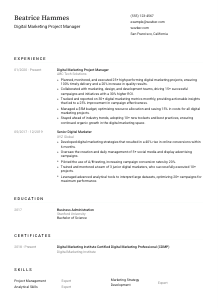
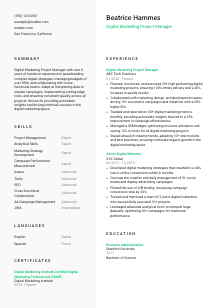
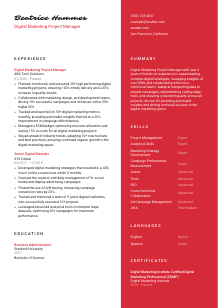
Driving online campaigns, but your resume isn't trending? Check out this Digital Marketing Project Manager resume example, created with Wozber free resume builder. It shows how to blend your project leadership with digital strategy, positioning your career as prominently as a viral post!
Digital marketing project managers sit at the point where campaign ambition meets operational discipline. Hiring teams want to see more than channel familiarity. They need proof that you can move work from brief to launch, coordinate designers and developers without slowing momentum, and keep campaign quality intact while budgets, timelines, and reporting demands stay in motion.
The first pass on your resume often comes down to whether your project scope, marketing outcomes, and tool stack are easy to trace. Wozber's free resume builder helps you shape that story in an ATS-friendly resume format, so terms like campaign delivery, ROI improvement, analytics reporting, and project management platforms show up clearly enough for employers to see where you can run digital programs with confidence.
For a Digital Marketing Project Manager, the top of the resume should settle the basics fast. This role depends on clear communication, organized execution, and stakeholder trust, so your contact details should look clean, current, and aligned with any logistical requirement in the posting.
Use your full name as the most visible text on the page. Keep it simple and professional. For a role that manages timelines, vendors, and campaign stakeholders, even the header should reflect order and clarity rather than decorative styling.
Place "Digital Marketing Project Manager" directly under your name when that is the role you are pursuing. Matching the target title helps recruiters and ATS tools sort your resume correctly, especially when your background includes adjacent titles such as Senior Digital Marketer, Campaign Manager, or Marketing Operations lead.
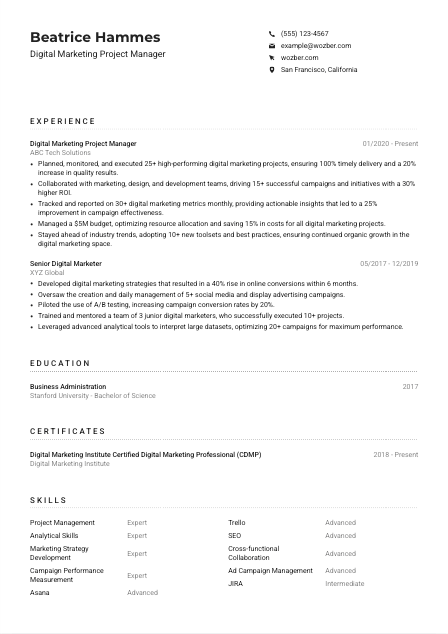
List a working phone number and a professional email address you check regularly. If the posting includes a location requirement, include your city and state here rather than leaving the employer to guess. In the example, "San Francisco, California" immediately addresses a stated requirement without taking up extra space elsewhere.
Location matters when an employer is hiring locally or expects in-office collaboration with marketing, design, and development teams. If the role specifies a city, state it plainly. If relocation is relevant, handle that in your application materials, not by cluttering the resume header.
A LinkedIn profile or personal website can strengthen this section if it supports your resume with campaign case studies, portfolio examples, or a consistent work history. For digital marketing roles, that link is most useful when it shows actual channel work, reporting fluency, or project ownership, not just another copy of your resume.
This section should confirm who you are, how to reach you, and whether any practical requirement such as location is already covered. Once that is clear, the rest of the resume can stay focused on campaign delivery and project results.




This is the section hiring managers read most closely for this role. They are looking for campaign execution, cross-functional coordination, budget control, reporting discipline, and performance improvement. Job titles matter, but the real differentiator is whether your bullets show that you managed work and improved outcomes at the same time.
Before rewriting your experience, mark the responsibilities that define success in the target role. Here, the core themes are project planning, on-time execution, cross-functional collaboration, performance reporting, budget management, and familiarity with tools like Asana, Trello, or JIRA. Those priorities should shape both which bullets you keep and how you phrase them.
Start with your current or most recent position and work backward. If you have already held a title close to the target role, give that experience the most space. In the example, leading with a Digital Marketing Project Manager role immediately establishes direct relevance before the reader reaches earlier digital marketing work.
Each bullet should show a concrete action you owned and the business result that followed. For this profession, useful verbs include planned, launched, optimized, coordinated, tracked, reported, and improved. A bullet such as managing 25+ digital marketing projects with 100% on-time delivery and a 20% quality lift works because it ties execution discipline to measurable performance.
Choose numbers that reflect how digital marketing projects are judged in practice. That can include campaign volume, ROI, conversion rate, CPA, engagement lift, delivery timelines, reporting cadence, budget size, or cost savings. The sample resume does this well with figures like a $5M budget, 30+ metrics tracked monthly, and a 30% higher ROI across campaigns.
Prioritize bullets that show project leadership inside digital marketing environments. Broad marketing wins still matter, but they should support the story of execution, optimization, and coordination. For example, A/B testing, analytics interpretation, and cross-team campaign launches all strengthen your candidacy more than unrelated general business achievements would.
Your experience section should make it easy to follow the scale of your projects, the teams you worked across, and the performance improvements you delivered. When those three points are clear, your resume reads like someone who can run digital marketing programs, not just contribute to them.
Education usually is not the most persuasive section for an experienced Digital Marketing Project Manager, but it often serves as an early screening checkpoint. Employers commonly want a bachelor's degree in marketing, business, or a related field, so this section should confirm that requirement without overexplaining it.
If the posting asks for a bachelor's degree in Marketing, Business, or a related field, list that qualification plainly. A degree such as Business Administration, Marketing, Communications, or another relevant discipline usually fits naturally, depending on the employer's wording.
Use a standard structure: degree, field of study, school, and graduation year. This makes the section easy to read in seconds, which matters when recruiters are moving quickly through multiple applicants.
When your degree connects to business analysis, marketing strategy, consumer behavior, or management, it reinforces the operational side of the role. In the example, a Bachelor of Science in Business Administration backs up the candidate's budget management and campaign planning background without needing extra explanation.
Most mid-career candidates can skip coursework unless it adds something the rest of the resume does not show. If you are earlier in your career, classes in digital analytics, marketing strategy, statistics, project management, or consumer research can help bridge experience gaps.
Honors, leadership roles, or relevant student projects are useful when they connect directly to digital marketing, analytics, or project coordination. If your professional record already shows years of campaign delivery, keep this section lean and let experience carry the weight.
For most applicants, education only needs to confirm that you meet the degree requirement and have a relevant academic base. Save the deeper story for your experience, skills, and summary.
Digital marketing changes quickly, and project managers in this space are expected to keep up with platforms, measurement practices, and execution methods. Certifications can help by showing recent learning, especially when they relate to campaign strategy, analytics, paid media, or marketing operations.
If the posting does not require a certification, include one only when it strengthens your positioning. A recognized digital marketing credential can still help by showing continued investment in the field, particularly when your recent work involves performance marketing, analytics, or multi-channel planning.
Lead with credentials that connect to how digital marketing projects are run and measured. Certifications in digital marketing, analytics, paid media, SEO, CRM platforms, or project management are usually more relevant here than broad general business courses.
List the certification name, issuing organization, and the active or earned date. Recency matters because tools, ad platforms, attribution models, and reporting practices evolve fast. The example's CDMP credential works because it is both recognizable and current enough to support ongoing professional development.
Use this section to reflect the pace of the field. If you regularly update your knowledge in campaign analytics, automation, testing, or workflow management, your certifications can reinforce the idea that you are not relying on outdated channel knowledge or stale reporting habits.
A focused certification section tells employers that your knowledge is current in a field where tools, benchmarks, and best practices move quickly. Keep it relevant to campaign execution and performance management.
A Digital Marketing Project Manager needs a blend of marketing fluency, operational control, and reporting discipline. Your skills section should reflect that mix clearly enough for both recruiters and ATS systems to recognize the kind of work you can lead.
Pull the core requirements directly from the job description first. In this case, that includes project management, analytics, campaign optimization, and familiarity with platforms such as Asana, Trello, or JIRA. Those should appear before secondary skills because they are central to the role's day-to-day execution.
If your resume format uses ratings, keep them believable and easy to scan. Labels such as Expert or Advanced can work when they match the depth shown in your experience. For example, rating yourself highly in Project Management and Analytical Skills makes sense only if your bullets also show budget ownership, monthly reporting, optimization decisions, and campaign delivery at scale.
Do not fill this section with platforms alone. Pair systems knowledge with capabilities such as cross-functional collaboration, marketing strategy development, campaign performance measurement, SEO, paid media coordination, or stakeholder communication. The sample resume gets this balance right by combining software like Asana and Trello with execution skills tied to real marketing workflows.
Your skills list should read like the toolkit of someone who can keep digital marketing work moving, measured, and aligned across teams. Every item should connect back to how you plan, execute, or optimize campaigns.
Digital marketing project management is communication-heavy work. Briefs, timelines, client or stakeholder updates, performance reporting, and cross-functional coordination all depend on clear language. If a posting calls out English literacy, make that easy to find.
List English prominently when the job specifies strong English literacy. That requirement often reflects the writing demands of campaign briefs, performance summaries, and stakeholder communication, not just conversational ability.
Additional languages can strengthen your profile when the company works across regions, multilingual audiences, or international campaign teams. Spanish, for example, may be useful in customer-facing marketing environments, but it should remain secondary to the core job requirements unless the posting emphasizes it.
Choose simple proficiency terms such as Native, Fluent, Intermediate, or Basic. These are easier to scan than vague descriptions and help employers understand whether your language skills are useful for presentations, reporting, localization review, or stakeholder collaboration.
For most Digital Marketing Project Manager roles, languages are a supporting detail rather than a deciding factor. Include them when they add context, but do not let them crowd out space needed for campaign results, analytics, or project leadership.
This section should quickly confirm that you can handle the communication demands of the role and, where relevant, support broader market reach. Keep it concise and credible.
Your summary should quickly connect your years of experience with the kind of digital marketing programs you manage. It is most effective when it combines role identity, project scope, and measurable outcomes in a few clean lines rather than offering a generic statement about being results-driven.
Look at the posting and identify the two or three points that matter most. Here, that means digital marketing project leadership, performance analysis, cross-functional coordination, and budget or timeline control. Build your summary around that mix instead of trying to mention every skill you have.
Start with a direct line that names your profession and level, such as a Digital Marketing Project Manager with 6+ years of experience in campaign execution and optimization. This gives immediate context and helps distinguish you from candidates who have only channel-specialist backgrounds.
Follow with one or two specifics that show the level at which you operate. Budget ownership, campaign volume, conversion improvement, ROI gains, or reporting leadership all work well here. The example summary uses budget scale, cross-functional collaboration, and data-driven improvement to establish credibility quickly.
Close with the pattern of value you bring, such as improving campaign effectiveness, keeping projects on schedule, or translating analytics into better marketing decisions. Keep it concise. A summary should set the frame for the resume, not repeat the whole experience section.
A strong summary tells the reader, within a few seconds, what kind of digital marketing work you lead and how you improve it. When written well, it positions the rest of the resume around execution quality, performance insight, and dependable project ownership.
A Digital Marketing Project Manager resume should make one thing unmistakable: you can organize complex campaign work, keep cross-functional teams moving, and improve results through data-informed decisions. When your title, metrics, tools, and delivery record align with the target posting, hiring teams can see that quickly.
Use Wozber's free resume builder to tighten structure, sharpen role-specific language, and improve ATS optimization with a cleaner presentation of your project scope and marketing results. The goal is an ATS-compliant resume that shows you can manage digital execution with the same discipline you bring to live campaigns.




