



Use Wozber and land your dream job
Create Resume
No registration required
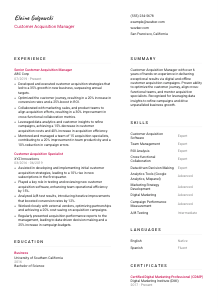
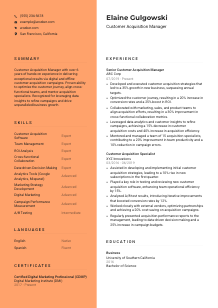
Adding up customer wins, but your resume is struggling to convert? Check out this Customer Acquisition Manager resume example, built with Wozber free resume builder. Learn how to align your acquisition expertise with job requirements, ensuring your career keeps bringing in new leads and loyal fans!
Customer acquisition leaders are hired to turn strategy into measurable pipeline. A resume for this role needs to show how you find new customers, improve conversion across the funnel, and keep acquisition spend tied to revenue goals. Hiring teams want to see commercial judgment in action, not broad marketing language.
Resume tailoring changes which part of your background gets noticed first. When the wording reflects acquisition targets, conversion work, ROI analysis, and team leadership, your profile is easier to rank in ATS screening and easier to read as a direct match for growth-focused openings. Wozber's free resume builder helps structure that alignment in an ATS-friendly resume format, so the hiring team can quickly see your ability to scale campaigns and lead acquisition performance.
This section is simple, but it still carries hiring value. For a Customer Acquisition Manager, clear personal details show professional polish and remove friction around contact, location, and role alignment before the reader reaches your campaign results.
Place your full name at the top in a clean, readable format. Keep it slightly more prominent than the rest of the header so your resume feels organized from the first line, much like a well-structured acquisition dashboard that surfaces the right information first.
Use the job title "Customer Acquisition Manager" directly under your name when that is the role you are pursuing. This creates immediate alignment with the posting and helps frame your background around acquisition strategy, conversion improvement, and team oversight instead of general marketing or sales support.
List a reliable phone number and a professional email address, ideally based on your name. Avoid unnecessary extras. The hiring team should be able to contact you as easily as they should be able to read your campaign metrics and management scope.
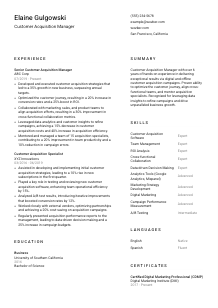
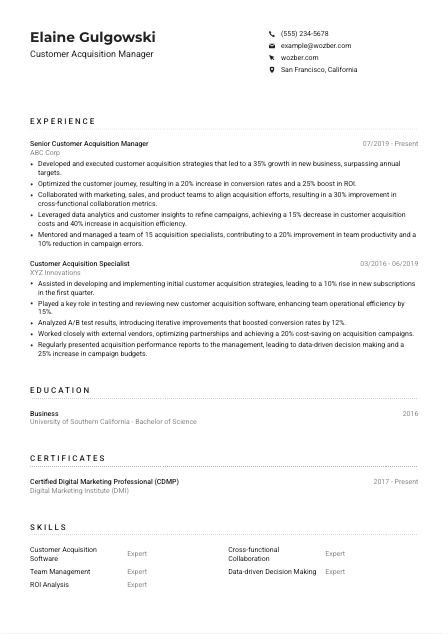
If a role includes a location requirement, show it clearly in your header. Here, listing San Francisco, California directly addresses the stated requirement and avoids questions about relocation or local availability. Use location this way when it helps remove a screening barrier, not as a filler detail.
Include LinkedIn or a professional website if it supports your candidacy with consistent information. For this profession, that might mean a profile that reinforces growth results, channel expertise, leadership progression, or tools used for reporting and analytics. If the link adds no value, leave it out.
Your personal details should confirm that you are reachable, professionally presented, and aligned with the opening from the start. In a role centered on growth performance, even the header should feel deliberate and easy to scan.




This is the section that carries the most weight for a Customer Acquisition Manager. Hiring teams look for channel strategy, funnel improvements, budget efficiency, and leadership outcomes. Your experience should show what you owned, how you optimized it, and what changed because of your work.
Start by identifying the few responsibilities that define the role. In this case, those include building acquisition strategy, improving the customer journey, refining campaigns through data, and managing specialists. Use those priorities to decide which achievements belong near the top of each role and which older bullets can be cut.
List positions in reverse chronological order and make the progression visible. For acquisition roles, that usually means moving from execution and testing into ownership of strategy, channel mix, budget efficiency, and team management. The sample resume does this well by moving from specialist-level support and A/B testing into senior ownership of acquisition strategy and team leadership.
Customer acquisition work is measured through outcomes, so your bullets should be as well. Use metrics tied to new business growth, conversion rate, customer acquisition cost, ROI, subscription growth, or team productivity. The example uses strong numbers such as 35% growth in new business, a 20% increase in conversion rates, and a 15% reduction in acquisition costs. Those figures quickly show commercial impact.
Go beyond saying you "managed campaigns." Specify whether you optimized digital and offline acquisition efforts, improved touchpoints in the customer journey, ran A/B tests, refined targeting based on customer insights, or aligned programs with sales and product teams. That is the level of detail that distinguishes a growth operator from a general marketer.
Prioritize achievements that support customer growth, conversion, analytics, and team leadership. If an older bullet does not help prove those strengths, replace it with one that does. A hiring manager filling an acquisition leadership role needs to see performance management, funnel thinking, and decision-making tied to revenue goals, not a broad list of unrelated marketing tasks.
Your experience section should read like a history of acquisition wins. When each bullet connects strategy, execution, and results, the hiring team can quickly see how you would contribute to growth targets, conversion performance, and team output.
Education usually will not outweigh acquisition results, but it still matters because many Customer Acquisition Manager postings set a degree as a screening requirement. Present it clearly so the reader can confirm the academic foundation and move on to your growth record.
If the posting asks for a bachelor's degree in Business, Marketing, or a related field, make sure your degree is easy to find. This role specifically asks for that background, so your Education section should confirm it without making the reader search for it.
List the institution, degree, field of study, and graduation year in a straightforward order. That is usually enough for experienced acquisition professionals. The sample format of school, degree, field, and year works well because it keeps the section scannable.
Use the exact name of your degree and concentration. If you earned a Bachelor of Science in Business, write it that way rather than simplifying or paraphrasing it. Accurate wording helps with both ATS matching and human review when degree requirements are explicit.
Most mid-career candidates do not need course lists, but they can help if they directly support the role. Subjects like consumer behavior, digital marketing, analytics, statistics, or sales strategy can add context when your early experience is lighter or your degree field is adjacent rather than direct.
Honors, scholarships, leadership roles, or relevant student projects can be worth listing if they reinforce analytical ability, commercial thinking, or leadership potential. Keep them brief. Once you have several years of acquisition work, academic details should support the story, not compete with your results.
For this profession, education mainly confirms you meet the stated baseline. Present it cleanly, match the required field where applicable, and let your experience carry the heavier proof of acquisition performance.
Certifications are useful when they sharpen your profile in digital marketing, analytics, optimization, or growth strategy. They matter most when they add current, role-relevant expertise beyond your degree and work history.
List certifications that strengthen your relevance to growth, campaign performance, analytics, conversion optimization, or digital marketing. A credential such as Certified Digital Marketing Professional fits naturally because it reinforces skills used in customer acquisition planning and execution.
A short list of certifications connected to acquisition strategy or measurement is stronger than a long list of loosely related courses. Prioritize credentials that support the responsibilities in the posting, especially if the role emphasizes campaign management, software proficiency, or analytical decision-making.
Dates help the reader judge how current the credential is, especially in areas shaped by changing platforms, privacy rules, attribution methods, and analytics practices. If the certification is active or renewed, show that clearly, as in the sample's continuing certification period.
For a Customer Acquisition Manager, ongoing learning suggests you stay current on channel shifts, optimization methods, and measurement frameworks. That matters when the role involves refining campaigns, improving ROI, and guiding specialists who rely on current best practices.
Certifications should support the story your experience already tells. When they are relevant and current, they strengthen your profile as someone who keeps acquisition strategy and measurement skills up to date.
A Customer Acquisition Manager needs a mix of performance marketing knowledge, analytical fluency, and people leadership. Your skills section should reflect that mix clearly enough for both ATS filters and hiring managers scanning for the tools and capabilities that drive customer growth.
Pull out direct skill requirements from the job description before writing this section. Here, the important cues include customer acquisition software, analytics tools, communication, and team management. Those terms give you a grounded starting point instead of a generic list of marketing skills.
Put the most role-relevant skills first. For this kind of opening, that often includes acquisition strategy, ROI analysis, conversion optimization, customer journey improvement, analytics platforms, cross-functional collaboration, and team leadership. The sample resume handles this well by placing customer acquisition software, team management, and ROI analysis near the top.
Do not overload this area with every platform or soft skill you have used. Choose skills that support the actual responsibilities of the role and that you can back up in your experience section. If you mention tools like Google Analytics or Mixpanel, make sure your bullets also show how you used data from them to improve campaign results or reduce acquisition costs.
Your skills section should quickly confirm your working toolkit. When it mirrors the job description and aligns with the results in your experience bullets, it strengthens both ATS alignment and the reader's confidence in your acquisition range.
Language skills matter here mainly as a communication requirement rather than a headline differentiator. For Customer Acquisition Managers, clear English communication supports reporting, cross-functional work, vendor coordination, and team management, so list languages in a way that is accurate and easy to scan.
If the job description explicitly requires English, list it first with an honest proficiency level. This role does, so English should appear prominently and clearly reflect your ability to communicate in meetings, reports, presentations, and day-to-day collaboration.
Use a clear label such as "Native" or "Fluent" for the language the employer expects you to use professionally. That removes uncertainty and helps the hiring team move on to the substance of your acquisition background.
Additional languages can be valuable when they help with audience insight, regional coordination, or customer communication. Spanish, for example, may broaden usefulness in certain markets, but it should remain secondary unless the role specifically calls for it.
Choose familiar levels such as Native, Fluent, Intermediate, or Basic. These are easy to interpret and better than vague phrases. Accuracy matters, especially in a management role where communication with internal teams and external partners is part of the work.
Treat language skills as functional business tools. For this profession, they can support collaboration across teams, clearer outreach in diverse markets, or stronger communication with vendors and stakeholders. Include them when they add real value, not just extra content.
For this role, the main goal is simple. Make it easy to confirm that you can communicate effectively in English, then include any additional languages that genuinely expand your usefulness in customer acquisition work.
The summary should quickly frame the kind of acquisition professional you are. In a few lines, it needs to establish experience level, growth focus, and the strengths that make you credible for owning strategy, conversion performance, and team results.
Before writing, identify the themes that appear repeatedly in the posting. Here, that includes acquisition strategy, campaign execution across channels, customer journey optimization, data-driven refinement, and team management. Those themes should shape the language of your summary.
Start with a direct statement that names your profession and years of experience. A line such as "Customer Acquisition Manager with 6+ years of experience" works because it immediately establishes seniority and relevance without wasting space.
Use the next sentence or two to connect your background to the role's priorities. Highlight outcomes such as driving new business, improving conversion rates, optimizing ROI, or leading acquisition specialists. The sample summary is effective because it pairs years of experience with customer journey optimization, cross-functional alignment, and data-informed campaign refinement.
Aim for three to five sentences with concrete language. Avoid broad claims about being results-driven or strategic unless you attach them to acquisition work, such as digital and offline campaigns, conversion improvement, CAC reduction, or team leadership. This section should read like an executive snapshot, not a paragraph of general traits.
A strong summary lets the hiring team understand your acquisition scope within seconds. When it combines experience level, growth outcomes, and leadership focus, it sets up the rest of the resume to confirm that impression.
A Customer Acquisition Manager resume should make one thing easy to judge. Can you build programs that bring in new customers efficiently, improve conversion performance, and guide a team toward clear acquisition targets?
Use Wozber's free resume builder to shape those wins into an ATS-compliant resume, refine your wording with AI support, and keep every section aligned with the job description. The finished document should present your growth record, analytical range, and leadership scope with the same discipline you bring to acquisition strategy.