



Use Wozber and land your dream job
Create Resume
No registration required
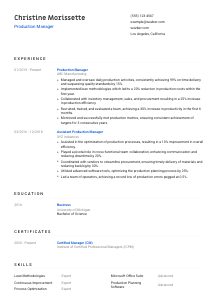
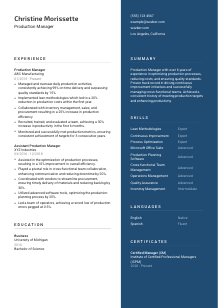
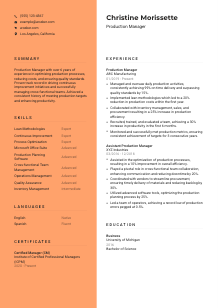
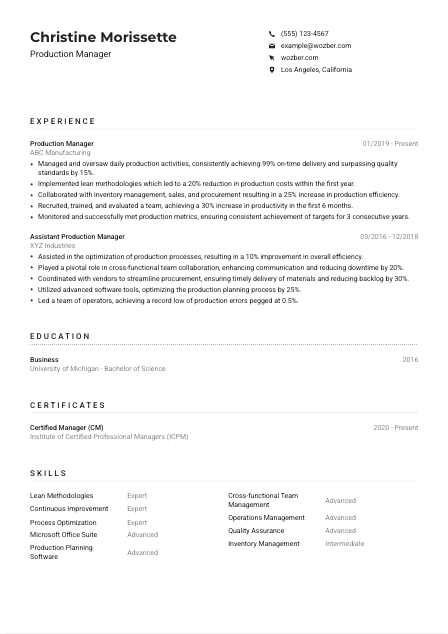
Calling the shots on the production floor, but your resume seems like a final cut gone wrong? Check out this Production Manager resume example, created with Wozber free resume builder. It shows how to smoothly bring your manufacturing mastery in line with job requirements, ensuring your career path hits box office blockbuster status every time!
Production managers are hired to keep output moving without letting quality, cost, labor, or delivery slip. A resume for this role needs to show command of the production floor, steady decision-making under schedule pressure, and a record of improving throughput, scrap, downtime, or cost through better process control.
When your resume mirrors the language of the job description, hiring teams can quickly connect your background to production planning, lean improvement, team supervision, and KPI reporting. Wozber's free resume builder helps shape that alignment into an ATS-compliant resume, so core qualifications such as plant leadership, cross-functional coordination, and measurable production results are easy to pick up early.
This section is straightforward, but it still needs to reflect how production roles are screened. Plant and manufacturing employers often move quickly when they can see the candidate's title, location, and contact details without hunting for them.
Use your full name in the largest text on the page so it is immediately identifiable. Keep the formatting clean and professional, the same way you would present a production report or shift summary.
Place "Production Manager" directly under your name if that is the role you are pursuing. This creates immediate alignment with the posting and helps both ATS software and hiring managers place you in the right operations track.
Include a current phone number and a professional email address. In plant operations hiring, interview scheduling often moves fast, so accuracy matters as much as presentation.
If the employer requests a specific location, show it in this section. In the example, listing Los Angeles, California directly addresses the stated requirement and removes a common screening question before it comes up.
Include LinkedIn or a professional website only if it supports your operations background with consistent job history, leadership scope, or project detail. For a Production Manager, that usually means reinforcing plant leadership and process improvement work, not adding extra clutter.
Keep the details clean, accurate, and aligned with the posting. For a Production Manager application, this section should quickly confirm who you are, what role you do, and whether any location requirement is already covered.




The experience section carries the most weight for a Production Manager. Hiring teams want to see what kind of operation you ran, what standards you were accountable for, and how your decisions affected delivery, labor, quality, and cost.
Before writing bullets, identify the work the employer is actually hiring for. In this posting, the clearest priorities are daily production oversight, lean improvement, cross-functional coordination, staff management, and production metric reporting. Those themes should guide which achievements you feature first.
List your most recent manufacturing and production roles first, with job title, company, and dates clearly shown. For management positions, make it easy to see your progression from line supervision or assistant management into broader plant or production leadership responsibility.
Focus each bullet on what you owned and what changed because of your work. The sample resume does this well with results like 99% on-time delivery, quality performance above target, and sustained target achievement over multiple years. That kind of phrasing shows control over the operation, not just participation in it.
Numbers are especially persuasive in manufacturing because they reflect the language of the job. Prioritize measures such as on-time delivery, cost reduction, uptime, downtime reduction, productivity gains, defect rate, backlog reduction, scrap, or planning efficiency. A bullet about cutting production costs by 20% or improving efficiency by 25% is much stronger than saying you "supported improvement initiatives."
Trim accomplishments that do not support your case for running a production operation. The best bullets show scheduling, staffing, process improvement, quality control, inventory coordination, procurement alignment, or corrective action tied to KPIs. Relevance matters more than volume.
Your experience section should make it easy to picture you running the floor, leading supervisors or operators, and improving results under real production targets. If the bullets show ownership, metrics, and operational scope, this section is doing its job.
Education is usually a supporting section for experienced Production Managers, but it still needs to answer the job posting cleanly. Employers often use it as a quick qualification check before they move on to leadership history and manufacturing results.
If the posting asks for a bachelor's degree in Business, Engineering, or a related field, list your degree in a way that makes that match obvious. In the example, "Bachelor of Science in Business" lines up neatly with the stated requirement.
Use a consistent structure with degree, field of study, school, and graduation year. Production hiring teams do not need excess detail here. They need to confirm the credential quickly and move back to your operating experience.
Avoid vague abbreviations if they make the qualification less clear. Spell out the degree and field so the connection to business, engineering, operations, or a related discipline is immediate.
Relevant coursework can help if you are earlier in your career or moving into production management from another area. Courses in operations management, supply chain, quality systems, industrial engineering, or process improvement are more useful than generic academic detail.
Honors, capstone projects, or leadership activities are worth adding only if they reinforce operations, process, or team leadership. For an experienced candidate, keep this concise so the resume stays focused on plant performance and management scope.
Make the degree requirement easy to confirm and keep the focus on relevance. For a Production Manager, education should support the application without competing with the experience section.
Certifications are not always mandatory in production management, but the right ones can strengthen your profile, especially when they relate to leadership, lean systems, quality, or continuous improvement. They are most useful when they support the kind of operation you are applying to lead.
Prioritize credentials tied to manufacturing leadership, lean practices, quality systems, safety, or operations improvement. A management credential such as the Certified Manager shown in the example adds weight because the role includes supervising teams and driving performance.
If the employer emphasizes lean methodologies, process improvement, or team leadership, highlight certifications that support those areas first. This keeps the section aligned with the responsibilities instead of reading like a general professional development list.
Show when the certification was earned and whether it is current, especially if the credential requires maintenance. Current dates suggest that your methods and managerial training are still active and relevant to today's production environment.
Production management changes with new planning systems, quality expectations, and continuous improvement practices. Ongoing certification in lean, Six Sigma, safety, or supervisory development shows that you keep sharpening the skills used on the floor and in reporting meetings.
List certifications that strengthen your case as a production leader, not just as a learner. The section works best when each credential connects clearly to plant operations, team management, or process improvement.
A Production Manager skills section should read like the toolkit of someone who can run output, solve bottlenecks, and lead people through changing production demands. Balance systems knowledge with operational leadership and process discipline.
Read the job description for technical and leadership terms that should appear in your resume if they reflect your background. Here, lean methodologies, process improvement, production planning software, Microsoft Office, communication, and cross-functional leadership are all clear signals.
Put the most role-relevant skills first. For this kind of position, that usually means lean methodologies, continuous improvement, process optimization, quality assurance, production planning, operations management, and team leadership. The example skill list works because it stays close to the responsibilities named in the posting.
Do not overload this section with every tool or trait you have ever used. Group skills around the real work of the role, such as production systems, quality and efficiency, planning and reporting, and people leadership. This improves ATS optimization and makes your strengths easier to read in one pass.
This section should confirm that you have the methods, systems knowledge, and leadership range to manage output and improve performance. If the list mirrors the language of the role and reflects your actual background, it is doing useful work.
Language ability is usually a secondary section for Production Managers, but it can matter in plants where supervisors, operators, vendors, and cross-functional teams work across different language backgrounds. Use it to support communication strength, not to fill space.
If the posting states English mastery, list English with an accurate proficiency level. That immediately addresses a stated requirement and supports the communication side of production leadership, from shift direction to reporting.
Include other languages when they are relevant to workforce communication, supplier coordination, or the market you work in. In the example, Spanish is a useful addition because it can support day-to-day communication in many manufacturing environments, though it is not a universal requirement.
Extra languages can strengthen your profile if they help with team supervision, training, or cross-functional coordination. If they are not relevant to the work environment, it is fine to keep this section minimal.
Use clear labels such as Native, Fluent, Professional, or Basic. Production managers often need to give instructions, handle escalation, and document issues accurately, so your level should reflect what you can genuinely do in the workplace.
When useful, language skills can support safer training, smoother shift handoffs, better vendor interaction, and stronger team management. Present them as practical operating strengths rather than general personal traits.
Language skills should support your ability to lead, coordinate, and communicate in the production environment. Keep the section honest and relevant to the teams and workflows you are likely to manage.
The summary is where you establish your operating level in a few lines. For a Production Manager, that means quickly showing years of experience, manufacturing scope, improvement work, and leadership results without drifting into vague claims.
Focus on the capabilities that define successful production leadership: managing daily output, improving process flow, maintaining quality standards, controlling costs, and leading teams. Your summary should sound like someone who understands production pressure and responds with structure.
Lead with your role and your years of experience, as in the example's "Production Manager with over 6 years of experience." That instantly sets your level and helps the reader place your background before they reach the experience section.
Use the summary to reflect the most important requirements from the posting, especially lean implementation, continuous improvement, team leadership, and hitting production targets. Keep the wording natural and rooted in work you have actually done.
Aim for 3 to 5 lines with real operational substance. Mention process optimization, cost reduction, quality performance, planning, or productivity gains rather than generic strengths. A concise summary with role-specific language gives the rest of the resume a sharper frame.
By the end of the summary, the reader should already understand your level, your manufacturing focus, and the results you tend to deliver. That sets up the rest of the resume to confirm you can lead production with discipline and measurable impact.
A Production Manager resume works when every section points back to the realities of the job: output, quality, cost control, planning, team leadership, and continuous improvement. Keep the language close to the posting, use metrics that belong in manufacturing, and make your management scope easy to read.
Wozber's free resume builder, ATS-friendly resume templates, and ATS resume scanner can help you tailor each section around the right terminology and present it in an ATS-friendly resume format. The final document should make one thing clear fast: you can run production, improve processes, and keep targets on track.




