



Use Wozber and land your dream job
Create Resume
No registration required
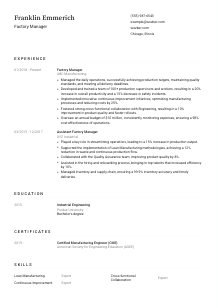
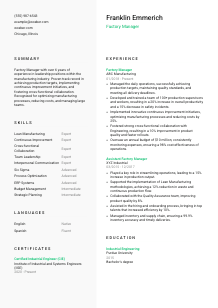
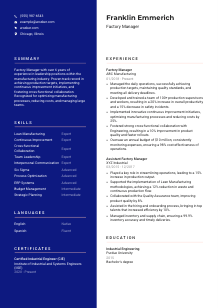
Steering production lines, but your resume isn't putting in overtime? Check out this Factory Manager resume example, created with Wozber free resume builder. Learn how to match your plant leadership skills to job specs, crafting a career narrative that runs as smoothly as your most efficient assembly line!
Factory leadership sits at the intersection of output, quality, safety, and cost. A Factory Manager resume has to show that you can keep production moving, improve the process behind it, and lead supervisors and operators without losing control of standards on the floor.
When that experience is tailored well, hiring teams can quickly distinguish plant leadership from broader operations management. Wozber's free resume builder helps shape an ATS-friendly resume format around the language used in the posting, so your background in continuous improvement, budget control, and cross-functional manufacturing work is easier to surface early.
This section is brief, but it still affects how smoothly your application moves forward. For a Factory Manager role, your header should make it easy to contact you, confirm your target role, and address any practical requirement that could affect site leadership availability.
Use your full name in a clean, readable format so it stands out immediately above the rest of the resume. Hiring teams reviewing plant leadership resumes often move quickly, so your header should feel straightforward and professional from the first line.
Place "Factory Manager" directly under your name if that is the role you are targeting. This creates instant alignment with the vacancy and helps frame your background around plant operations, team supervision, production targets, and manufacturing performance rather than a broader management label.
Include a professional email address and a phone number you actually answer. Check for errors carefully. A missed digit or typo can stall an interview request just as easily as a missed handoff can disrupt a production schedule.
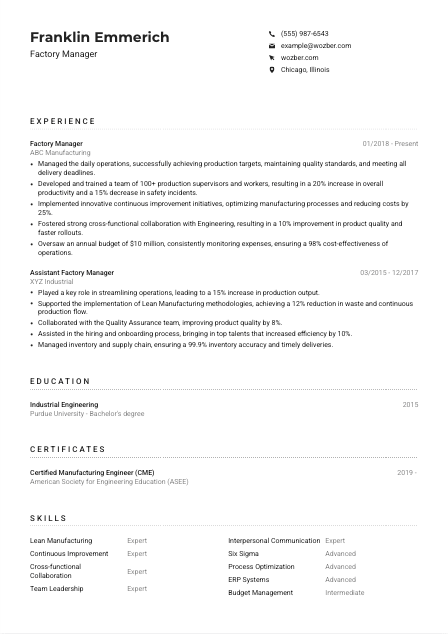
If the employer specifies a site location or relocation expectation, include your city and state clearly. In this example, listing Chicago, Illinois directly supports the requirement and removes uncertainty about whether you can be on-site where the factory operates.
If you include LinkedIn or a professional website, make sure it reflects your manufacturing leadership record. Project consistency across your resume and online presence by showing the same titles, dates, and operational achievements such as cost reduction, productivity gains, or process improvement work.
Your personal details should answer the basic operational questions fast: who you are, what role you are pursuing, how to reach you, and whether location is already resolved. That keeps attention on your plant leadership experience, where it belongs.




This is the section that carries the most weight for a Factory Manager. Employers want to see what kind of operation you led, how you improved throughput or quality, how you managed supervisors and production teams, and what results followed from your decisions.
Start by identifying the operational themes in the description. For Factory Manager roles, that usually means production targets, quality standards, delivery performance, safety, cost control, team development, and continuous improvement. In the example posting, Lean Manufacturing, Six Sigma, cross-functional work, and budget ownership are clear priorities, so those ideas should appear naturally in your experience bullets where they reflect real work.
List roles in reverse chronological order and make the leadership path easy to follow. Titles such as Factory Manager, Assistant Factory Manager, Production Manager, or Operations Supervisor help recruiters understand the scale and maturity of your plant experience quickly. Include company name, title, and dates without clutter.
Under each role, focus on what changed because of your leadership. Good bullets show actions tied to manufacturing results: improved line efficiency, lower scrap, better on-time delivery, stronger safety performance, fewer bottlenecks, or tighter budget control. The sample resume does this well by pairing process improvement work with a 25% cost reduction and linking team development to a 20% productivity increase.
Metrics are especially persuasive in manufacturing because the work is measured constantly. Use figures tied to output, downtime, waste, safety incidents, labor productivity, inventory accuracy, defect rates, or annual budget scope. Managing a team of 100+ employees or a $10 million budget, as shown in the example, gives real context to leadership scope that generic claims cannot match.
Edit aggressively so the section stays focused on factory leadership. Prioritize achievements involving production management, continuous improvement, team supervision, engineering or QA coordination, supply chain support, and cost-effective operations. If a bullet does not help explain how you run or improve a manufacturing environment, it is probably taking space from stronger evidence.
By the end of this section, the reader should understand the scale of the operation you handled, the improvements you delivered, and how you led people and processes under real production pressure. That is the core of a credible Factory Manager resume.
Education matters here because it often signals technical grounding in process, systems, and industrial decision-making. For a Factory Manager, the degree usually supports the story your experience already tells about manufacturing knowledge and operational judgment.
Put the most relevant degree first, especially if the employer asks for a bachelor's degree in Engineering, Business Management, or a related field. Degrees in industrial, mechanical, manufacturing, or operations-focused disciplines are often especially relevant because they connect naturally to process improvement and plant performance.
List the institution, degree, field of study, and graduation year or date. Keep it simple. Factory leadership resumes are usually read for operational substance, so the education section should be easy to scan without extra formatting or unnecessary detail.
If your degree directly reflects a stated requirement, do not bury it. In the example, a bachelor's degree in Industrial Engineering maps neatly to the employer's preference for an engineering-related background and reinforces the candidate's process improvement credibility.
Early-career candidates can mention relevant coursework in areas such as operations management, quality systems, supply chain, or production planning. For experienced Factory Managers, that space is usually better used on work results unless the coursework is unusually relevant to the target industry or plant environment.
Honors, capstone projects, or research can be worth including if they connect to manufacturing systems, industrial engineering, or leadership potential. Keep this brief. Once you have years of plant leadership experience, academic extras should support the story, not compete with your operating record.
Your education section should confirm that you have the technical or business foundation the role calls for. Keep it concise, relevant, and easy to connect to the manufacturing work described elsewhere on the resume.
Certifications can add useful weight to a Factory Manager resume, especially when they support continuous improvement, industrial engineering, quality, or manufacturing leadership. They are most valuable when they reinforce the exact methods and standards the employer already cares about.
Review the job description for preferred credentials and list the ones that align most closely. Here, certifications related to manufacturing or industrial engineering deserve priority because the employer explicitly mentions them. The same applies to Lean, Six Sigma, or other process-improvement credentials when those methodologies appear in the role requirements.
A shorter list of well-matched certifications is usually more effective than a long list of loosely related courses. For Factory Manager roles, credentials that support plant efficiency, quality improvement, engineering judgment, or operational leadership carry more weight than general training certificates.
If a certification is current, recently earned, or requires active status, include the date or validity period. That helps show you are up to date with current manufacturing practices and continuous improvement frameworks rather than relying on old credentials with unclear standing.
Manufacturing environments keep changing through automation, process redesign, quality expectations, and cost pressure. Keeping certifications current in areas such as Lean Manufacturing, Six Sigma, industrial engineering, or safety systems shows that your management approach evolves with the operation.
This section should reinforce your command of the systems and methodologies behind efficient factory performance. The best certifications strengthen your case as someone who can improve output, control waste, and lead a disciplined operation.
A Factory Manager skill list should reflect how the plant runs and how improvement happens. That means balancing technical methods, people leadership, and the cross-functional coordination needed to keep production, quality, maintenance, and supply moving together.
Read the job description for both stated and implied capabilities. In this example, Lean Manufacturing, Six Sigma, communication, team leadership, cross-functional collaboration, and continuous improvement are all clearly relevant. Also consider adjacent skills the work depends on, such as process optimization, production planning, ERP familiarity, budget management, and safety oversight if they match your background.
Choose skills that describe how you operate in manufacturing settings. For many Factory Managers, that includes process improvement, workforce leadership, quality coordination, cost control, root-cause analysis, KPI tracking, and collaboration with engineering, QA, and supply chain teams. The sample resume is strongest where the skills support the experience rather than repeating vague leadership language.
Put the highest-priority manufacturing and leadership skills first, then follow with supporting capabilities. A good mix might start with Lean Manufacturing, Continuous Improvement, Team Leadership, Cross-functional Collaboration, and Six Sigma before moving into ERP systems, strategic planning, or budget management. Organizing the list this way helps both ATS parsing and human review focus on the most important plant-management strengths first.
Your skills section should read like the operating toolkit behind your results. If it is aligned well, a hiring manager can quickly connect your methods, leadership range, and manufacturing knowledge to the demands of the factory they need someone to run.
Language ability is rarely the headline for a Factory Manager, but it can still matter in daily operations. Clear communication affects supervisor alignment, safety instruction, training, vendor coordination, and collaboration with cross-functional partners, so list languages in a way that reflects real working ability.
If the job description names a required language, list it with an honest proficiency level. In this case, strong English communication is a stated requirement, so English should appear clearly on the resume rather than being left implied.
Other languages can be valuable if they help you lead a multilingual workforce, communicate with suppliers, or support regional operations. For example, Spanish may be useful in many manufacturing settings, but include it because you can use it on the job, not just because it looks impressive.
Use clear labels such as Native, Fluent, Intermediate, or Basic. Factory leadership depends on precise communication, so vague language ratings are less useful than straightforward descriptions of what you can actually handle in meetings, training, and daily floor communication.
Some Factory Manager positions are primarily local, while others involve global suppliers, multi-site reporting, or diverse production teams. If language skills strengthen your ability to manage those realities, include them. If not, keep the section minimal and accurate.
A second language matters most when it improves coordination, trust, and clarity in real plant settings. That could mean smoother onboarding, clearer safety communication, or fewer misunderstandings with partners across functions or regions. Keep the emphasis practical.
List language skills when they support communication on the floor or across the supply chain. For Factory Manager roles, accuracy matters more than variety. The section should help the employer understand how well you can lead, instruct, and coordinate.
The summary sits at the top of the resume and shapes how the rest of your background is read. For a Factory Manager, it should quickly establish your manufacturing leadership level, your operating strengths, and the kind of measurable plant results that follow from your management.
Before writing, identify the few themes the employer cares about most. In this posting, those include production performance, continuous improvement, team leadership, cross-functional coordination, and cost control. Let those priorities guide what appears in the opening lines instead of writing a generic management profile.
Open with your years of experience and the environment you have led. A line such as "Factory Manager with 6+ years of manufacturing leadership experience" works because it immediately places you in the right setting. If you have managed multi-shift production, large headcount, or high-volume operations, that can also be worth referencing briefly.
Include two or three specific strengths that match the job, such as hitting production targets, reducing costs through process improvement, leading Lean initiatives, or partnering with engineering and QA to improve quality. The sample summary works because it ties leadership to outcomes like process optimization and cross-functional execution, rather than staying at the level of broad traits.
Aim for a short paragraph of about 3 to 5 lines. Use enough detail to show operational credibility, but not so much that it starts duplicating the experience section. A few well-chosen facts, methods, and outcomes will do more than a long list of manufacturing buzzwords.
After reading the summary, the employer should already understand your level, your plant-management strengths, and the kind of operational results you deliver. That gives the rest of the resume a clear frame and makes your experience easier to evaluate.
A Factory Manager resume works when it makes your leadership visible in production terms: output, quality, safety, cost, team development, and process improvement. Every section should support that picture, from the title under your name to the metrics in your experience bullets.
Use Wozber's free resume builder to organize that story in an ATS-compliant resume, then refine it with the ATS resume scanner so the language matches the role you are targeting. The finished resume should make one thing easy to judge: whether you can step into a manufacturing operation and run it well from day one.




