



Use Wozber and land your dream job
Create Resume
No registration required
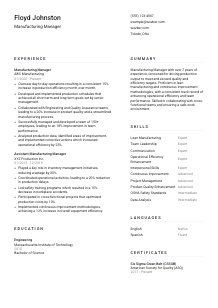
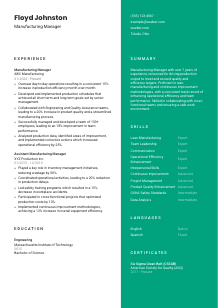
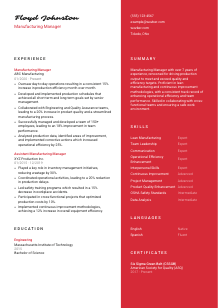
Managing production, but your resume gets stuck on an assembly line? Explore this Manufacturing Manager resume example, created with Wozber free resume builder. Learn how to frame your leadership and efficiency to match job requirements, propelling your career to the forefront of industrial success!
Manufacturing managers are hired to keep production moving without letting quality, safety, or labor performance slip. A resume for this role needs to show how you run an operation in real terms: output targets met, process waste reduced, teams developed, corrective actions taken, and improvements that held up on the floor.
Hiring teams often sort manufacturing leadership candidates by operational scope very quickly. When your resume uses the same language as the posting, such as lean manufacturing, production scheduling, OSHA, quality improvement, and cross-functional work with engineering or QA, Wozber's free resume builder helps you shape that experience into an ATS-compliant resume that makes your plant leadership background easier to recognize early.
This section is brief, but it still carries hiring value. For a Manufacturing Manager, clean contact details and the right location cues remove friction immediately, especially when the employer needs someone who can step into plant leadership without relocation uncertainty or follow-up on basic logistics.
Use your full name as the clearest heading on the page. Keep it easy to scan and slightly larger than the body text so it anchors the resume without distracting from your production results, leadership history, and operational scope.
Place "Manufacturing Manager" directly under your name when that is the role you are targeting. This helps both ATS parsing and human reviewers connect your background to plant operations leadership right away, instead of making them infer it from later sections.
List a reliable phone number and a professional email address. Double-check for accuracy. If a plant leader is being considered for interviews about production targets, team oversight, or safety ownership, the contact section should never be the part that creates avoidable delays.
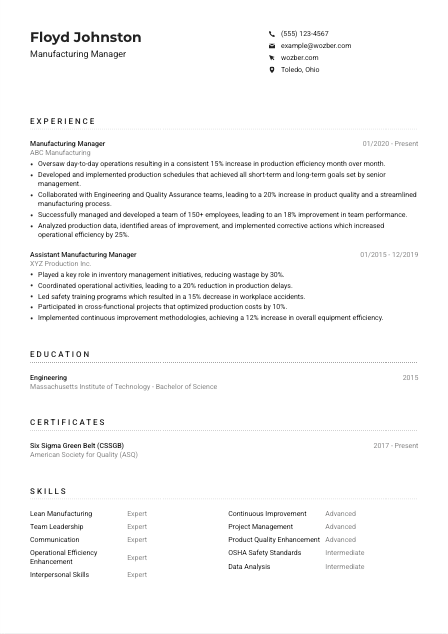
If the employer names a city or relocation expectation, include your city and state so that point is settled early. In the example, "Toledo, Ohio" directly supports a stated requirement. That does not make location critical in every Manufacturing Manager search, but when it is mentioned, address it clearly.
Include LinkedIn or a professional website if it strengthens your application. For manufacturing leadership roles, that profile should reinforce your resume with the same titles, dates, certifications, and operational accomplishments, especially if you want to show promotion history, plant size, or continuous improvement work in more depth.
This section should answer the practical questions fast: who you are, what role you are targeting, and whether basic logistics line up. Then the reader can move straight to the parts that show how you lead production.




This is the core of a Manufacturing Manager resume. Employers want to see whether you have led production in a way that improved throughput, quality, safety, cost control, or team performance, and whether you can do it across daily operations as well as longer-term process improvement work.
Start by pulling the main operational priorities from the posting and make sure your recent bullets answer them directly. If the role calls for overseeing day-to-day manufacturing operations, production scheduling, quality improvement, and corrective action, your bullets should show those exact areas with results. The example does this well with points on production efficiency, schedule delivery, quality gains, and operational efficiency improvements.
List your most recent manufacturing leadership role first, then work backward. For each position, include the company name, your title, and employment dates. In operations hiring, reviewers often want to understand progression quickly, such as moving from Assistant Manufacturing Manager into full manufacturing leadership.
Under each role, focus on what changed because of your work. Manufacturing leadership bullets should cover outcomes such as improved OEE, reduced scrap, fewer delays, stronger schedule attainment, higher first-pass yield, better labor performance, or safer operations. A bullet like "managed production staff" is weak on its own. A bullet that shows performance coaching led to an 18% team improvement says much more.
Numbers give context to manufacturing work. Include team size, production gains, downtime reduction, waste reduction, safety improvements, cost savings, or quality lift when those figures are available. In the sample resume, metrics like a 15% increase in production efficiency, 20% improvement in product quality, and responsibility for 150+ employees immediately clarify scope and impact.
Choose achievements that support this level of responsibility. Prioritize supervision of operations, lean projects, cross-functional process work, staff development, KPI analysis, and corrective action. If earlier experience includes inventory or coordination work, keep the bullets that show measurable production or efficiency value, as the assistant manager example does with reduced wastage, fewer delays, and better equipment efficiency.
Your experience section should make it easy to picture you running production, reading the data, improving the process, and leading the people involved. If those four things are clear, your resume is doing its job.
For Manufacturing Manager roles, education usually works as a baseline qualifier rather than the main selling point. It still needs to be easy to find and clearly connected to the technical side of production, process control, engineering support, or manufacturing systems.
If the posting asks for a bachelor's degree in Engineering, Manufacturing, or a related field, list that credential clearly. The example's Bachelor of Science in Engineering fits the requirement directly and removes doubt about technical foundation early in the review.
Use a straightforward entry with degree, field of study, school, and graduation year. That is the format most recruiters and ATS systems expect, and it keeps the section easy to scan while they focus on your operations background elsewhere.
For manufacturing leadership, the field of study matters because it can reinforce process knowledge, production problem-solving, and collaboration with engineering teams. If your degree is in Engineering, Manufacturing, Industrial Technology, or a related discipline, make sure that field is visible rather than buried.
Relevant coursework can help if you are early in your career or moving into manufacturing leadership from a technical path. Courses in operations management, quality systems, industrial engineering, supply chain, or safety can strengthen the section. For experienced managers, detailed coursework is usually less useful than plant results and leadership metrics.
Honors, capstone projects, or leadership roles are worth adding if they connect to manufacturing, engineering, process improvement, or team leadership. Keep them only if they support your current target role instead of distracting from hands-on production experience.
This section should confirm that you meet the stated educational bar and have the technical grounding to work credibly with production, engineering, and quality teams. Then let your experience carry the heavier weight.
In manufacturing leadership, certifications can sharpen your profile when they reinforce how you run the operation. The most useful ones usually point to continuous improvement, quality discipline, safety knowledge, or process control rather than general professional development.
Start with credentials that strengthen the employer's stated priorities. If lean manufacturing or Six Sigma appears in the posting, move those certifications to the top. The example's Six Sigma Green Belt is a strong match because it directly supports process improvement and data-driven problem solving on the production floor.
Choose certifications that help explain how you improve output, quality, safety, or consistency. Lean, Six Sigma, quality management, OSHA-related training, or industry-specific manufacturing credentials usually add more value here than unrelated coursework or broad online certificates.
Show the year earned, and include renewal or active status when relevant. This is useful for certifications tied to current methodologies, compliance expectations, or ongoing professional standing. Clear dates also help hiring teams understand how recently you have invested in process improvement training.
Manufacturing environments change with new equipment, quality requirements, automation, and safety expectations. Ongoing certification work can support moves into larger plants, multi-line oversight, or more advanced continuous improvement roles. Keep this section current so it reflects where your operational skills stand now.
Certifications should support the story already visible in your experience: that you improve processes, manage risk, and lead with discipline. When they align with the plant's operating model, they add real weight.
The skills section works best when it reads like a compact operating profile. For a Manufacturing Manager, that means balancing production leadership, process improvement, quality awareness, safety knowledge, and the people skills needed to coordinate supervisors, engineering, QA, and senior management.
Review the posting for both explicit and implied skills. In this case, lean manufacturing, continuous improvement, communication, collaboration, OSHA familiarity, data analysis, and team leadership all belong in the mix. Use the employer's terminology where it matches your actual background so the resume stays aligned in both ATS and human review.
List the capabilities you have used in plant operations, not a generic list of strengths. Useful entries include lean manufacturing, production scheduling, KPI analysis, root cause analysis, team development, quality improvement, corrective action, safety compliance, and operational efficiency. The sample skill list works because it stays close to what the job actually asks the manager to do.
Order matters. Lead with the capabilities most central to the target role, such as lean manufacturing, leadership, continuous improvement, OSHA safety standards, and cross-functional communication. That way, the first scan already tells the reader that you can run production, improve it, and manage the team around it.
This section should look like the toolkit of someone who can lead a production environment, improve performance, and work across functions without losing control of safety or quality. Keep it tight and role-specific.
Language requirements are not always a deciding factor in manufacturing hiring, but they matter when the posting states one clearly. For a Manufacturing Manager, language skills are most useful when they support team communication, training, safety instructions, vendor coordination, or work across multilingual operations.
If the posting states that English is essential, list it explicitly with an honest proficiency level. For this role, that matters because production meetings, safety documentation, coaching conversations, and cross-functional coordination all depend on clear written and spoken communication.
Additional languages can strengthen your profile when they help you lead diverse teams, communicate with suppliers, or support multi-site operations. In the example, Spanish adds useful context, though it is an advantage rather than a universal requirement for every Manufacturing Manager role.
Stick with terms such as Native, Fluent, Advanced, or Conversational. Clear labels help hiring teams understand how confidently you can use each language in meetings, training, reporting, or shop-floor communication.
If a second language has helped with onboarding, safety training, shift communication, or supplier relationships, include it. In manufacturing, language skills matter most when they improve execution, reduce misunderstandings, or support a safer and more efficient operation.
Some Manufacturing Manager jobs are local plant leadership roles with little need for extra language depth. Others involve global suppliers, multilingual labor forces, or international reporting lines. Let the scope of the position determine how prominent this section should be.
Keep this section practical. If language ability helps you lead teams, communicate safety expectations, or operate across a broader manufacturing network, it belongs here.
Your summary should quickly establish the kind of manufacturing leader you are. In a few lines, it needs to connect your years of experience with the production results, improvement methods, and team leadership strengths that matter most for the role you want next.
Start with your title, years of experience, and a short statement about the kind of operation you lead. The sample summary does this well by naming more than 7 years of experience and linking that background to production output, quality, and efficiency targets.
Use the next sentence or two to show what defines your work. For this role, that may include lean manufacturing, Six Sigma, production efficiency gains, team development, process streamlining, or quality improvement. Keep the claims grounded in the same themes that appear in your experience section.
Aim for 3 to 5 lines that a hiring manager can absorb quickly. This section should summarize your operational value, not repeat your whole career history. Tight writing works best here, especially for leaders whose resumes already carry detailed metrics in the experience section.
Adjust the wording so it matches the position you are applying for. If the posting emphasizes continuous improvement, OSHA awareness, cross-functional collaboration, or schedule planning, reflect those priorities naturally in the summary. That tailored opening helps frame the rest of the resume in the right context from the first few seconds.
A strong summary tells the reader what kind of manufacturing environment you have led and what results usually follow when you are in charge. Once that is clear, the rest of the resume can prove it.
A Manufacturing Manager resume should read like the profile of someone who can run the floor, improve the process, and lead the team behind the numbers. When your sections are tailored around production output, quality, safety, continuous improvement, and measurable leadership results, hiring teams can place your experience faster and more confidently.
Use Wozber's free resume builder to organize that story in an ATS-friendly resume format, then refine it with role-specific language, plant metrics, and the requirements that matter most for the job you want. The finished resume should make one thing clear: you are ready to lead manufacturing performance from day one.




