



Use Wozber and land your dream job
Create Resume
No registration required
Operating machinery, but your resume feels stuck in idle? Rev up with this Factory Worker resume example, built with Wozber free resume builder. It shows how to match your production prowess to job specifications, so your career doesn't get boxed in!
Factory work is judged in motion. Hiring teams want to see whether you can keep a line running, handle equipment safely, catch defects before they move downstream, and work steadily through repetitive, output-driven shifts. Your resume should make that operating reliability visible, with clear proof of production work, safety habits, and quality checks rather than broad claims about being hardworking.
A tailored resume changes how quickly your background reads against the role's daily demands. When your wording reflects the posting's language around machinery, quality standards, and safety protocols, an ATS-compliant resume becomes much easier to sort and prioritize for manufacturing openings. Wozber's free resume builder helps you line up those terms cleanly so the hiring team can quickly see whether you have the shop-floor experience to step in and contribute.
For factory roles, the personal details section is mostly practical. Supervisors and recruiters need to know who you are, how to reach you quickly for shift-based hiring, and whether you meet any location or communication requirements listed in the posting.
Place your full name at the top in a clear, readable format. Keep it simple and professional so it stands out immediately on a fast resume scan.
Add "Factory Worker" below your name if that is the role you are pursuing. Matching the job title helps frame the rest of the resume around production-floor work instead of more general warehouse or labor experience.
List a phone number you answer regularly and a professional email address. Manufacturing hiring often moves quickly, especially for active production needs, so missed calls or unclear contact details can slow down your application.
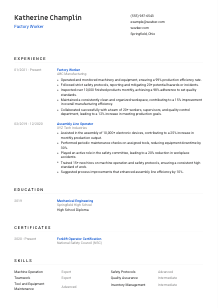
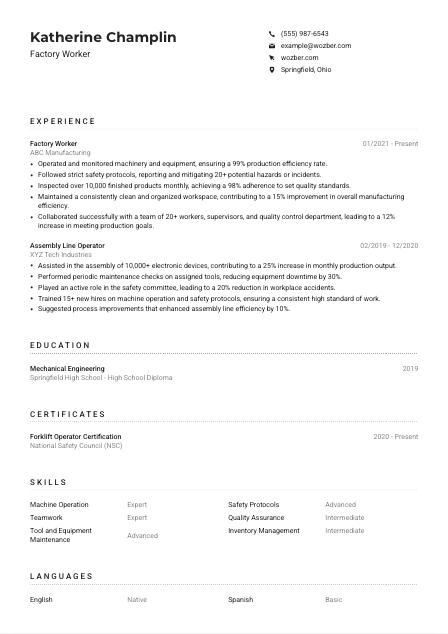
If the employer asks for candidates in a specific area, include your city and state. In the example, Springfield, Ohio is listed because the posting requires local availability or relocation. Use that kind of detail when the job posting makes location part of the screening process.
A personal website or LinkedIn profile is optional for many factory positions. Include one only if it adds useful information such as certifications, safety training, or stable work history. If it does not strengthen the application, leave it out.
This section should remove friction, not add it. Clear contact details, the right job title, and any required location information help the employer move straight to your production experience.




In manufacturing hiring, experience carries the most weight when it shows what you operated, what standards you worked to, and how your work affected output, downtime, safety, or quality. Job titles matter, but the bullets under them are what show whether you can perform in a real production environment.
Start by marking the duties and requirements that appear most often in the job ad. For a factory worker role, that usually means machine operation, monitoring equipment, following safety procedures, inspecting finished goods, keeping the area organized, and working with supervisors or quality teams. These are the points your experience section should answer directly.
List your most recent manufacturing or production work first. Include job title, employer, and dates so the reader can quickly trace how recent your shop-floor experience is and whether you meet requirements like 1+ year in a production environment.
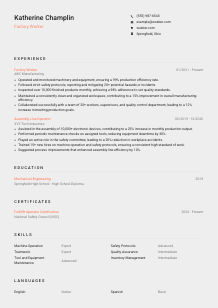
Do not stop at listing duties such as "operated machinery" or "inspected products." Show what happened because you did that work well. The example does this effectively with bullets tied to production efficiency, hazard reporting, and quality adherence, which gives much more hiring value than a plain task list.
Metrics make factory experience more credible when they reflect how the work is actually measured. Strong examples include output volume, defect rate, downtime reduction, safety incidents prevented, on-time production targets, or efficiency gains. "Inspected over 10,000 finished products monthly" and "reduced equipment downtime by 30%" are the kind of specifics that hiring managers recognize immediately.
Focus this section on work that connects directly to plant, production, assembly, packaging, maintenance support, or quality control. If you have unrelated jobs, keep them brief unless they show transferable habits such as safety compliance, pace, reliability, or team coordination under shift pressure.
The strongest experience sections show equipment use, safety discipline, quality control, and measurable output. When those points are clear, a hiring manager can picture you on the floor, not just on paper.
Education is usually a straightforward section for factory worker roles, but it still matters because many postings set a minimum credential. Present it clearly so the employer can confirm that requirement without digging.
If the posting calls for a high school diploma or equivalent, list that first and clearly. For many production roles, this is a basic qualification rather than a deciding factor, so clarity matters more than detail.
Include the school name, diploma or degree, field if relevant, and graduation year or date. Keep the structure consistent so the section is easy to scan during high-volume hiring.
If your coursework, vocational training, or school program touched mechanical systems, industrial arts, maintenance, or technical shop skills, include that when it supports your fit. In the example, the field listed adds a bit more context than a diploma alone.
Short courses in workplace safety, machine basics, quality control, or lean manufacturing can strengthen this section if you do not yet have long production experience. They help show familiarity with the environment and expectations of factory work.
If you have continued training in equipment handling, OSHA practices, or production processes, include it. Keep the focus on learning that connects to safer work, better output, or smoother operation on the floor.
For this section, clean presentation wins. Show the diploma or equivalent clearly, then add any manufacturing-related learning that supports your ability to work safely and effectively in production.
Certifications can give a factory worker resume extra traction, especially when they connect directly to safety, equipment handling, or plant operations. They are especially useful when the posting names them as preferred qualifications.
Start with certifications that map directly to the posting. Forklift credentials and OSHA safety training are strong examples because they relate to equipment use, hazard awareness, and compliance on the floor. If the employer mentions them as a plus, they deserve top placement.
Choose certificates that support manufacturing, warehouse, assembly, maintenance, or safety responsibilities. A short list of relevant credentials is more useful than a long list of unrelated training.
If a certification has an issue date, renewal cycle, or current status, show it. That helps the employer see whether the training is current, especially for safety-related qualifications.
Recent training can strengthen your profile even if it is listed as preferred rather than required. In production hiring, a current forklift or OSHA certification can help show that you can step into a structured, safety-focused environment with less ramp-up time.
When your resume says you work safely and handle equipment well, relevant certifications help support that claim. Keep this section tight, current, and closely tied to the actual work of the role.
The skills section should reflect the tools, habits, and work patterns that matter on a manufacturing floor. Generic traits do little here unless they connect to real job performance such as safe machine use, product inspection, pace, consistency, or team coordination across shifts.
Pull skill terms directly from the job description where they match your background. For this kind of opening, terms like machine operation, tool and equipment maintenance, safety protocols, quality assurance, and teamwork are all useful because they reflect actual production tasks and ATS search terms.
Factory work depends on both. Include hard skills such as machine operation, preventive maintenance, inspection, material handling, or inventory tracking, then support them with practical people skills like teamwork, shift communication, and following supervisor instructions accurately.
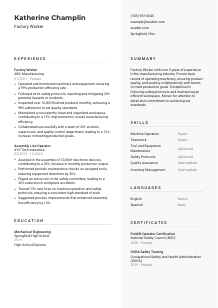
Choose the skills you can demonstrate through your experience. The example keeps the list focused on machine operation, maintenance, safety, quality, and teamwork, which lines up well with the posting. That kind of discipline makes the section easier to trust and easier to scan.
A strong skills section should sound like the floor you have worked on. Use role-specific terms, keep them relevant, and make sure your experience bullets back them up.
Language matters in factory settings because instructions, hazard reporting, shift handoffs, and quality procedures all depend on clear communication. If the job calls for English, make that easy to see right away.
If the posting states that candidates must function effectively in English, list English first with an honest proficiency level such as Native or Fluent. For safety and production roles, this is a practical requirement, not a decorative detail.
Other languages can be useful in plants with diverse teams or multilingual supervisors, but they should follow the required language, not replace it. A second language can add value for day-to-day coordination if you can actually use it at work.
Use realistic labels. Overstating your level can create issues if the role involves spoken instructions, training, safety reporting, or cross-shift communication.
Only mention language ability where it supports communication on the job. For most factory roles, the key question is whether you can understand instructions, report issues clearly, and work effectively with the team.
Additional language skills can help in team-based environments, especially where workers coordinate across lines, departments, or handoff points. They are secondary to production and safety qualifications, but still worth listing when genuine.
For factory hiring, language skills should support safe communication and reliable teamwork. Put English first when required, then add other languages that you can use honestly in a work setting.
The summary should give a fast, credible picture of your manufacturing background. In a few lines, it should show your experience level, the kind of production work you know, and the standards you can work to around safety, quality, and output.
Start with the practical reality of the job. Factory worker summaries work best when they reflect production experience, equipment use, attention to detail, and consistent safety behavior. Those are the themes that help frame the rest of the resume.
A direct first line works best, such as identifying yourself as a factory worker with a certain number of years in manufacturing or production. The example does this well by establishing 3+ years of industry experience immediately.
Choose strengths that match the posting and that you can support elsewhere in the resume. Good options include operating machinery, maintaining quality standards, reducing downtime, following safety procedures, or helping the team hit production goals.
Aim for a concise paragraph, not a speech. Three to five lines is enough to establish your production background and working style. The best summaries sound practical, steady, and specific, much like the work itself.
Your summary should quickly tell the employer whether you have the right production background, safety mindset, and quality focus. If those points are clear in the first few lines, the rest of the resume has a much stronger start.
A factory worker resume works best when it shows how you contribute to output, safety, and product quality in a real production setting. Keep the details concrete, use metrics where they reflect actual shop-floor performance, and tailor your wording to the posting without stretching beyond your experience.
Use Wozber's free resume builder to organize that experience into an ATS-friendly resume template, align your language with the posting, and check key terms with an ATS resume scanner. The result should make one thing easy to judge: whether you can step into the operation, work safely, and help the line run well.




