



Use Wozber and land your dream job
Create Resume
No registration required
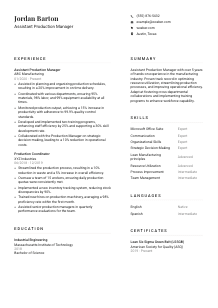
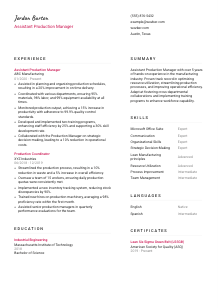
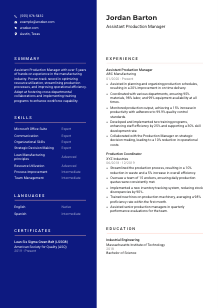
Coordinating on-set, but your resume feels out of frame? Check out this Assistant Production Manager resume example, created with Wozber free resume builder. It shows how to match your behind-the-scenes skills to production job requirements, ensuring your career stays in the spotlight!
Production floors run on timing, coordination, and control. An Assistant Production Manager is expected to keep schedules moving, labor and materials aligned, and quality issues from turning into missed shipments or rework. Your resume should make that operating discipline visible through production planning, team coordination, process improvement, and measurable output.
A tailored resume changes how quickly your background reads against the opening, especially when an ATS is looking for manufacturing terms like production scheduling, Lean Manufacturing, quality control, and supervisory experience. Wozber's free resume builder helps organize those details into an ATS-compliant resume that shows where you have supported throughput, training, and day-to-day plant operations.
In manufacturing hiring, basic details do more than identify you. They immediately confirm whether you are reachable, locally viable, and applying for the production leadership track rather than a general operations role.
Use your full name as the most visible text on the page, with straightforward formatting that fits a professional operations resume. Assistant Production Manager roles are reviewed for clarity and accuracy, so keep the presentation simple and polished rather than decorative.
Place "Assistant Production Manager" directly below your name when that is the role you are pursuing. This helps position your background around production oversight, schedule support, labor coordination, and floor-level leadership instead of broader titles such as operations or project support.
List a working phone number and a professional email address with no formatting errors. Hiring teams filling plant leadership roles often move quickly when a candidate shows the right mix of manufacturing experience and supervisory exposure, so make it easy to contact you without any friction.
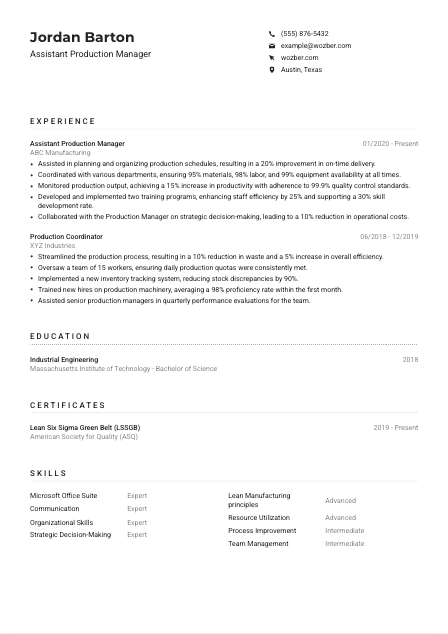
If a posting includes a location requirement, include your city and state in this section. Here, Austin, Texas is specifically mentioned, so the sample resume handles that well by listing Austin, Texas up front. If you are relocating, make that clear in a concise way so location does not become an avoidable screening issue.
Include LinkedIn or a professional website only if it supports your application with credible detail, such as manufacturing experience, leadership progression, or process improvement work. Make sure the titles, dates, and responsibilities there match your resume, especially if you reference plant metrics or supervisory scope.
This section should confirm who you are, how to reach you, and whether you meet practical screening requirements such as location. Run a final check in Wozber's ATS resume scanner so these details stay clean and readable in parsing.




For this role, the experience section carries most of the weight. Hiring teams want to see how you have supported output, coordinated resources, handled people responsibility, and improved shop-floor performance under real production conditions.
Start by identifying the operating responsibilities in the job description, then reflect them in your own experience. For an Assistant Production Manager, that usually means production scheduling, cross-functional coordination, quality monitoring, training, and supervisory work in a manufacturing environment. Build bullets that speak directly to those areas instead of relying on generic operations language.
Use reverse chronological order so your most relevant plant or production work appears first. This helps the reader see your current level of responsibility, whether that is assisting a Production Manager, coordinating line activity, supervising operators, or supporting throughput and resource planning across shifts.
Your strongest bullets should connect what you managed to what improved. The sample resume does this well by tying schedule planning to a 20% improvement in on-time delivery and linking department coordination to high availability of materials, labor, and equipment. That kind of framing tells a hiring manager you understand production flow, not just task completion.
Use numbers that belong naturally in manufacturing work: on-time delivery, productivity gains, waste reduction, labor coverage, downtime, quality rates, training results, or cost savings. Metrics like 99.9% quality compliance, a 15% productivity increase, or a 10% reduction in operational costs carry more weight than vague claims about efficiency.
Prioritize work that proves readiness for production leadership. If an older role does not connect to scheduling, resource utilization, process improvement, team oversight, inventory control, or manufacturing execution, reduce it or remove it. Space is better used on accomplishments that show how you keep production moving and standards on track.
This section should show a pattern of reliable execution in manufacturing settings. Wozber's free resume builder can help you structure each role so the reader quickly sees your supervisory scope, operational results, and relevance to the opening.
Education matters here because the employer has specified a bachelor's degree and named fields tied to production analysis and management. Present it clearly so the requirement is easy to confirm without digging.
List the degree that best aligns with the posting, especially if it is in Business Management, Industrial Engineering, or a related field. In the example, a Bachelor of Science in Industrial Engineering is a strong match because it supports process thinking, systems improvement, and manufacturing analysis.
Include your degree, field of study, school, and graduation year in a clean sequence. Production hiring rarely needs a long academic narrative. What matters is that the qualification is easy to scan and clearly tied to the baseline requirement.
Write out the exact degree and field rather than abbreviating in a way that could create ambiguity. A clear entry such as "Bachelor of Science in Industrial Engineering" gives the reviewer an immediate connection to production systems, efficiency work, and manufacturing operations.
If you are early in your career, selected coursework can support your application, especially in operations management, quality systems, supply chain, manufacturing processes, or Lean methods. If you already have several years of plant experience, as in the sample, the degree itself usually does enough heavy lifting.
Honors, projects, or student leadership can help if they relate to production improvement, team coordination, engineering analysis, or operations planning. Keep them only when they strengthen your case for manufacturing leadership rather than filling space with unrelated campus activity.
Your education section should confirm that you meet the stated degree requirement and support the technical side of the role. Organize it so the connection to production and manufacturing work is immediate.
Certifications are especially useful in production roles when they reinforce process discipline, quality systems, continuous improvement, or supervisory readiness. They work best when they clearly support the work you describe in experience.
Choose certificates that connect directly to manufacturing operations. Lean Six Sigma, quality management, safety training, and production improvement credentials are usually more relevant here than broad business courses. The Lean Six Sigma Green Belt in the sample is a strong example because it supports the job's emphasis on Lean Manufacturing principles.
A shorter, targeted list is more effective than a long catalog. Focus on credentials that reinforce your ability to improve workflow, reduce waste, support quality standards, train teams, or contribute to operational planning.
Add issue dates and renewal information where applicable, especially for active credentials or certifications that require current standing. This is useful when the certificate supports ongoing process improvement work or formal quality practices in the plant.
Manufacturing environments change with new systems, reporting methods, and continuous improvement expectations. Updating this section shows that your knowledge is keeping pace, whether through Lean training, safety credentials, or other operations-focused development.
Certificates should support the same story told elsewhere in your resume: that you can help improve output, efficiency, and consistency in a manufacturing setting. Keep this section tight and role-relevant.
In an Assistant Production Manager resume, the skills section should reflect the tools and working strengths that support daily manufacturing execution. Keep it grounded in production realities, not generic business language.
Extract the capabilities the employer actually names, then compare them with your background. For this opening, that includes production management software, Microsoft Office Suite, communication, leadership, organization, and Lean Manufacturing. You can also add adjacent strengths that support the work, such as resource utilization, quality control, inventory coordination, or team training, if they reflect real experience.
Organize skills so they read like a manufacturing profile rather than a mixed list of buzzwords. You might group technical and operational tools together, then follow with leadership and process-focused strengths. The sample works well by combining software capability with operational skills like resource utilization and process improvement.
Do not crowd this section with every skill you have. Prioritize the ones most useful in a plant environment and most likely to matter in screening, such as scheduling support, Lean methods, quality adherence, team coordination, and reporting tools. Relevance matters more than volume here.
This section should reinforce that you can support production targets, work across departments, and handle the systems behind daily operations. Wozber's free resume builder helps format these skills in an ATS-friendly resume so manufacturing keywords stay easy to find.
Production leadership depends on clear communication, whether you are relaying schedule changes, training operators, or coordinating with maintenance, quality, and materials teams. List languages in a way that supports that reality.
If the posting states that English proficiency is required, list English first and mark your level clearly. In this case, English is a fundamental requirement, so placing it at the top with "Native" or "Fluent" removes uncertainty immediately.
Additional languages can be valuable in manufacturing environments, especially when teams are diverse or communication happens across shifts and functions. A second language such as Spanish can strengthen your profile if it reflects real working ability, as it may help with training, daily coordination, or issue resolution.
Use honest proficiency levels. If you can manage day-to-day workplace communication, say so. If your ability is basic, label it accordingly. Language claims are easy to test in interviews, and accuracy matters in roles that involve instruction and coordination.
Language ability matters most when it improves execution. If you have used another language to support onboarding, communicate safety instructions, or work with suppliers or cross-border teams, it is worth listing because it connects directly to operations.
If you are actively improving a language that could help in the workplace, you can include it at an appropriate level. This is especially useful when it supports communication with line staff, vendors, or partner teams, but only if the entry remains credible and relevant.
Language entries should make it easier to understand how you communicate in a production setting. Keep the section honest, practical, and aligned with the communication demands of the job.
The summary should quickly tell the reader what kind of manufacturing leader you are. For an Assistant Production Manager, that means combining operational scope with the outcomes you help drive on the floor.
Anchor your summary in the actual work: supporting production schedules, coordinating resources, maintaining quality, improving efficiency, and helping lead teams in a manufacturing environment. This gives the section substance right away and keeps it aligned with how the role is performed.
Your first sentence should establish your title or nearest equivalent, years of experience, and manufacturing background. The sample summary does this effectively by identifying more than 5 years in the manufacturing industry, which immediately frames the candidate within plant operations rather than general management.
Bring in the requirements that matter most for the role, such as resource utilization, process improvement, training, production coordination, and cross-functional collaboration. Use the employer's language where it reflects your actual work, especially terms like Lean Manufacturing, quality control, and supervisory experience.
Aim for a compact paragraph that highlights the scale and direction of your contribution without repeating the full experience section. Focus on the few points that matter most: manufacturing tenure, operational strengths, and the kind of measurable improvements you support. That is enough to set up the rest of the resume well.
Your summary should tell the reader, in a few lines, that you understand production operations and can help improve throughput, coordination, and workforce performance. Use Wozber to refine the wording and keep the section aligned with ATS optimization and the role's core priorities.
An effective Assistant Production Manager resume makes plant operations legible on the page. It should show how you support schedules, coordinate materials and labor, maintain quality standards, train teams, and contribute to process improvement with measurable results.
Before sending it out, use Wozber's free resume builder and ATS resume scanner to tighten language, match the posting more closely, and keep everything in an ATS-friendly resume format. The finished document should make it easy to judge your readiness to step into production leadership.




