



Use Wozber and land your dream job
Create Resume
No registration required
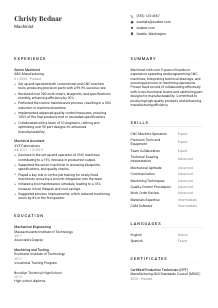
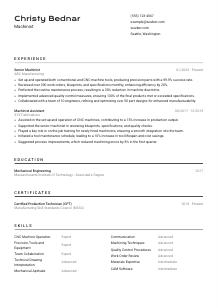
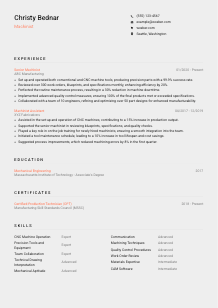
Shaping metal masterpieces, but your resume feels a bit rough around the edges? Check out this Machinist resume example, created with Wozber free resume builder. Learn how to turn your engineering expertise into a perfectly profiled format, positioning you as the cutting edge candidate for machining careers!
Machinist resumes work best when they show how you handle precision under production pressure. Hiring teams want to see that you can move from blueprint to finished part, hold tight tolerances, set up and run conventional or CNC equipment, and keep quality and machine condition under control without slowing output.
The first screen often comes down to whether your resume clearly connects machining experience to the exact work on the floor. Wozber's free resume builder helps you shape an ATS-compliant resume around the posting's language, so terms like CNC setup, technical drawings, tolerances, maintenance, and quality control are easy to match in ATS scans and easy for a production manager to spot in seconds.
On a machinist resume, the contact section should do one practical job well. It should identify you clearly, confirm that you are reachable, and remove avoidable friction such as location concerns when the employer needs someone on site in a shop or plant environment.
Use your full name as the clearest label on the page, in a larger font than the rest of the header. In manufacturing hiring, resumes are often reviewed quickly between production priorities, so clean presentation matters. Keep the styling simple and readable rather than decorative.
Place "Machinist" directly under your name if that is the role you are targeting. That immediate alignment helps separate you from adjacent profiles such as machine operator, CNC programmer, or manufacturing technician when the employer needs someone who can handle setup, operation, tolerances, and shop-floor problem solving.
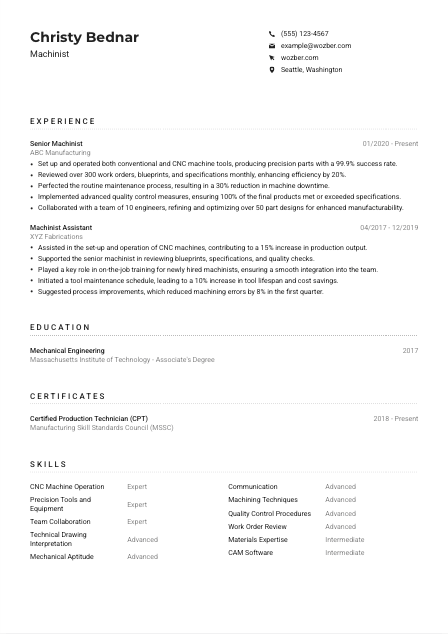
If the posting asks for local availability or relocation, include your city and state. Here, listing "Seattle, Washington" directly supports a stated requirement and removes uncertainty about start logistics. For other machinist roles, use location strategically when on-site access, shift scheduling, or relocation timing matters.
Do not include age, marital status, gender, or other personal data unrelated to machining work. Keep attention on the information that helps an employer place you in the shop, contact you, and understand your fit for the role.
This section should make it easy to contact you and confirm that basic logistics line up. For a machinist, that means a clear title, accurate contact details, and location information only when it helps the employer move faster.




The experience section carries the most weight on a machinist resume. Employers look here for the type of machines you have run, the precision standards you have worked to, the production or quality outcomes you improved, and how well you support the broader manufacturing process.
Read the posting like a work order. Mark the core requirements, then mirror them in your experience bullets when they reflect your real background. For this opening, that includes CNC setup and programming, reading blueprints, working to specifications, performing routine maintenance, applying quality control, and collaborating with engineers on manufacturability.
List positions in reverse chronological order and keep each entry easy to scan with company, title, and dates. A progression from assistant-level shop support to senior machinist work tells a useful story because it shows growing responsibility with setup, troubleshooting, output, and cross-functional coordination.
Focus each bullet on what you machined, how you worked, and what changed because of your contribution. Strong machinist bullets often reference machine type, setup or programming work, tolerances, quality checks, work-order volume, scrap reduction, downtime reduction, or throughput gains. The sample resume does this well by tying day-to-day machining work to results like a 99.9% success rate and a 20% efficiency improvement.
Quantify your impact with measures that actually matter on the floor. Good examples include production output, defect rate, first-pass yield, machine uptime, cycle-time improvement, number of work orders handled, or cost savings from tool-life and maintenance improvements. Figures like "reviewed over 300 work orders monthly" or "reduced downtime by 30%" give hiring managers a much sharper picture than broad claims about being efficient.
Prioritize experience that supports the opening you want now. If a bullet does not show machining skill, shop reliability, quality discipline, or manufacturability input, trim it or rewrite it. Every line should help the employer picture you operating their equipment, reading their prints, and producing parts to spec.
A machinist experience section should answer practical questions fast. What machines have you run, how accurately have you worked, what production problems have you improved, and how much responsibility can you carry from setup through inspection?
Machinist hiring usually leans more heavily on hands-on experience, but education still matters because it shows your technical foundation. Relevant schooling helps confirm that you understand machining principles, shop math, tooling, mechanical systems, and the training path behind your practical work.
Use the education section to reflect the baseline requirements first. In this case, a high school diploma or equivalent is required, while vocational training or apprenticeship experience is preferred. If you have machining, tooling, manufacturing, or mechanical coursework, make sure it is visible instead of buried.
List school, credential, field of study, and completion year in a consistent order. That clean structure helps the reviewer quickly separate general education from trade-specific preparation such as machining programs, tool and die coursework, or apprenticeship training.
If your formal training aligns with the role, label it clearly. Terms like "Vocational Training Program," "Machining and Tooling," or "Apprenticeship" connect more directly to manufacturing hiring than vague academic descriptions. The sample education section works because it surfaces both a high school diploma and trade-relevant technical training.
This is especially useful if you are early in your machining career. Include coursework or projects tied to CNC programming, manual machining, blueprint reading, metrology, GD&T, materials, or shop safety when they help explain your readiness for production work.
If you have continued building knowledge through short courses, machine-specific training, CAM instruction, or quality-related learning, mention it where appropriate. Machining changes with equipment, tooling, and process controls, so current training helps show that your methods are up to date.
Keep this section practical. Employers do not need a long academic story. They need to see the training that supports your ability to read prints, understand machining processes, and step into production with fewer ramp-up questions.
Certifications are not always mandatory for machinist roles, but the right ones can strengthen your resume when they support safety, production standards, quality systems, or technical training. They work best when they sharpen the picture already established by your shop experience.
Even when a certificate is not listed as a requirement, the job description may point toward the kind of formal training that matters. A role focused on CNC operation, quality control, and communication may value credentials tied to manufacturing processes, production standards, safety, or machine technology.
List certifications that connect directly to machining or the environment around it. Relevant examples can include production technician credentials, CNC training, metrology, OSHA safety training, or manufacturer-specific machine certifications. In the sample resume, the Certified Production Technician credential adds industry relevance without trying to replace hands-on experience.
Certification dates help employers judge currency, especially for areas affected by changing standards, equipment, or safety practices. If a certificate is active, renewable, or recently completed, show that clearly.
A current certificate can signal that you stay engaged with new methods, tooling, or production requirements. That matters in shops where machinists are expected to adapt to new CNC controls, process changes, or tighter quality expectations over time.
This section should add weight, not clutter. Include certifications that reinforce your machining capability, production discipline, or quality awareness, and leave out anything that does not help with the role.
A machinist skills section should read like a practical inventory of what you can do in the shop. The best lists balance machine capability, print-reading accuracy, materials and tooling knowledge, quality habits, and the communication needed to work with engineers, supervisors, and other operators.
Start with the posting and identify both technical and interpersonal requirements. Here, that includes CNC machine operation and programming, technical drawing interpretation, mechanical aptitude, materials and machining techniques, quality control, and clear communication. Those are the terms to prioritize when they match your experience.
Lead with the capabilities most central to the role. For this kind of opening, skills such as CNC Machine Operation, Technical Drawing Interpretation, Quality Control Procedures, Machining Techniques, and Mechanical Aptitude belong near the top. The sample resume also benefits from placing shop-floor strengths ahead of more secondary items.
Avoid turning this section into a catch-all inventory. A shorter list of relevant machining skills is stronger than a long list of generic abilities. If you use proficiency levels, make sure they are realistic and support what appears in your experience section. A hiring manager should be able to connect each top skill to actual production work you have described elsewhere.
Every skill here should support the type of parts, machines, tolerances, and shop collaboration the role requires. If a listed skill cannot be backed up by your work history, it does not belong near the top.
Language ability matters on machinist resumes when it affects safety, reporting, and day-to-day coordination. Clear communication supports accurate handoffs, work-order understanding, issue reporting, and collaboration around prints, tolerances, and quality concerns.
If the posting asks for strong English proficiency, list English clearly and use an honest proficiency level. For machinists, this matters because instructions, work orders, setup sheets, inspection notes, and team communication often depend on precise wording.
Extra languages can be useful in multilingual shops, supplier coordination, or team training environments. If you speak another language well, include it after English in order of proficiency. In the example resume, Spanish adds value as an additional communication asset without distracting from the core machining qualifications.
Describe each language with clear levels such as "Native," "Fluent," "Intermediate," or "Basic." Avoid vague wording. Straightforward labels give the employer a practical sense of how you can communicate on the floor or in documentation.
For some machinist jobs, language ability is secondary. For others, it helps with shift communication, training, vendor interaction, or reading documentation from different sources. Include languages when they add operational value, not simply to fill space.
Language skills are useful, but they should remain a supporting section unless communication across languages is central to the job. The priority for machinist hiring is still your ability to machine parts accurately, maintain equipment, and work from technical documentation.
For machinist roles, language information should help explain communication strength, safety readiness, or team coordination. Keep it brief, accurate, and tied to how the work gets done.
The summary sits at the top of the resume, so it should quickly establish your level, your machining scope, and the kind of production value you bring. For machinists, that usually means combining years of experience with specific strengths such as CNC operation, print interpretation, precision work, quality control, or manufacturability support.
Read the posting and identify the few responsibilities that define success in the role. Here, the center of gravity is CNC operation and programming, reading technical drawings, maintaining precision, supporting quality procedures, and working with engineering on part design. Build your summary around that mix rather than around generic statements about being hardworking.
Your first line should tell the employer who you are and how much experience you bring. A phrase like "Machinist with over 5 years of hands-on experience" works because it immediately sets seniority and trade focus. If your background is more specialized, you can refine it with details such as CNC setup, prototype work, production machining, or close-tolerance components.
Choose strengths that are central to the role and easy to support later in the resume. Good options here include operating and programming CNC machines, interpreting technical drawings, applying quality control procedures, and collaborating with engineers to improve manufacturability. The sample summary succeeds because it stays close to the actual requirements instead of drifting into broad personality claims.
Aim for a short paragraph that can be read in one glance. Dense, role-specific wording works better than a long introduction. A production manager should finish this section already knowing your experience level, core machining range, and whether the rest of the resume is likely to support the opening.
A machinist summary should quickly tell the reader whether you can handle the mix of equipment, precision, quality, and shop coordination the role demands. If those points are clear at the top, the rest of the resume lands harder.
A well-tailored machinist resume makes the practical questions easy to answer. Can you set up and run the required machines, read prints accurately, hold specifications, maintain equipment, and contribute to production without creating quality issues?
Use Wozber's free resume builder to organize that experience into an ATS-friendly resume format, then refine the wording with its ATS resume scanner and AI resume builder features so your sections reflect the job description with more precision. The result should make your machining range, production discipline, and readiness for the role clear from the first scan.




