



Use Wozber and land your dream job
Create Resume
No registration required
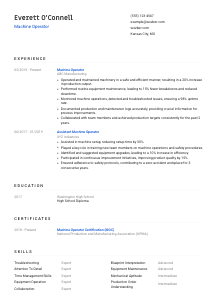
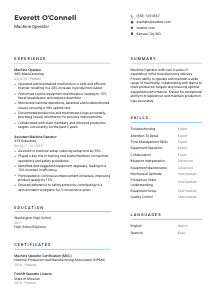
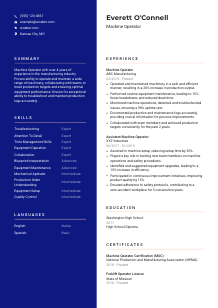
Commanding machines, but your resume seems stuck in idle? Tune into this Machine Operator resume example, created with Wozber free resume builder. Learn how to match your machine mastery to job directives, ensuring your career gears are always set for high productivity and success!
Machine operator hiring moves quickly because the work has immediate consequences. A resume needs to show that you can keep equipment running safely, catch problems before they turn into scrap or downtime, and stay accurate with production output and maintenance records. If those basics are buried under generic manufacturing language, your experience can look thinner than it is.
The first screen often separates people who simply worked near machines from people who actually operated, adjusted, maintained, and monitored them. Wozber's free resume builder helps you line up your wording with the job posting in an ATS-friendly resume format, so terms like equipment maintenance, troubleshooting, blueprint reading, and production logs appear where hiring teams expect them. That makes it easier to see your operating scope fast.
This section is simple, but it still does real work. For a machine operator application, your header should confirm who you are, how to reach you, and whether you meet any practical requirement that could affect scheduling, shift coverage, or relocation.
Use your full name exactly as you use it in work records, certifications, and application forms. Keep it the most visible text in the header so supervisors, HR staff, and plant recruiters can identify your resume quickly when they move between printouts, ATS records, and interview schedules.
Place the job title directly under your name and use the version the employer uses when it reflects your background. Here, "Machine Operator" is the clearest choice. That helps position you correctly in ATS searches and immediately tells the reader that your experience belongs on a production floor, not in a broader warehouse or general labor category.
Add a reliable phone number and a professional email address you check regularly, especially if employers may contact you about shift timing, start dates, or on-site testing. Keep the format clean and easy to scan. Small details matter when a hiring team is moving fast to fill a production opening.
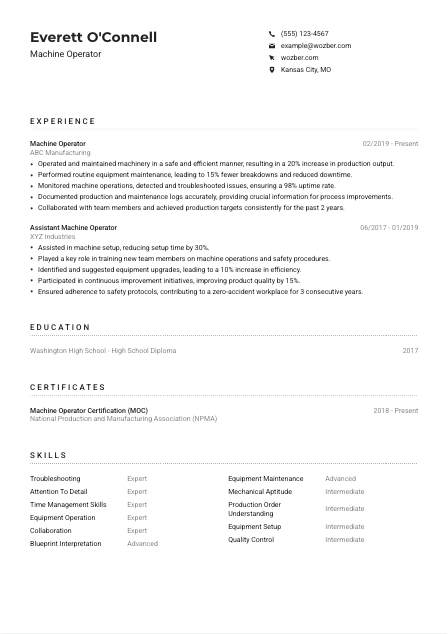
If the posting names a city or requires relocation, make that easy to find in your header. In this example, Kansas City, MO is relevant, so listing Kansas City, MO immediately removes doubt about commute or relocation. Use this only when location is actually part of the employer's screening criteria.
Include LinkedIn or a professional site only if it supports your application with useful details such as certifications, manufacturing experience, safety training, or equipment-related responsibilities. If the link adds no value beyond your resume, leave it out. For hands-on production roles, relevance matters more than having extra links.
Your personal details should answer the practical questions first: who you are, what role you are pursuing, how to contact you, and whether any location requirement is covered. When that is clear, the reader can move straight to your machine operation experience.




For machine operators, the experience section carries most of the decision weight. Hiring teams want to see the kind of equipment environment you worked in, how you handled uptime and quality expectations, and whether you took responsibility for maintenance, troubleshooting, and production documentation.
Mark the actions and requirements that define the role, then mirror them with your own experience. In this posting, the priorities are safe equipment operation, routine maintenance, troubleshooting, blueprint or production order reading, and accurate logging. Those phrases tell you what your bullets should emphasize instead of relying on generic lines about working in manufacturing.
For every position, include title, company, and dates in reverse chronological order. If your title was broader, use your bullets to clarify machine-specific work such as setup, operation, changeovers, minor adjustments, preventive maintenance, or quality checks. The sample resume does this well by moving from Assistant Machine Operator to Machine Operator, which shows progression in hands-on responsibility.
Your accomplishments should describe what you operated, what you maintained, and what improved because of your work. Strong examples include increasing production output, reducing breakdowns, improving uptime, or keeping logs that supported process improvements. The sample bullet about achieving a 98% uptime rate works because it ties monitoring and troubleshooting directly to a production result.
Use numbers wherever you can support them. For this field, useful metrics include throughput, downtime reduction, setup time, scrap reduction, uptime, defect rates, safety records, and on-time production performance. A line like "performed routine equipment maintenance" becomes much stronger when paired with a result such as fewer breakdowns or reduced stoppages.
Trim experience that does not strengthen your case for operating equipment in a manufacturing setting. If you include broader production or warehouse work, connect it to relevant tasks like reading production orders, checking tolerances, following safety procedures, or supporting continuous improvement. Every bullet should reinforce that you can run equipment reliably under production targets.
By the end of your experience section, the reader should understand the equipment environment you worked in, the production standards you supported, and the results you delivered. That is what turns past job titles into a credible machine operator profile.
Education usually takes a smaller share of the page for machine operator roles, but it still matters because many postings set a baseline credential. Present it clearly, then let your operating experience carry the rest of the argument.
If the employer asks for a high school diploma or equivalent, make sure it appears exactly and clearly. This posting does, so the sample resume's High School Diploma entry covers that requirement without overexplaining it. Meet the baseline first, then let the rest of your resume show production value.
List the school, credential, and graduation year or date in a clean structure that is easy to scan. This section does not need extra detail unless you have training that directly supports equipment operation, safety, maintenance, or blueprint reading.
Most machine operator roles care more about plant experience than academic detail. If you completed technical coursework in machining, industrial maintenance, manufacturing systems, or shop math, include it because it supports your day-to-day operating work. Otherwise, keep this section brief.
Short courses in OSHA safety, forklift operation, lockout/tagout, blueprint reading, or preventive maintenance can fit here if you do not list them elsewhere. These details help show that you understand production floor expectations beyond simply running a machine.
Academic awards or unrelated activities usually do little for this type of application unless they connect clearly to reliability, technical training, or industrial work. Use the space for information that supports plant readiness and equipment responsibility.
For a machine operator resume, education should confirm that you meet the stated requirement and, if relevant, show any technical training that supports safe and efficient production work.
Certifications are not always mandatory for machine operator jobs, but the right ones can strengthen your resume quickly. They show current training, equipment familiarity, and a level of seriousness about safety and production standards.
Choose certificates that relate directly to manufacturing work, equipment handling, safety, or maintenance. In the example, a Machine Operator Certification and a Forklift Operator License both support day-to-day plant work. That kind of relevance matters more than listing unrelated courses.
Do not crowd this section with every training record you have. Prioritize certifications that reinforce the posting's needs, such as safe operation, mechanical aptitude, troubleshooting, material handling, or regulated equipment use.
Show when each certification was earned and whether it is current, especially for licenses or credentials that expire or require renewal. That helps employers see that your training is usable now, not just something completed years ago.
Manufacturing employers notice candidates who keep up with safety procedures, equipment updates, and plant standards. If you complete new training in lockout/tagout, quality systems, maintenance basics, or machine-specific operation, update your resume so it reflects your current capability.
Well-chosen certifications add another layer of credibility to your resume. They tell employers that you bring more than experience alone. You also have training that supports safe operation, compliance, and dependable production work.
A machine operator skills section should read like a working checklist for the floor, not a generic mix of soft traits. Focus on the abilities that support safe operation, steady output, issue detection, and accurate production work.
Start with the capabilities the posting makes explicit. Here, that includes mechanical aptitude, troubleshooting, blueprint and diagram interpretation, attention to detail, time management, and equipment operation. Using the employer's language helps your resume connect in both ATS screening and human review.
Lead with the skills that affect machine performance and product quality before adding broader workplace strengths. Technical and operational items like equipment maintenance, quality control, setup, production order reading, and troubleshooting should usually come before collaboration or general communication.
If you have enough depth, organize skills into categories such as Machine Operation, Maintenance and Troubleshooting, Quality and Documentation, and Teamwork or Communication. The sample resume already includes a solid mix, and it becomes even stronger when the order highlights the skills most tied to uptime, output, and accuracy.
A well-built skills section should confirm that you can operate equipment, catch problems, follow instructions, and support production goals without constant supervision. If the list feels generic, it is probably missing the machine-floor details that matter.
Language sections are usually brief for machine operator resumes, but they can still answer an important requirement. When a posting specifically mentions English tasks, your resume should make that point clear without turning the section into filler.
This posting states that English language tasks must be handled efficiently, so English should appear first with an honest proficiency level. The sample resume lists English as Native, which addresses that requirement directly and cleanly.
After the required language, list any others in descending order of proficiency. Extra languages are not always central for machine operators, but they can be helpful in multilingual teams, safety communication, or training environments.
Choose plain terms such as Native, Fluent, Advanced, Intermediate, or Basic. Avoid vague descriptions. Hiring teams need a quick read on whether you can handle written instructions, production logs, safety communication, and day-to-day coordination.
If another language helped you train coworkers, support team communication, or work across shifts in a diverse plant, that can be worth noting elsewhere in your resume. Do not force the point here if it was not part of your actual work.
For most machine operator applications, languages should stay secondary to equipment experience, safety record, and production results. Include them, but do not let this section take space away from operating, maintenance, or quality-related content.
For this kind of role, the language section mainly needs to confirm that you can handle instructions, documentation, and team communication. Once that is clear, your resume should return focus to production work.
The summary sits at the top of the resume, so it needs to establish your operating background fast. For machine operator roles, that means years of experience, manufacturing context, equipment responsibility, and one or two proof points that show you can support output, uptime, and quality.
Start with your title and your years of experience in manufacturing or production. A line like the sample's "Machine Operator with over 4 years of experience in the manufacturing industry" works because it gives the reader role, tenure, and context in one sentence.
Use the summary to highlight core capabilities from the posting, such as troubleshooting, equipment maintenance, blueprint reading, attention to detail, or production log accuracy. Pick the ones you can support later in the resume, especially the skills tied to machine reliability and consistent output.
A short summary gets stronger when it contains a real performance indicator or clearly stated contribution. That might be reducing downtime, improving output, maintaining high uptime, or supporting quality targets. Keep it brief, but make it specific enough to sound earned.
Avoid broad claims like hardworking, team player, or results-driven unless you connect them to actual production work. This section should sound like someone who runs equipment, solves machine issues, and keeps records straight during a live shift, not like a generic manufacturing applicant.
Your summary should give the reader an immediate sense of your manufacturing experience, your machine-floor strengths, and the kind of production performance you support. When it is tailored well, the rest of the resume reads with much more context.
A machine operator resume works when it shows practical control over equipment, maintenance habits, troubleshooting ability, and steady production support. Every section should help the employer picture you on the floor, handling the machine, the documentation, and the pace of the work.
Use Wozber's AI resume builder and ATS resume scanner to align your wording with the posting, surface missing requirements, and build an ATS-compliant resume that is easy to review. When the final version is tailored well, hiring teams can quickly judge whether you are ready to step into the line and keep production moving.




