



Use Wozber and land your dream job
Create Resume
No registration required
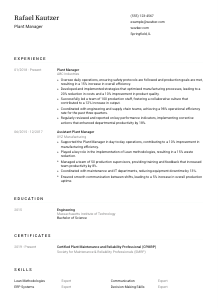
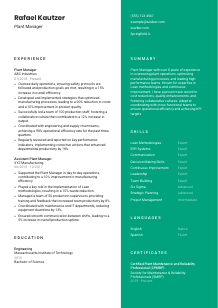
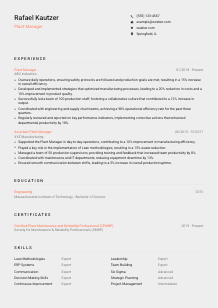
Nurturing green giants, but your resume lacks growth? Branch into this Plant Manager resume example, created with Wozber free resume builder. Learn how to bring your leadership expertise together with job requirements, sprouting a career journey as impressive as your botanical accomplishments!
Plant Manager resumes are strongest when they show control of a live operation, not just oversight in title. Hiring teams want to see how you have handled output, safety, cost, quality, labor, and process improvement in an environment where one weak decision can affect production targets, scrap rates, downtime, or compliance.
A tailored resume helps separate broad operations experience from true plant leadership by making your manufacturing scope and results visible fast. Wozber's free resume builder helps you align your wording with the job description, keep the structure clean for ATS optimization, and make it easier for the reader to spot the parts that matter most for a Plant Manager, such as production ownership, continuous improvement work, and team leadership.
This section should identify you quickly and remove avoidable friction. For a Plant Manager role, that means clear contact information, an exact role title, and location details that address practical availability for an on-site leadership position.
Place your full name at the top in a clean, readable format. Keep it visually prominent so the resume is easy to identify when it is printed, shared internally, or reviewed alongside plant operations candidates with similar backgrounds.
Add "Plant Manager" below your name if that is the role you are pursuing. This immediately frames your background around plant-level leadership rather than broader operations, production, or manufacturing management titles that may be adjacent but not identical.
Use a phone number you answer reliably and a professional email address based on your name. Accuracy matters here. If a hiring manager wants to discuss production leadership experience, Lean implementation, or ERP exposure, you do not want a typo getting in the way.
Plant leadership roles are often tied closely to site presence, so location can influence whether your application moves forward. If the employer needs someone in Springfield, IL or open to relocation, include your city and state so that requirement is answered without forcing the reader to search for it.
Include LinkedIn or a professional website only if it supports your resume with consistent titles, career progression, and manufacturing credentials. For this kind of role, a polished profile that reinforces plant operations scope, leadership history, and continuous improvement work can strengthen your application.
Your personal details should confirm that you are reachable, professionally presented, and realistically available for the plant. Keep this section tight so the reader can move straight to your operating experience.




The experience section carries the most weight for a Plant Manager. Titles matter, but what gets attention is operational scope, measurable performance, and proof that you can lead production through daily pressure while improving the system behind it.
Read the posting for the recurring themes behind the title. Here, the employer is clearly focused on daily operations, safety, quality, production targets, cost reduction, process optimization, KPI review, and cross-functional coordination. Those themes should shape the bullets you choose and the language you use.
List positions in reverse chronological order with title, company, and dates. For plant leadership, this structure should also show progression into higher-responsibility roles such as supervisor, assistant plant manager, operations manager, or plant manager, making your leadership path easy to follow for both ATS systems and human reviewers.
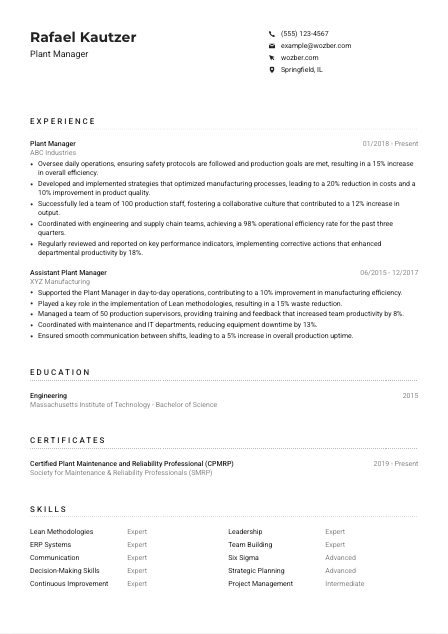
Focus each bullet on a responsibility you owned and the result it produced. Plant Manager bullets should cover areas such as throughput, labor leadership, quality improvement, downtime reduction, safety performance, cost control, inventory flow, or shift coordination. The example resume does this well with bullets tied to efficiency gains, cost reduction, improved product quality, and KPI-based corrective action.
Numbers make your impact credible when they reflect how manufacturing is actually measured. Include percentages tied to efficiency, scrap reduction, cost savings, output, uptime, on-time production, or quality improvement. Metrics like a 15% efficiency increase, 20% cost reduction, or 98% operational efficiency tell a much clearer story than general claims about strong performance.
Give the most space to roles that show ownership of production teams, manufacturing processes, continuous improvement, and coordination with functions like engineering, maintenance, supply chain, and finance. Older or less relevant experience can stay brief. The resume should read like a record of growing plant responsibility, not a full biography of every job you have held.
Every bullet should help the reader picture the operation you managed and the results you improved. When your experience section clearly connects decisions to output, cost, quality, and team performance, your candidacy becomes much easier to take seriously.
Education is rarely the headline for a senior plant leader, but it still matters because it confirms the technical or operational foundation behind your decisions. Keep it straightforward and aligned with the degree level and field the employer requested.
Start with the baseline requirement in the posting. Here, the employer asks for a bachelor's degree in Engineering, Operations Management, or a related field. If you meet that requirement directly, make it easy to see without burying the degree under extra detail.
List your degree, field of study, school, and graduation year in a consistent order. This helps ATS parsing and lets the reviewer confirm quickly that you meet the academic requirement before moving on to your plant operations experience.
If your degree is especially relevant to manufacturing leadership, show that plainly. A Bachelor of Science in Engineering, like the one in the example resume, supports the technical side of process optimization, production systems, and cross-functional work with engineering teams.
If you are early in your career or moving into plant leadership from a technical path, relevant coursework in operations, industrial engineering, supply chain, quality systems, or production planning can help. For established managers with 7+ years in operations, experience and results usually matter more than academic detail.
Honors, leadership roles, or project-based achievements can stay if they reinforce analytical ability, technical grounding, or leadership potential. Keep them brief. For a Plant Manager, these details are supporting context, not the main proof of readiness.
Your education section should quickly answer whether you meet the degree requirement and whether your background supports plant-level decision-making. Once that is clear, let your operations record do the heavier lifting.
Certifications can strengthen a Plant Manager resume when they point to practical improvement work, reliability knowledge, or formal process discipline. The best ones support how you run a facility, improve output, and lead operational change.
Even when certifications are not mandatory, they can reinforce themes the employer cares about. In this case, continuous improvement and operational efficiency are prominent, so credentials tied to Lean, Six Sigma, maintenance reliability, or manufacturing excellence are the most relevant.
List credentials that connect to how plants are actually managed. Lean and Six Sigma certifications can support your process improvement work. A credential like the CPMRP shown in the example adds useful credibility around maintenance and reliability, which often affect uptime, asset performance, and production continuity.
Add the issue date and, if relevant, the active period. This helps the reviewer understand whether the certification is current and whether your training reflects recent operating practices rather than outdated coursework.
Plant leadership changes with new systems, reporting expectations, and improvement methods. A current certification list tells employers you stay engaged with operational best practices, whether that means continuous improvement, reliability, safety, or systems management.
Relevant certifications should strengthen the story your experience already tells. Choose the ones that point directly to better process control, stronger reliability, and disciplined improvement across the plant.
A Plant Manager skills section should reflect both plant execution and leadership range. Employers usually want to see a mix of process improvement capability, systems knowledge, and the people skills needed to run shifts, supervisors, and cross-functional partners effectively.
Start with the skills the posting names directly, then add closely related abilities you genuinely use. For this role, that includes Lean methodologies, Six Sigma, ERP systems, leadership, communication, and decision-making. Those are not generic extras. They are tied to how production issues get solved and how plant performance is managed.
Lead with the capabilities most likely to matter in day-to-day plant leadership. Process improvement, ERP fluency, KPI management, team leadership, strategic planning, quality focus, and cost control often carry more weight than broader project terms. The example resume handles this well by giving prominence to Lean, ERP systems, continuous improvement, and leadership.
Do not turn the section into a warehouse of every skill you have ever touched. Group or order skills so the reader can scan them quickly, and keep the claims consistent with your experience bullets. If you list Six Sigma, ERP systems, or strategic planning, your work history should show where those skills produced measurable plant outcomes.
This section works best when it reinforces your experience instead of repeating buzzwords. A focused skills list helps the reader connect your plant results to the methods, systems, and leadership strengths behind them.
Language requirements can matter more in plant environments than candidates sometimes expect. Safety instructions, shift handoffs, production reporting, supervisor coaching, and cross-functional meetings all depend on clear communication, so list languages with the same precision you would use for any operating detail.
Check the posting for stated language requirements and place them prominently. Here, English is required for speaking, reading, and writing, so it should appear first with an accurate proficiency level. That immediately answers a practical operating requirement.
If the employer names a language, do not bury it under less relevant details. Place it clearly in the languages section so the reviewer can confirm communication readiness for reporting, instructions, and daily plant coordination without extra guesswork.
Describe each language with clear terms such as Native, Fluent, Advanced, or Intermediate. Plant environments rely on precision, and vague wording around language ability can create uncertainty about whether you can handle meetings, documentation, or front-line communication.
Extra languages can help in facilities with multilingual teams, regional supplier relationships, or broader manufacturing networks. In the example, Spanish adds another layer of communication range, but it works as a plus rather than replacing the required English proficiency.
Some plant roles are purely local. Others involve diverse workforces, external vendors, or international reporting lines. Present your languages in a way that reflects that environment. Keep the section short, clear, and tied to real workplace communication needs.
For a Plant Manager, language ability supports safety, reporting, leadership, and coordination across the facility. List languages clearly so there is no ambiguity about your ability to operate in the plant's working environment.
Your summary should tell the reader, in a few lines, what kind of plant leader you are. This is where you frame your experience level, operating strengths, and the business results you tend to deliver before the hiring team reads the rest of your resume.
Before writing, identify the few themes the employer keeps returning to. Here, they want someone who can run daily operations, improve manufacturing processes, lead supervisors and staff, work across functions, and manage by KPI. Those points should shape the summary instead of a generic management statement.
Start with your title, years of experience, and core area of leadership. For example, a Plant Manager with 8+ years in plant operations immediately gives the reader useful context, especially when paired with language about manufacturing performance, process improvement, or multi-team leadership.
Use one or two short phrases that connect your methods to outcomes. Cost reduction, quality improvement, efficiency gains, Lean implementation, continuous improvement, and cross-functional execution are all relevant here. The sample summary works because it combines experience level with operational results and improvement discipline.
Aim for a tight paragraph, not a mini cover letter. Four to five lines is usually enough to establish your plant leadership profile, highlight your strongest operational themes, and set up the rest of the resume without repeating every detail that will appear in experience.
A strong summary gives the reader a fast, credible picture of your operating style and impact. When it highlights production leadership, improvement work, and measurable business results, the rest of the resume lands with more force.
A Plant Manager resume should make one thing clear quickly: you can run a facility, improve performance, and lead people through daily production demands. When your sections line up around measurable operations results, continuous improvement work, ERP or plant systems knowledge, and leadership scope, the hiring team can understand your value without digging for it.
Use Wozber's free resume builder to shape that story into an ATS-compliant resume, tighten the wording with role-specific phrasing, and check alignment with an ATS resume scanner. The finished document should make it easy to judge your readiness to lead safety, quality, output, and operational improvement from day one.




