



Use Wozber and land your dream job
Create Resume
No registration required
Fine-tuning assembly lines, but your resume feels out of sequence? Stitch it together with this Manufacturing Technician resume example, created with Wozber free resume builder. Learn how to thread your hands-on expertise into job specs, ensuring your career is always on track and on production pace!
Manufacturing technicians work where uptime, product specs, and safe equipment use meet. Hiring teams want to see that you can run and calibrate equipment, catch quality deviations before they become scrap or rework, and keep production moving without creating risk on the line. Your resume needs to make that operating discipline visible quickly.
A tailored resume changes how your background is read by showing the exact mix of equipment operation, troubleshooting, documentation, and quality control the job calls for. Using Wozber's free resume builder and an ATS-friendly resume format helps you match the language of the posting cleanly, so both the ATS and the hiring manager can immediately see your readiness for a manufacturing floor role.
Manufacturing hiring often moves fast, especially when a site needs someone who can step into shift work, follow plant procedures, and communicate clearly with operators, leads, and quality staff. Your personal details should confirm the basics without clutter and remove any doubt about availability, location, or professional focus.
Make your name easy to find and easy to read. Use a clean font and slightly larger size than the body text. In manufacturing roles, presentation does not need flair. It should reflect the same clarity you would bring to production logs, equipment settings, and shift handoff notes.
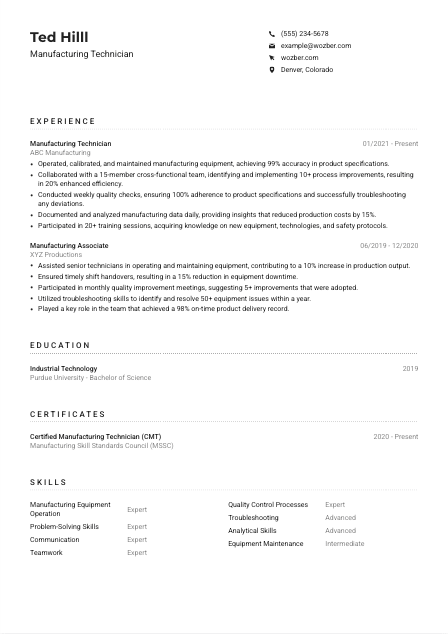
Place "Manufacturing Technician" directly under your name if that is the role you are pursuing. This helps frame your background immediately and supports ATS matching when the posting uses that exact title. If your previous title was "Manufacturing Associate" or similar, keep that in your experience section, but use the target title in the header when it accurately reflects your direction.
Add a reliable phone number and a professional email address with no nicknames or formatting errors. In plant environments where hiring can involve quick interview scheduling or follow-up after a screening call, small mistakes here create unnecessary friction. If you include a website or LinkedIn profile, make sure it is current and consistent with the experience on your resume.
If the employer wants someone based in a specific area or willing to relocate, state that clearly in this section. For the example role, listing Denver, Colorado directly supports the location requirement and removes a common screening question early. Use this as a tailoring move for postings that specify site proximity, not as a rule for every resume version.
A LinkedIn profile can help if it reinforces your manufacturing history, certifications, or progression across production roles. This is most useful when it adds context such as equipment types, training history, or measurable achievements like downtime reduction or output gains. Skip extra links that do not strengthen your case for line operations, maintenance support, or quality-focused work.
Your personal details should confirm that you are a reachable, job-aligned candidate who can realistically step into the production environment. Wozber's free resume builder helps keep this section clean, accurate, and ready for fast review.




This is the section hiring managers read to decide whether you can contribute on the floor. For a manufacturing technician, that means showing equipment operation, troubleshooting, preventive or routine maintenance, quality checks, documentation, and practical process improvement. Titles matter less than what you actually kept running, fixed, measured, or improved.
Before writing bullets, isolate the work that appears repeatedly in the job description. Here, the priorities are operating and calibrating equipment, maintaining functionality, performing quality checks, documenting production data, and working with cross-functional teams to improve efficiency and reduce downtime. Those themes should shape your bullet points more than generic production wording.
List roles in reverse chronological order and include job title, company name, and dates. That structure lets a hiring manager quickly track your time in manufacturing or production environments, which matters when the posting asks for at least 2 years of experience. Wozber's ATS-friendly resume template helps keep that layout readable for both recruiters and screening systems.
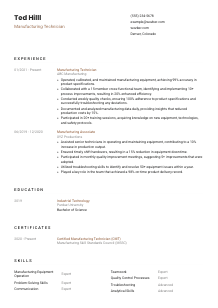
Do not stop at "operated equipment" or "performed inspections." Show what happened because of your work. The example resume does this well with details like achieving 99% accuracy in product specifications, implementing 10+ process improvements, and reducing production costs by 15% through data analysis. Those bullets translate routine responsibilities into output, quality, and efficiency results that matter in manufacturing.
Metrics carry weight when they reflect real shop-floor performance. Good examples include uptime, downtime reduction, output increase, defect rate, spec adherence, on-time delivery, scrap reduction, cost savings, or number of issues resolved. The sample's 20% efficiency gain, 15% downtime reduction, and 50+ equipment issues resolved in a year are strong because they sound native to production work, not added for effect.
Prioritize accomplishments that relate directly to equipment reliability, quality control, troubleshooting, process improvement, and team coordination. Leave out older or unrelated points that do not help prove those capabilities. For a manufacturing technician opening, a concise set of relevant bullets is stronger than a long list that buries your work with calibration, inspections, shift handovers, or corrective action support.
Your experience section should show that you can keep equipment functioning, maintain product quality, and contribute to smoother production. Wozber's ATS resume scanner can help you line up your wording with the posting so those strengths show up clearly in both ATS screening and human review.
Education usually plays a supporting role in manufacturing technician hiring unless the employer asks for a specific degree or technical training. What matters most is whether your education strengthens your case for equipment work, process understanding, quality control, or industrial operations. Present it clearly and do not overbuild it.
Some manufacturing technician jobs require only production experience, while others prefer technical education in industrial technology, manufacturing, electronics, or mechanical systems. This posting does not call for a specific degree, so education should support your profile rather than dominate it. That makes your hands-on experience the lead story.
Include your degree, field of study, school, and graduation year. A straightforward entry is enough. In the example, a Bachelor of Science in Industrial Technology from Purdue University gives useful context because it connects naturally to production systems and equipment-based work.
If your education directly relates to manufacturing processes, industrial maintenance, automation, quality systems, or operations, make that connection obvious through the field of study. A degree such as Industrial Technology is worth featuring because it supports the practical demands of calibration, maintenance, and process improvement without needing extra explanation.
Relevant coursework can help if you are earlier in your career or if the program covered topics that matter for the job, such as quality assurance, manufacturing systems, safety procedures, process control, or equipment maintenance. Keep it selective. Only include it when it adds technical substance that your work history does not already cover.
Projects, capstones, or honors are useful when they connect to production efficiency, troubleshooting, process analysis, or equipment operation. If you are several years into manufacturing work, these details are usually less important than your operating results on the job. Use them to reinforce technical grounding, not to fill space.
This section should confirm the technical foundation behind your manufacturing experience, not distract from it. Keep the focus on study that helps explain your readiness for production equipment, quality standards, and continuous improvement work.
Certifications can add useful weight in manufacturing, especially when they point to recognized training in production processes, equipment, quality, safety, or maintenance practices. They are rarely a substitute for line experience, but they can sharpen your profile when the employer wants someone who learns quickly and works within established standards.
Review the posting for any required or preferred credentials. This job does not list a mandatory certification, so include the ones that reinforce your technical background. A Certified Manufacturing Technician credential fits naturally because it speaks to core production knowledge rather than a generic training record.
List certifications tied to manufacturing operations, equipment handling, quality systems, lean practices, safety procedures, or maintenance. The closer the credential is to daily plant work, the more useful it is. Broad or unrelated certificates should stay off the resume unless they support a specific part of the role you are targeting.
Dates help a hiring team see whether your training is recent or active. In the example, "2020 - Present" on the CMT certification signals continued relevance. That matters in environments where equipment, procedures, and safety requirements change over time.
Manufacturing teams value people who keep up with new equipment, operating procedures, and safety protocols. If you have completed recent training on calibration methods, quality standards, lockout procedures, or updated production systems, include it. The example's mention of 20+ training sessions supports that pattern of continued learning well.
The right certifications make your technical profile easier to trust, especially when they align with equipment work, quality control, and standardized procedures. Keep this section focused on credentials that strengthen your case for the specific manufacturing environment you want to join.
Manufacturing technician skills need to read like tools you use on the job, not a generic list of strengths. Employers look for a practical mix of equipment operation, troubleshooting, quality awareness, documentation, and teamwork because the role sits between machine performance, production output, and product specifications.
Start with the posting and pull the exact capabilities it emphasizes. Here that includes operating and troubleshooting manufacturing equipment, understanding quality control procedures, analytical problem-solving, communication, and teamwork. Matching that language improves ATS alignment and keeps your skills section anchored in real job requirements.
Put technical and operational skills first when they are central to the role. For this kind of opening, skills such as manufacturing equipment operation, quality control processes, troubleshooting, equipment maintenance, and data documentation deserve more attention than broad workplace traits. The example skill list gets this balance mostly right by placing equipment operation and quality control alongside communication and teamwork.
A shorter skills section works better when each item is supported somewhere in your experience. If you list troubleshooting, there should be a bullet showing issues identified and resolved. If you list quality control, your experience should mention inspections, spec adherence, or deviation handling. Wozber's ATS-friendly resume format helps keep the section compact and easy to scan without turning it into a keyword dump.
This section should read like the set of capabilities you bring to a production line, maintenance routine, or quality-driven shift. When your listed skills match both the posting and your accomplishments, employers can connect your keywords to real manufacturing performance.
Language matters in manufacturing because instructions, safety procedures, quality records, and shift communication all depend on accuracy. This section is usually brief, but it becomes important when the posting specifies communication requirements or when multilingual ability supports the plant environment.
If the job calls for strong English speaking and comprehension, list English first with an accurate proficiency level such as Native or Fluent. That directly answers a stated requirement and matters for reading work instructions, understanding safety updates, and documenting production issues clearly.
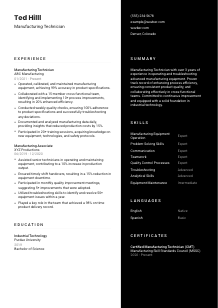
Additional languages can be worth including when they support teamwork, training, or communication across a diverse workforce. In the example, basic Spanish adds a helpful extra detail without overstating capability. Keep this grounded. Extra languages are a bonus, not a substitute for the core manufacturing qualifications the job requires.
Use honest levels such as Native, Fluent, Intermediate, or Basic. Manufacturing settings rely on clear verbal instructions, accurate handoffs, and readable documentation, so inflated language claims can create problems later. Precise labels help hiring teams understand where you can communicate confidently and where your ability is more limited.
If the role involves reading technical manuals, participating in cross-functional meetings, or handling detailed quality documentation, language proficiency becomes more than a checkbox. Present it in a way that supports those responsibilities rather than as a general personal asset.
Only include languages you can discuss in a professional setting at the level claimed. A short, accurate list is better than a longer one with weak relevance. For most manufacturing technician resumes, this section should simply confirm communication readiness and, where applicable, a useful secondary language.
For this type of role, language skills should reinforce safe communication, accurate documentation, and smooth coordination on the floor. Keep the section brief and factual, with English proficiency clearly stated when the job requires it.
A manufacturing technician summary should quickly answer three questions: how much relevant experience you have, what technical work you handle well, and what kind of production results follow from your work. Keep it tight, specific, and tied to the realities of equipment reliability, quality control, and process improvement.
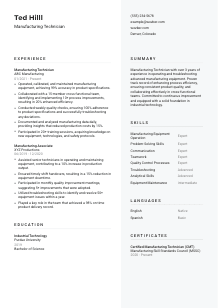
Start with your title and the amount of experience you bring in manufacturing or production environments. The example summary does this effectively by leading with more than 3 years of experience. That gives immediate context and aligns well with a posting asking for at least 2 years in manufacturing.
Include two or three capabilities that sit at the center of the job, such as operating and troubleshooting manufacturing equipment, maintaining product quality, or improving process efficiency. Use the phrasing from the posting where it reflects your actual background. This helps both ATS matching and human review without sounding forced.
Aim for 3 to 5 lines and avoid vague claims like "hardworking professional" or "team player with great attitude." Instead, summarize the technical scope and outcomes you can deliver. For example, mention equipment operation, quality compliance, downtime reduction, or cross-functional improvement work in a concise way that previews your experience bullets.
Close the summary with a practical contribution, such as improving efficiency, supporting reliable output, maintaining specification accuracy, or adapting to new equipment and procedures. The sample summary works because it links process efficiency, product quality, teamwork, and industrial technology into one short statement without drifting into generic language.
When written well, this section tells a hiring manager exactly what kind of manufacturing technician you are before they read a single bullet point. Keep it grounded in equipment work, quality standards, and measurable production results.
A manufacturing technician resume works when it shows that you can operate equipment reliably, troubleshoot issues without slowing the line, document production data accurately, and hold quality standards under real operating conditions. Every section should support that picture, from location and language details to metrics on uptime, efficiency, and spec adherence.
Use Wozber's free resume builder, ATS-compliant resume tools, and ATS resume scanner to tailor your content around the requirements that matter most in the posting. The final result should make it easy to judge whether you can step into the production environment and contribute from day one.




