



Use Wozber and land your dream job
Create Resume
No registration required
Orchestrating operations, but your resume has stage fright? Cue in this Production Supervisor resume example, created with Wozber free resume builder. Learn how to harmonize your leadership rhythm with job criteria, making your career performance take center stage!
Production supervisors are trusted with the part of manufacturing that cannot drift: keeping output on schedule while safety, quality, labor coverage, and line performance stay under control. A resume for this role needs to show that you have led production in real operating conditions, handled shift-level decisions, and improved results on the floor rather than simply supported them from the sidelines.
Hiring teams move quickly when a resume makes production ownership easy to trace, especially in ATS screening. Wozber's free resume builder helps you align your wording with the posting and present it in an ATS-friendly resume format, so strengths like schedule planning, ERP use, team supervision, and process improvement are visible early. That clearer picture matters when employers are deciding who can step into a live manufacturing environment and keep it running well.
For a Production Supervisor, the top of the resume should read like a clean shift handoff: clear, accurate, and easy to act on. This section does not need personality statements or extra detail. It needs to confirm who you are, what role you are targeting, and whether you meet practical requirements such as location and availability.
Use your full name as the main heading in a larger, readable font. In manufacturing hiring, clarity matters from the first line. Your name should be easy to find above everything else, just as key production metrics are easy to find on a dashboard.
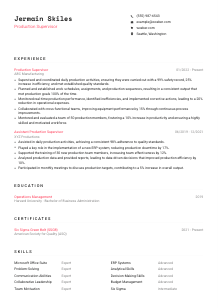
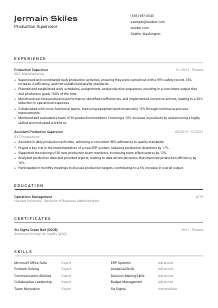
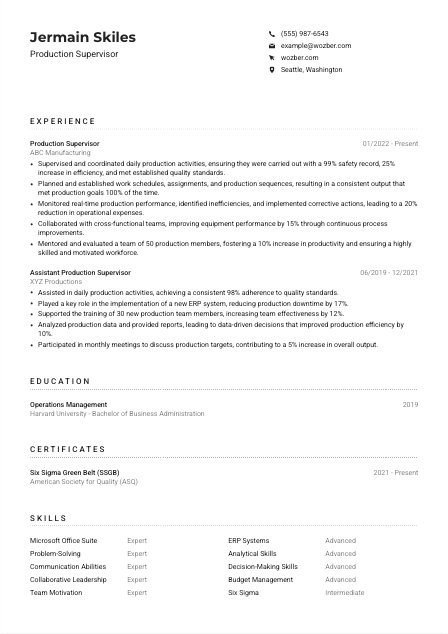
Place "Production Supervisor" directly under your name when that is the role you are pursuing. This removes ambiguity, especially if your recent titles include related roles such as Assistant Production Supervisor, Shift Lead, or Manufacturing Team Lead. The sample resume does this well by naming the target role immediately.
List a reliable phone number and a professional email address. Use an email format based on your name, not a nickname or informal handle. If you include a LinkedIn profile or professional website, make sure the job titles, dates, and achievements match the resume exactly so there are no inconsistencies during review.
If the posting asks for candidates in a specific area or those willing to relocate, show that plainly in this section. Here, Seattle, Washington is part of the requirement, so listing Seattle in the resume header directly supports your application. If you are relocating, state that clearly instead of leaving the employer to guess.
Include a LinkedIn URL, portfolio, or company bio page only if it adds relevant context, such as leadership progression, plant experience, or operations credentials. Production hiring rarely depends on personal branding extras. A link earns its place when it reinforces your supervisory track record, certifications, or manufacturing background.
This section should answer the practical basics in seconds: who you are, what job you are pursuing, and whether you meet immediate logistics for the role. Keep it clean and operational.




This is the section most manufacturing employers read hardest. They want to see whether you have supervised output, responded to production issues in real time, improved line performance, and led teams against measurable targets. Daily oversight, schedule control, quality discipline, and cost awareness should all show up through your accomplishments, not just your job titles.
Pull out the working priorities behind the job ad before you write or revise a single bullet. In this case, the recurring themes are safe production, efficient scheduling, quality standards, real-time monitoring, cross-functional improvement, and team development. Those are the areas your experience bullets should map to so the employer can quickly connect your background to current plant needs.
List your roles in reverse chronological order, starting with your most recent production leadership position. For each role, include title, company, and dates first. That simple structure helps a hiring manager track your progression from support roles into direct supervision, as shown in the example move from Assistant Production Supervisor to Production Supervisor.
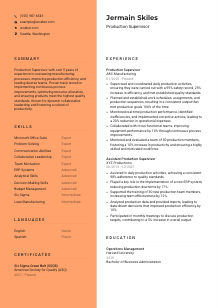
Production supervision is measured through throughput, downtime, scrap, labor efficiency, safety performance, schedule attainment, and cost control. Write bullets that connect what you managed to what improved. The sample resume does this effectively with outcomes such as a 25% efficiency increase, a 20% reduction in operational expenses, and a 99% safety record. Those numbers make the scope of supervision real.
Focus your strongest bullets on the same operating responsibilities named in the job description. If the employer stresses work schedules and production sequences, include examples of how you planned staffing, balanced workloads, or kept output on target. If collaboration matters, show where you worked with maintenance, quality, engineering, or supply chain to improve equipment performance or reduce waste.
Not every past task deserves space. Prioritize experience that shows shift supervision, process improvement, coaching, ERP usage, reporting, or manufacturing decision-making. If an older role is less relevant, trim it to the essentials and let your recent plant leadership carry the section. The reader should come away with a clear sense that you can run production, not simply participate in it.
Your experience section should show a supervisor who can keep production moving, correct issues quickly, and improve results over time. Use numbers, team scope, and plant-relevant outcomes to make that visible.
Education usually will not outweigh plant performance for a Production Supervisor, but it still matters when the posting calls for a bachelor's degree or a relevant field such as operations or business. Present it in a way that confirms you meet the requirement and supports your progression into supervisory work.
When the employer asks for a bachelor's degree in Operations Management, Business, or a related area, make that connection easy to spot. If your degree is directly relevant, state both the degree and field in full. The example does this well with a Bachelor of Business Administration in Operations Management.
List the school, degree, field of study, and graduation year in a clean order. Education is a verification section, so avoid over-formatting. Hiring teams should be able to confirm your academic background as quickly as they confirm a production date or shift assignment.
Most experienced production supervisors do not need to expand on coursework. Still, if you are earlier in your career, a few relevant details can help, especially if they connect to operations planning, quality systems, supply chain, or process improvement. Keep it brief and include only what strengthens the case for manufacturing leadership.
Leadership in student organizations, capstone projects, or operations casework can help if they demonstrate planning, team coordination, or process analysis. This matters most when you have limited supervisory history. Once you have several years on the manufacturing floor, these details should stay secondary to production results.
If your development continued beyond your degree through Lean, Six Sigma, inventory management, or operations training, make sure that story is visible across the resume. Some of that may sit in Certifications rather than Education, but the combined picture should show that you keep building the skills used to improve throughput, quality, and cost performance.
Use this section to confirm the academic requirement and support your operations background without overloading it. For this role, education should reinforce your manufacturing credibility, not compete with your production achievements.
Certifications carry real weight in production environments when they connect to process control, waste reduction, inventory flow, and continuous improvement. They show that your supervisory decisions are backed by methods employers already use on the floor, especially in plants that rely on Lean practices, root cause analysis, or structured problem-solving.
If the job description names Six Sigma, Lean Manufacturing, or similar credentials, move those to the top of this section. Even when certifications are listed as preferred rather than required, they can sharpen your profile because they connect directly to process improvement and operational discipline.
Choose certifications that support the actual work of a Production Supervisor: improving efficiency, controlling quality, reducing waste, and managing inventory or workflow. In the example, Six Sigma Green Belt and CPIM both reinforce practical strengths that matter in manufacturing operations.
List the certification name, issuing organization, and date earned or active date range. Precision matters here. Employers want to know whether the credential is current and from a recognized source, especially when the certification supports improvement programs already used in their facility.
Manufacturing systems, reporting tools, and improvement methods keep evolving. Recent certifications or active credentials suggest that you are still refining how you approach line performance, training, and operational efficiency. That matters for supervisors expected to lead change, not just maintain routine output.
List certifications that strengthen your authority in continuous improvement and plant operations. The best ones make your process thinking easier to trust before you ever reach the interview.
A Production Supervisor skills section should feel grounded in the way a facility actually runs. Hiring teams expect a mix of operational tools, supervisory judgment, and improvement methods. Keep the list focused on skills that connect directly to shift execution, reporting, team leadership, and process performance.
Read the posting for both stated and implied skills. Here that includes production software, ERP systems, Microsoft Office, analytical thinking, decision-making, communication, and leadership in a manufacturing setting. Add related capabilities that are standard for the role when they reflect your real experience, such as scheduling, quality control, safety oversight, KPI tracking, or continuous improvement.
Every skill listed should be supported by your experience, certifications, or summary. If you claim ERP systems, your bullets should show system implementation, reporting, or downtime reduction. If you claim team leadership, include team size, training, or productivity improvement. The example resume ties analytical and ERP skills to measurable production gains, which makes the list more believable.
Lead with the capabilities most likely to matter on day one, such as ERP systems, production planning, problem-solving, communication, Lean or Six Sigma, and team supervision. Avoid turning the section into a catch-all list. A shorter, sharper list gives a clearer picture of how you operate in a manufacturing environment.
Your skills section should quickly confirm that you can supervise people, read production data, use the systems in play, and improve shop-floor performance. Keep it tightly aligned with what the job actually demands.
Language ability matters in manufacturing when supervisors need to give clear instructions, document issues, coach team members, and coordinate with quality, maintenance, and management. This section is usually brief, but it can support your application when the job requires strong English communication or when the workforce is multilingual.
If the role specifically requires English communication, list English first and state your level clearly. For a Production Supervisor, that signals you can handle shift communication, incident reporting, training, and cross-functional coordination without confusion.
Order matters. Lead with the language the employer named, then include others that may help on the floor or across broader operations. This keeps the section aligned with the role instead of making it read like a personal profile.
Additional languages can be useful when supervising diverse production teams, onboarding new operators, or reducing communication gaps during handoffs and training. In the example, Spanish supports wider team communication, but it remains a bonus rather than a universal requirement for every Production Supervisor opening.
Use honest proficiency labels such as Native, Fluent, Conversational, or Basic. Production environments depend on clarity, especially around safety procedures, work instructions, and corrective actions. Overstating language ability can become a real issue once interviews or plant visits begin.
If the job involves multiple shifts, vendor coordination, or teams with varied language backgrounds, multilingual ability may deserve more attention. If language is not central to the role, keep this section compact and let your supervisory experience carry the stronger weight.
List language skills in a way that supports day-to-day manufacturing communication. The main point is simple: can you direct, train, report, and coordinate clearly in the environment you are applying to?
The summary sits at the top of the resume, so it should quickly answer the key question for this kind of hire: what scale of production leadership have you already handled? A strong summary gives a compact view of your manufacturing background, supervisory experience, improvement focus, and the results you are known for delivering.
Use the job description to identify the few themes that deserve top billing. For this role, those themes are safe and efficient production, meeting quality standards, coordinating schedules, improving processes, and leading production staff. Your summary should reflect that operating reality in a few direct lines.
Start with your title and years of relevant experience, then anchor it in manufacturing or production supervision. The example summary leads with more than 5 years in overseeing manufacturing processes, which immediately places the candidate in the right lane for the role.
Follow your opening line with concise proof points tied to the role. That can include improving efficiency, reducing operating costs, implementing ERP-related changes, raising productivity, or managing team performance. Keep these focused on outcomes a plant manager or operations leader would care about.
Aim for three to five lines that read with control and specificity. Skip broad claims about passion or work ethic. A Production Supervisor summary should sound like someone who understands throughput, workforce coordination, quality expectations, and process improvement, and who has already produced results in those areas.
Your summary should make it easy to place you in a production environment and trust your range quickly. By the time the reader reaches your experience section, they should already expect to see supervisory results, process discipline, and measurable plant impact.
A Production Supervisor resume works when it shows control of the floor, not just familiarity with manufacturing. If your sections clearly reflect team supervision, schedule ownership, KPI improvement, safety performance, ERP use, and process discipline, hiring teams can quickly see how you would operate in their plant.
Use Wozber's AI resume builder to sharpen that alignment, strengthen ATS optimization, and present your experience in an ATS-compliant resume that matches the language of the role without sounding forced. When your resume makes your production results easy to track, you give employers a straightforward reason to move you forward.




