



Use Wozber and land your dream job
Create Resume
No registration required
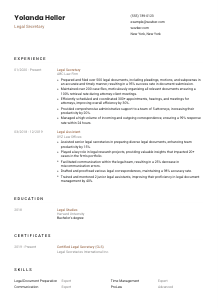
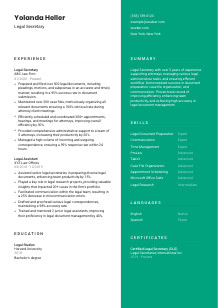
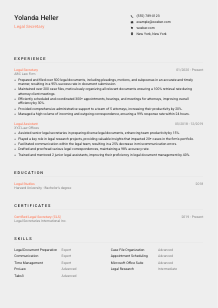
Bundling legal prowess, but your resume seems a tad brief? Check out this Legal Secretary resume example, created with Wozber free resume builder. It shows how to smoothly present your administrative acumen to match the law firm's criteria, helping your career argument carry the weight of a precedent!
Legal secretaries keep legal work on track when deadlines are fixed, filings have to be exact, and attorneys need reliable support across documents, calendars, and client communication. Your resume should make that operational value visible fast, especially your accuracy with pleadings and motions, your control of case files, and your ability to keep a busy practice organized without dropped details.
A tailored resume changes how quickly a firm can place you in the flow of its work. When your wording reflects the posting's language around document filing, scheduling, legal research, and software, Wozber's free resume builder helps you shape an ATS-compliant resume that reads clearly to both screening systems and legal hiring teams. That makes it easier to see whether you can step into active matters and support attorneys from day one.
This section is simple, but in legal hiring, small misses can raise unnecessary questions. Contact details should be clean, professional, and easy to scan, with no distractions that compete with the substance of your legal support experience.
Place your name at the top in a clear, professional font. Law firms review many resumes quickly, so your header should be easy to spot without looking stylized or overdesigned. Keep the presentation polished and straightforward.
Add "Legal Secretary" directly under your name when that is the role you are pursuing. It immediately frames your background around legal administration, document handling, scheduling, and attorney support instead of leaving the reader to infer your focus from later sections.
Include a working phone number and a professional email address. Use an address based on your name when possible. In a role that depends on timely correspondence with attorneys, clients, courts, and vendors, even your contact details should reflect reliability and professionalism.
If the posting requires a specific location, meet that requirement clearly in your header. Here, listing New York, New York helps remove doubt about availability for an on-site or local role. Treat location this way when it is explicitly requested, not as a universal rule for every legal secretary resume.
A LinkedIn profile or professional website can strengthen your application if it is current and consistent with your resume. For legal support roles, that profile should reinforce your office experience, software familiarity, and administrative scope rather than function as a generic online presence.
Your personal details should answer practical questions immediately: who you are, how to reach you, and whether you meet any stated location requirement. Then the hiring team can move straight to your legal support background.




For legal secretaries, experience is where firms look for proof of pace, accuracy, and trustworthiness. Hiring teams want to see the kind of work you handled, the volume you supported, and how well you kept attorneys, documents, and deadlines moving together.
Start by pulling out the main work patterns in the posting, then map your experience to them. For this role, that includes preparing and filing pleadings, motions, and subpoenas, maintaining case files, scheduling hearings and meetings, assisting with legal research, and managing correspondence. If you have done those tasks, name them directly instead of describing them in broad administrative terms.
List roles in reverse chronological order with title, employer, and dates. That structure works well in legal hiring because it shows your most recent office environment first, whether it was a law firm, legal department, or litigation support setting. Clear structure also helps ATS systems parse your background correctly.
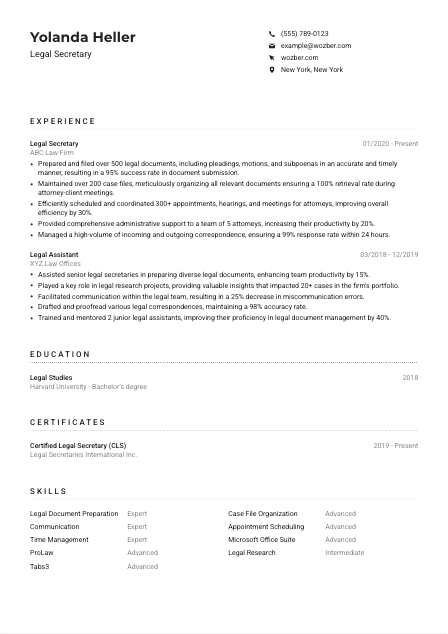
Numbers matter in legal support because they show scope and consistency. The sample resume does this well by noting more than 500 legal documents prepared and filed, 200 case files maintained, and 300+ appointments and hearings coordinated. Metrics like filing accuracy, turnaround time, response rates, calendar volume, or attorney-to-secretary support ratio make your contribution easier to understand.
Mirror the posting's terminology where it matches your real experience. If the job mentions "pleadings," "motions," "subpoenas," "case files," or "legal research," use those exact terms in your bullets rather than replacing them with vague phrases like "handled paperwork" or "supported office operations." This strengthens ATS alignment and gives hiring managers a more precise picture of your work.
Prioritize experience that shows legal office discipline, document control, scheduling accuracy, client communication, and support for attorneys. Even if you have broader administrative achievements, keep the bullets focused on law-firm-relevant work. A concise list of targeted accomplishments reads better than a longer section filled with unrelated office tasks.
Your experience section should show that you can keep legal documents, calendars, and communication flowing accurately under pressure. When that is clear, your value to a legal team is much easier to judge.
Education matters most here when it confirms you meet the posted baseline and understand legal office work. Keep this section direct, with the most relevant degree information easy to find.
If the role asks for a bachelor's degree in Legal Studies or a related field, make that match obvious. A degree such as the sample's Bachelor's in Legal Studies directly supports your familiarity with legal concepts, terminology, and research practices that show up in day-to-day secretary work.
List your degree, field of study, school, and graduation year. That is usually enough. Legal hiring teams do not need a heavily detailed academic narrative when your experience already carries the application.
If you earned honors, completed legal writing or research-heavy coursework, or hold a credential that complements your degree, include it when it adds useful context. Keep the focus on details that support legal document work, research support, or office readiness.
Early-career candidates can use selected coursework to show preparation in areas such as civil procedure, legal research, contract law, or legal writing. For candidates with several years in a law office, that space is usually better spent on professional accomplishments.
Lead with the most relevant and highest completed education. You do not need to list older or less relevant academic details if they do not add to your legal secretary profile. The section should confirm qualification, not distract from your work history.
Your education section should quickly confirm that you meet the role's academic requirements and have a solid foundation for legal office work. Then let your experience carry the rest of the case.
Certifications are not always mandatory for legal secretaries, but they can add useful weight when they reinforce legal administration skills, document accuracy, or commitment to the profession. Include them when they sharpen your positioning, not just to fill space.
Choose credentials that connect clearly to legal support work. A certification such as "Certified Legal Secretary (CLS)" strengthens your resume because it relates directly to legal procedures, office standards, and professional competence in a law-firm setting.
Dates matter when a credential is active, renewed, or recently earned. In legal environments, current credentials suggest that you stay engaged with professional standards and office practices rather than relying only on past experience.
Name the certification, issuing organization, and date or validity range. That level of detail makes the credential easy to understand and verify, especially when it comes from a recognized legal support association.
If you plan to add certifications, focus on options tied to legal administration, e-filing, records management, legal technology, or office software used in law firms. Ongoing training is especially helpful when job postings mention specific tools or updated filing workflows.
A relevant certification can strengthen your profile when it reinforces the legal office skills your experience already shows. Used well, it supports a picture of someone who takes legal support work seriously.
A legal secretary skills section should read like the toolkit of someone who can step into a busy practice and keep work moving. That means combining legal-office technical skills with the communication and organizational abilities attorneys depend on every day.
Start with the required skills named in the job description, then add closely related ones you genuinely use. Here, software proficiency in ProLaw or Tabs3 is important, along with attention to detail, organization, communication, legal document preparation, case file management, scheduling, and legal research support.
Do not list software alone. Pair platform knowledge with the work it supports, such as preparing pleadings, organizing matter files, tracking deadlines, handling correspondence, and coordinating hearings. The sample resume does this well by combining ProLaw and Tabs3 with legal document preparation, case file organization, and appointment scheduling.
A shorter, better-targeted skills section is stronger than a broad inventory of general office abilities. Focus on capabilities that matter in legal support settings and that also appear elsewhere in your resume through accomplishments or responsibilities.
This section should quickly confirm that you have the legal software familiarity, document-handling ability, and day-to-day office discipline the role requires. Every listed skill should connect to work you can actually discuss and defend.
Language ability matters in legal support when it affects document drafting, client contact, and the clarity of day-to-day communication. Present it plainly, with honest proficiency levels and only as much emphasis as the role warrants.
If the posting states that you must communicate effectively in English, make that visible in this section. For a legal secretary, strong English is tied to drafting correspondence, proofreading filings, relaying messages accurately, and communicating professionally with attorneys and clients.
Additional languages can be valuable, especially in firms serving multilingual clients or cross-border matters. Spanish, for example, may be useful in client-facing communication, intake coordination, or translating the practical flow of information, even when English remains the primary working language.
Describe your level with standard terms such as "Native," "Fluent," or "Intermediate." Avoid overstating ability. In legal settings, precision matters, and language claims should be as accurate as any other qualification on the page.
Some legal secretary roles rely heavily on bilingual communication, while others focus almost entirely on English drafting and internal coordination. Let the posting guide how much space this section should receive.
Additional language skills are a plus when they strengthen client service or office communication. They should complement your core legal support qualifications, not take attention away from document preparation, scheduling, and case organization.
List the language ability the role requires, then add any extra languages that genuinely strengthen your work in a legal office. Keep it accurate and proportional to the demands of the position.
Your summary should give a law firm a fast, concrete sense of the support you provide. In a few lines, connect your years in legal offices with the specific work you handle well, the tools you know, and the results you help produce.
Start with your title, years of experience, and the type of legal office support you provide. Keep it specific. A legal secretary summary should immediately establish experience with attorney support, legal documents, case files, scheduling, and correspondence rather than sounding like a generic administrative profile.
Call out the areas where you add value fastest, such as document preparation, filing, calendar coordination, legal research assistance, or records organization. If software proficiency is important in the posting, mention the relevant platforms here when you have real experience with them.
A short summary gets stronger when it includes measurable context. The sample resume points to improved attorney productivity, high filing accuracy, and fast correspondence response times. You do not need many numbers here, but one or two grounded results can separate your summary from a generic introduction.
Aim for three to five lines. Enough detail to show your legal office value, but not so much that it repeats the experience section. The summary should function like a precise opening statement, not a full case file.
A good summary should quickly position you as a legal secretary who can handle documents, deadlines, and attorney support with accuracy. If those strengths are clear in the opening lines, the rest of the resume has a strong foundation.
A legal secretary resume works when it makes daily legal support easy to picture: accurate filings, orderly case records, dependable scheduling, professional correspondence, and steady support for attorneys under deadline. Keep every section tied to that reality.
Use Wozber's AI resume builder to tighten your wording, align your experience with the posting, and present it in an ATS-friendly resume format that holds up in both ATS optimization and human review. The final result should make one thing clear: you can keep legal work organized, timely, and ready to move.




