



Use Wozber and land your dream job
Create Resume
No registration required
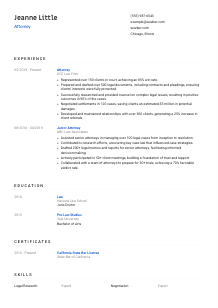
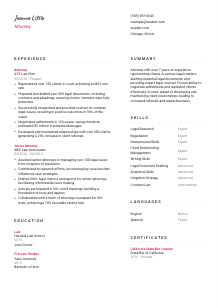
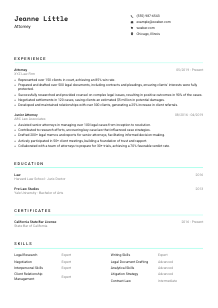
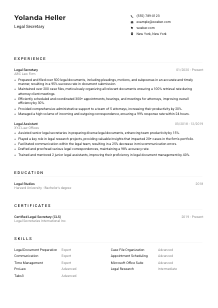
Arguing cases, but your resume lacks conviction? Check out this Attorney resume example, created with Wozber free resume builder. It shows how to present your legal expertise in line with job demands, positioning your career for a verdict of success!
Attorney resumes are read with a practical question in mind: can this lawyer handle matters that require sound judgment, strong writing, disciplined research, and credible client representation under pressure. Generic claims about being detail-oriented or strategic do very little here. Hiring teams want to see the work itself through litigation outcomes, drafting volume, research depth, negotiation results, and the kinds of matters you have managed.
A tailored resume changes how quickly those qualifications come through, especially when an ATS is filtering for credentials such as a JD, bar admission, and core legal functions like drafting pleadings or advising clients. Wozber's free resume builder helps you align your wording with the posting, keep an ATS-friendly resume format, and present your legal background in a way that makes your courtroom, advisory, and drafting experience easier to recognize.
Legal hiring starts with fundamentals that cannot be vague. Your name, title, contact details, and location need to show that you are reachable, professionally presented, and, where relevant, already aligned with jurisdiction or relocation expectations. Keep this section clean and factual.
Use your full name in a slightly larger font so it is easy to find at the top of the page. For attorneys, this is not a branding exercise as much as a matter of professional clarity. Court filings, client correspondence, and bar records all run on exact identification, and your resume should do the same.
Place "Attorney" under your name when that is the role you are pursuing. Matching the title used in the job posting helps frame the rest of your experience immediately, especially if your past titles include variations such as Associate, Junior Attorney, Counsel, or Litigation Attorney.
Include a current phone number and a professional email address. Small errors here create avoidable friction in a hiring process that often moves quickly once a firm or legal department wants to schedule interviews. If you include a website or LinkedIn profile, make sure the practice areas, dates, and bar information match the resume.
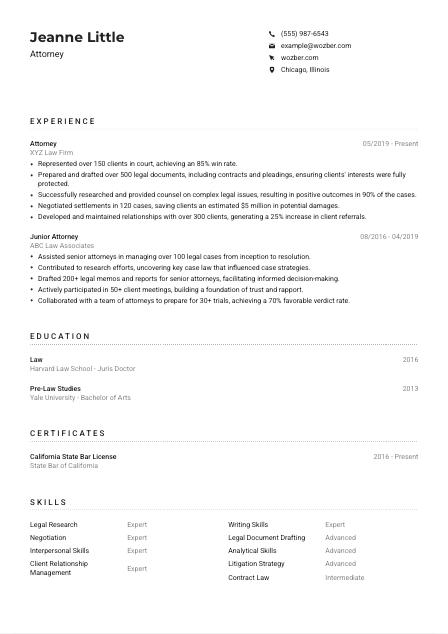
If the employer needs someone based in a specific market, list your city and state. In the example, Chicago, Illinois matters because the posting asks for local presence or relocation. That kind of detail helps remove questions about practical availability without taking up much space.
A LinkedIn profile can reinforce your practice history, publications, speaking engagements, or representative matters. Keep it consistent with your resume and useful to a legal employer. If it is sparse or outdated, leave it off until it reflects your current work accurately.
Your header should confirm the basics fast: who you are, what role you are targeting, how to reach you, and whether location is already aligned with the employer's needs.




This is the section most likely to determine whether your resume moves forward. For attorneys, experience needs to show the kind of matters you handled, how you contributed, what documents you drafted, whether you appeared in court or before agencies, and what results followed from your work. Broad statements about responsibility are much weaker than specific case-related outcomes.
Start by marking the work the employer emphasized: client representation, legal research and analysis, drafting contracts, pleadings, and motions, negotiating settlements, and staying current on legal developments. Then make sure those functions appear in your own bullet points using accurate legal language drawn from your actual practice.
Use reverse chronological order and include your title, employer, and dates. Then show the setting in which you practiced. A law firm role can highlight client advocacy, motion practice, and trial preparation, while an in-house role may lean more heavily on contract review, compliance, risk analysis, and business advising. That context tells the reader how to interpret your achievements.
Strong attorney bullets show what you handled and what changed because of your work. The example does this well with specifics such as representing more than 150 clients in court, drafting over 500 legal documents, and negotiating settlements across 120 cases. Those statements work because they connect legal tasks to real volume, outcomes, and client impact.
Use metrics that belong naturally in legal work: number of clients represented, documents drafted, matters managed, settlements reached, trial outcomes, referral growth, or estimated damages avoided. An 85 percent win rate or $5 million saved in potential damages gives hiring teams a clearer read on performance than generic phrases about success.
Choose bullets that support the practice needs of the job you want now. If the role emphasizes courtroom advocacy and drafting, lead with hearings, motions, pleadings, and settlement work. If your background includes unrelated administrative wins, trim them unless they support client management, case handling, or legal operations in a meaningful way.
By the end of this section, a reader should understand the matters you have handled, the legal work you personally performed, and the results you delivered for clients, firms, or business stakeholders.
Education matters in legal hiring because some qualifications are threshold requirements, not nice-to-have details. Your law degree needs to be easy to find and easy to read. After that, include additional academic background in a way that supports your legal path without crowding the section.
When a posting asks for a Juris Doctor from an accredited law school, make that credential unmistakable. List your JD prominently with the school and graduation year. This is one of the first qualifications many employers and ATS filters will look for.
Present each entry with school, degree, field of study, and graduation year. Legal employers do not need decorative formatting here. They need fast confirmation that the academic requirements are met and that your timeline makes sense alongside your bar admission and work history.
Your undergraduate degree belongs here, but it should stay secondary to the JD. In the example, the BA appears after Harvard Law School, which keeps the legal credential in the strongest position. That ordering is especially useful once you have several years of practice experience.
Most practicing attorneys do not need to list courses. Make an exception if you are early in your career or applying to a niche practice area where classes, clinics, journals, or seminars directly support the role, such as corporate transactions, employment law, or appellate advocacy.
Honors, law review, moot court, clinics, or notable research can strengthen this section if they relate to writing, advocacy, or subject-matter depth. For attorneys with 3+ years of experience, keep these details brief unless they remain highly relevant to the practice area.
Your education should quickly establish that you hold the required legal degree and have the academic foundation expected for licensed practice.
For attorneys, this section is less about collecting certificates and more about showing you are authorized to practice and current in your professional standing. If the posting mentions licensure, bar admission belongs here unless you place it elsewhere prominently. Additional legal credentials can help when they reinforce a practice area.
The posting requires an attorney who is licensed to practice law in the state or eligible for licensure on motion. That makes bar admission one of the most important credentials on the page. If you hold an active license, list it clearly with the issuing bar and current status dates where appropriate.
Additional credentials are useful when they connect to the work you want, such as mediation training, privacy certifications, compliance designations, or specialized dispute resolution programs. Do not add unrelated certificates just to fill space.
Include issue dates or active ranges for licenses and certifications, especially when the credential signals current eligibility to practice. In the example, the state bar license includes an active date range, which helps establish continuity.
Law changes constantly through statutes, regulations, and case law. If continuing legal education or specialized training materially supports your target role, include the strongest items to show that your knowledge is current and applied, not static.
For most attorneys, this section should first answer the licensure question. Any additional certification should reinforce the kind of legal work you are qualified to handle.
The best attorney skills sections do not read like a generic professional checklist. They echo the work of practice: research, drafting, negotiation, litigation support, client advising, issue spotting, and communication that holds up in courtrooms, conference rooms, and written submissions. Keep the list targeted and support it elsewhere in the resume with proof.
Start with the skills the employer called out directly, including research, analytical thinking, problem-solving, written communication, and verbal communication. Then add adjacent legal skills that support those functions, such as legal document drafting, negotiation, litigation strategy, contract review, or client counseling, if they reflect your experience.
Lead with the competencies that affect case handling and legal advice. Legal research, writing, negotiation, and client relationship management are strong examples because they connect directly to representation, motion practice, settlement discussions, and advisory work. The sample resume uses that approach well by pairing legal and interpersonal skills rather than separating them.
Choose skills you can back up through your experience bullets. If you list litigation strategy, there should be trial preparation, hearings, or case outcomes somewhere else on the resume. If you list contract law, your experience should mention drafting, review, negotiation, or advisory work tied to agreements.
Your skills list should sound consistent with your actual practice and make it easier to connect your experience to the legal work the employer needs covered.
Language ability matters in legal work when it affects client communication, cross-border matters, community-facing practice, or the employer's operating environment. Even when English is the only stated requirement, list languages carefully and use clear proficiency levels. Accuracy matters because legal communication leaves little room for overstatement.
If a posting states that the role operates in an English-speaking work environment, list English clearly with your proficiency level. For legal roles, that requirement touches everything from drafting and negotiations to courtroom advocacy and client advice.
Place the most relevant language first, then add others that could support client service or matter coverage. In many US-based attorney roles, English will lead. Additional languages may be especially useful in immigration, employment, family law, or community-based practice settings.
A second language can strengthen your profile when it helps with client intake, witness interviews, document review, or relationship-building. The example includes Spanish, which could be a real asset in client-facing practice, even though it is not a universal requirement for attorney roles.
Choose straightforward terms such as Native, Fluent, Advanced, or Conversational. Avoid inflating your level. In legal work, the difference between being able to exchange pleasantries and being able to explain rights, review contracts, or negotiate accurately is substantial.
Language ability can improve trust, reduce friction in client communication, and widen the kinds of matters you can support. That value is strongest when the language skill is credible, relevant, and presented without exaggeration.
When listed accurately, languages can show broader client reach and practical communication value beyond the baseline English requirement.
Your summary should work like a concise professional opening. In a few lines, it needs to tell a legal employer what kind of attorney you are, how much experience you bring, and which core strengths define your practice. Keep it grounded in actual legal work and measurable results rather than broad claims about passion or excellence.
Open with your title, years of experience, and the kind of legal work you handle most confidently. For an attorney, that may include litigation, contract drafting, client counseling, regulatory work, employment matters, or general commercial practice, depending on your background.
Use one or two concrete examples that match the posting. The sample summary works because it mentions years of experience, client representation, legal document drafting, and settlement work. If you have metrics such as matter volume, win rate, or damages avoided, use them selectively.
Choose capabilities that influence the quality of your work, such as legal research, persuasive writing, negotiation, analytical judgment, or client relationship management. Keep the focus on strengths that support the role's actual responsibilities, not generic personality traits.
Aim for 3 to 5 lines. A hiring partner or legal recruiter should be able to read it quickly and understand your level, scope, and main value. Concision matters here because the rest of the resume needs room to prove the points you introduce.
A focused summary should quickly position you as a lawyer with the right level of experience, legal judgment, and practice strengths for the role you are targeting.
Once each section is aligned, your resume should read like a clear professional record of licensed practice, legal writing strength, research depth, client representation, and results. That is what helps an attorney resume stand up in a competitive review process.
Use Wozber's free resume builder to organize that record in an ATS-friendly resume template, tailor the language to the posting, and strengthen ATS optimization with terms that match your actual work. The final version should make it easy to judge whether you can step into the role and handle the legal responsibilities from day one.




