




Use Wozber and land your dream job
Create Resume
No registration required
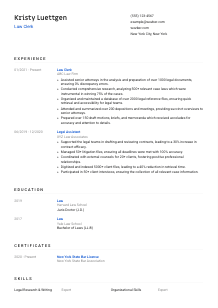
Working through cases, but your resume seems objectionable? Object no further! Unseal this Law Clerk resume example, created with Wozber free resume builder. Learn how to present your legal acumen to match job specifications, positioning you as a rulebook virtuoso in the eyes of potential employers!
Law clerk work sits close to the record. Attorneys rely on clerks to find controlling authority, draft clean memoranda, organize files that can be retrieved fast, and capture the substance of hearings or depositions without missing a key detail. Your resume should make that kind of legal support visible, especially your research depth, drafting quality, and accuracy under supervision.
A tailored law clerk resume changes how quickly a hiring team can place you in the workflow. When your document mirrors the posting's language around legal research, document preparation, file management, and clear written English, it becomes easier to pass ATS screening and easier for attorneys to picture you handling live case support. Wozber's free resume builder helps you shape that alignment in an ATS-friendly resume format so your experience reads like someone who can contribute from day one.
In legal hiring, small errors carry more weight than they do in many other fields. A personal details section should be clean, professional, and easy to verify, because it sets the tone for the precision expected in research memos, drafts, and court-related documentation.
Use your full name as the header in a larger, professional font so it is easy to spot on the page. Law firms and legal departments often review many resumes quickly, and a clean header supports the same clarity you are expected to bring to briefs, motions, and internal memoranda.
Add "Law Clerk" directly below your name when that is the role you are pursuing. This immediately frames your background around attorney support, legal research, drafting, and case-file work instead of leaving the reviewer to guess whether you are applying as a paralegal, legal assistant, or early-career attorney.
Include a reliable phone number and a professional email address, ideally a simple format based on your name. In legal hiring, a typo in contact details can raise concerns about the same kind of carelessness that causes citation mistakes, filing errors, or version-control problems in legal documents.
If a posting names a specific location, show that clearly in your personal details. Here, listing "New York City, New York" directly addresses a stated requirement and removes uncertainty about local availability. Treat that as tailoring to the opening, not a rule for every law clerk resume.
A LinkedIn profile or professional website can help if it is current and consistent with your resume. For legal candidates, that profile should reinforce your experience, education, writing-related strengths, and professional presentation rather than introduce informal content or conflicting dates.
Handle this section with the same discipline you would use for a court filing or attorney-facing draft. Accurate contact details, the right title, and any location requirement should be settled before a reviewer reaches your experience.




For a law clerk, experience is where hiring teams look for proof that you can support active matters without slowing attorneys down. They want to see research, drafting, file organization, and courtroom or deposition support described in concrete terms, with enough detail to understand your scope and reliability.
Pull out the practical work named in the job description before you edit your bullets. For a law clerk, that often includes legal research, analyzing case law and statutes, drafting motions or memoranda, maintaining reference files, and summarizing proceedings. Those are the terms your experience section should reflect when they match work you have actually done.
List positions in reverse chronological order with job title, employer, and dates. Legal hiring teams need a quick read on where you built drafting experience, what type of office supported your development, and whether your recent work aligns with litigation support, document preparation, or broader legal operations.
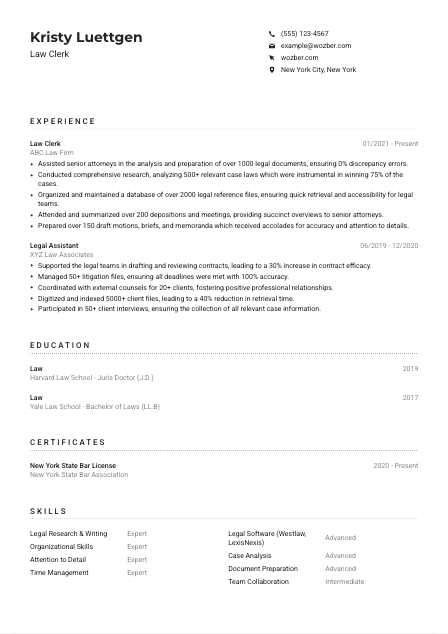
Your best bullets should focus on the work product attorneys depend on. That includes researching precedent, preparing draft briefs or motions, organizing litigation files, attending depositions or hearings, and summarizing what happened in a usable format. The sample resume does this well by naming specific outputs such as 150+ draft motions, briefs, and memoranda and 200+ summarized depositions and meetings.
Numbers help when they describe volume, speed, accuracy, or case contribution in a believable way. Useful metrics for this profession include document counts, file volumes, retrieval-time improvements, research volume, deadline accuracy, or win-rate contribution where the connection is clear. In the example, citing 500+ case laws analyzed and 2000 managed reference files gives the reader a concrete sense of scale.
Keep the section centered on legal responsibilities and outcomes that transfer to the target role. If you have related work as a legal assistant or in a legal clinic, emphasize drafting, document review, file control, hearing preparation, client intake support, or deadline management. Remove bullets that do not strengthen your case for handling attorney support work with precision.
By the end of your experience section, a reviewer should be able to picture you researching authorities, preparing drafts, managing legal files, and supporting attorneys through the day-to-day demands of active matters.
Education matters in law clerk hiring because it establishes the legal training behind your writing, research, and analytical work. When a posting names both undergraduate legal study and a J.D. or equivalent, your resume should surface those credentials quickly and present them in a format that leaves no doubt about eligibility.
Start with the credentials that directly answer the posting. Here, that means showing both a bachelor's-level law qualification or related field and a Juris Doctor or equivalent legal education. If you hold both, make sure neither is buried below less relevant academic details.
List each school with degree, field of study, institution, and graduation year. Legal resumes benefit from orderly presentation because it mirrors the disciplined structure expected in case citations, research notes, and formal written submissions.
When the posting explicitly asks for a J.D. or equivalent legal education, use the degree name exactly as awarded and make it easy to find. In the sample resume, "Juris Doctor (J.D.)" is clear and direct, which helps a reviewer connect the candidate's education to the requirement immediately.
If you are early in your legal career, include legal writing courses, research-intensive seminars, moot court, journal work, or academic projects tied to statutory analysis, case briefing, or motion practice. These details can strengthen your resume when professional experience is still developing.
Honors, law review, mock trial, research assistant work, or top performance in writing-heavy coursework can add value when they reinforce legal analysis and writing strength. Include them selectively, especially if they support the kind of clerkship work the target role emphasizes.
Your education section should quickly confirm that you have the formal legal training to handle research, drafting, and attorney support work. Keep it straightforward, visible, and aligned with the posting's stated academic threshold.
Many law clerk roles do not require certifications beyond the educational foundation, but credentials can still strengthen your resume when they relate directly to legal practice, court readiness, or specialized support work. The key is relevance, not volume.
If the job does not ask for a license or certification, do not force this section to carry more weight than it should. Instead, use it to add relevant legal credentials that support your research, drafting, or office-readiness. For this opening, a New York-related credential may be useful context, but it is not the main hiring requirement.
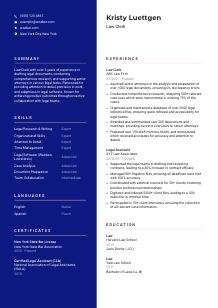
Prioritize licenses or certifications that connect to legal operations, document handling, compliance, or jurisdictional familiarity. In the example, the New York State Bar License and Certified Legal Assistant credential both add professional context, though not every law clerk candidate will have or need those exact credentials.
Add issue dates or active date ranges for current licenses and certifications. This helps legal employers understand whether a credential is current, recent, or ongoing, which is especially useful for bar-related status or professional associations tied to legal practice standards.
Continuing education, legal research training, e-discovery coursework, compliance certificates, or writing-focused programs can strengthen your profile when they support the actual work of the role. This is especially helpful if you are building a litigation-support or research-heavy path.
Treat certifications as supporting material. When they reinforce legal training, professional credibility, or jurisdictional knowledge, they add value. When they do not connect to the work, leave them out.
Skills sections carry more weight in legal resumes when they echo the actual tools and strengths used in daily case support. Hiring teams look for a practical mix of legal research, writing, document handling, software familiarity, and the personal discipline needed to work accurately under deadlines.
Start with the capabilities the role depends on. Here, that includes legal research, legal writing, attention to detail, file organization, clear written English, and proficiency with legal software and databases. Build your list from those core functions instead of filling the section with generic workplace traits.
Use the same terminology the employer uses when it is accurate for your background. If the posting asks for legal software and databases, name the platforms you know, such as Westlaw or LexisNexis, rather than relying only on a vague phrase like "computer skills." The sample resume handles this well by pairing legal research and writing with named research tools.
Lead with the abilities that matter most to a law clerk's daily work: research, writing, case analysis, document preparation, organization, and deadline reliability. Soft skills such as collaboration or time management can stay, but they should not outrank the technical and drafting strengths that attorneys are hiring for.
Your skills section should read like a practical legal toolkit. A reviewer should quickly see that you can research efficiently, draft clearly, work accurately with legal files, and use the databases and systems the office relies on.
Language skills matter in legal work when they affect drafting, client communication, document review, or service in a multilingual community. For a law clerk role, the baseline is usually strong written English, because research memos, summaries, and draft pleadings all depend on precise language.
If the posting calls for clear written English, make that visible in your languages section. Mark your English proficiency accurately, such as "Native" or "Fluent," so there is no doubt about your ability to draft summaries, research notes, and attorney-facing documents.
Include other languages when they could support client intake, document review, community-facing matters, or multilingual office work. In a market like New York City, a language such as Spanish can be genuinely useful, but only include languages you can use confidently in a professional setting.
Use clear labels like "Native," "Fluent," "Advanced," or "Conversational" rather than overstating ability. Legal work depends on accuracy, and that expectation applies to how you describe your own language skills as much as it does to how you summarize a deposition or draft a memorandum.
Some law clerk roles place much more value on additional languages, especially in immigration, family law, criminal defense, or community-based practice. In other offices, English writing strength will matter far more. Adjust the emphasis based on the work, not just on the fact that you speak more than one language.
A second or third language can strengthen your resume when it expands the kind of legal support you can provide. The value comes from practical use, such as better client communication or document comprehension, not from listing languages as a purely personal detail.
For a law clerk, language proficiency should reinforce written precision and, where relevant, broader client or document access. Lead with English clarity, then add other languages that bring real legal value.
The summary is your quickest chance to position yourself for the specific kind of legal support the role requires. In a few lines, it should establish your experience level, your strongest legal functions, and the kind of work product you can deliver under attorney supervision.
Before writing, identify the two or three themes repeated in the job description. For this role, those themes are legal research, drafting legal documents, file organization, and clear written support for attorneys. Let those priorities shape the summary instead of opening with generic enthusiasm.
Open with a direct line such as "Law Clerk with 3+ years of experience" or a similarly accurate description. That immediately places you in the legal support track and gives context for the level of responsibility you have handled across research, drafting, and case preparation.
Use the next sentence or two to highlight the work you do well, such as analyzing case law, preparing draft motions and memoranda, summarizing hearings, or maintaining high-volume legal files. The sample summary works because it names drafting, research, and legal software proficiency rather than relying on broad claims alone.
Aim for three to five lines with no filler. A law clerk summary should read cleanly, use legal terminology naturally, and connect your background to the office's immediate needs. Leave room for the experience section to prove the details with metrics and examples.
A well-written summary should give the reader a fast, credible picture of the legal work you can handle. When it is tailored well, the rest of the resume reads as confirmation rather than explanation.
A law clerk resume should make three things easy to see: how well you research, how clearly you write, and how reliably you support attorneys across documents, files, and live proceedings. When each section points back to those functions, your application reads with much more credibility.
Use Wozber's free resume builder to organize that experience in an ATS-compliant resume, then sharpen the language with role-specific phrasing and legal terminology that match the posting. The result should give a hiring team a clear read on your ability to step into legal research, drafting, and case support without a long ramp-up.




