



Use Wozber and land your dream job
Create Resume
No registration required
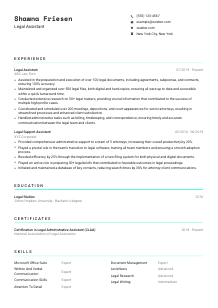
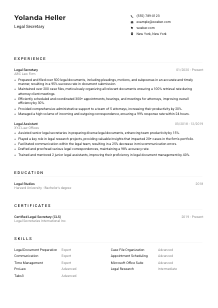
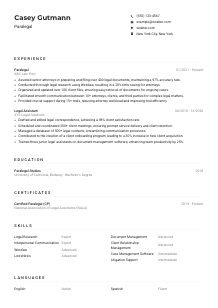
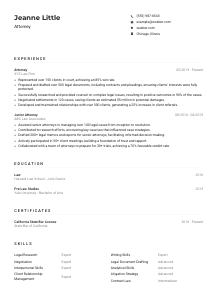
Supporting attorneys, but your resume lacks a verdict? Explore this Legal Assistant resume example, created with Wozber free resume builder. Learn how to bring together your legal acumen and multitasking skills, ensuring your career briefs align perfectly with any job litigation!
Legal assistants keep casework moving when deadlines, filings, attorney calendars, and document accuracy all collide at once. A resume for this field needs to show more than general administrative support. It should make clear that you can manage legal documents, maintain reliable records, support research, and keep day-to-day legal operations organized without errors.
Resume screening for legal assistant roles often narrows quickly around relevant legal workflow. If your resume buries document preparation, court scheduling, billing support, or research work under broad office language, it can miss the mark in both ATS filters and human review. Wozber's free resume builder helps you align your wording with the posting in an ATS-friendly resume format, so hiring teams can quickly see where your experience fits the legal work in front of them.
This section is simple, but legal employers still notice sloppiness here. A clean header with accurate contact details, the right title, and any location detail the posting asks for sets the tone for the document handling and precision they expect in the role.
Use your full name exactly as you present yourself professionally. Keep it prominent and readable so it stands apart from the rest of the page. In legal hiring, polish matters, and even your header should reflect the same care you would bring to client correspondence, filing packets, or contract drafts.
Place "Legal Assistant" directly under your name when that is the role you are applying for. This helps frame your background immediately, especially if your past titles include variations such as Legal Support Assistant or Administrative Assistant in a legal department. It tells the reader that your experience is being presented for legal support work, not general office support.
Include a phone number you answer, a professional email address, and, if relevant, a website or LinkedIn profile that matches your resume. Accuracy matters here. A typo in your email or an outdated number creates the wrong impression for a role built around detail, deadlines, and dependable communication with attorneys, clients, and outside parties.
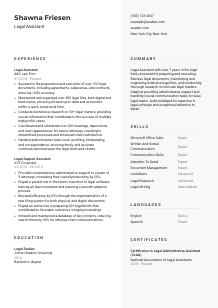
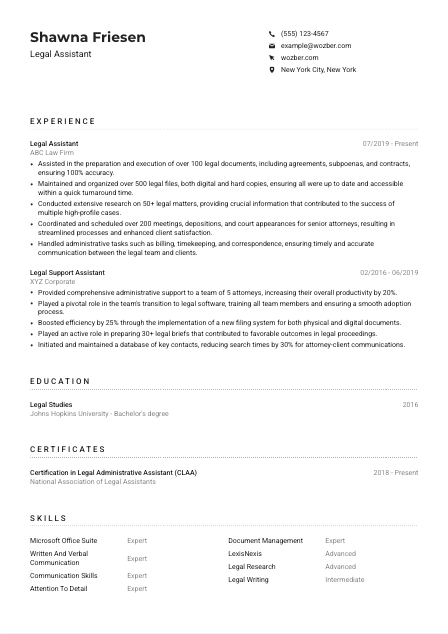
If an employer specifies a location requirement, show it clearly in your personal details. In this example, listing "New York City, New York" answers a stated requirement without forcing the employer to guess about availability or relocation. For other legal assistant roles, include city and state when location affects court access, in-office scheduling, or local hiring rules.
A LinkedIn profile can add value when it reinforces your legal background, software familiarity, and progression across law firm or corporate legal environments. Keep the content consistent with your resume. If your profile is sparse or outdated, leave it off until it reflects the same level of organization you want employers to expect from your file management and legal support work.
A precise header does quiet but important work. It confirms who you are, where you are based when required, and how to reach you, while signaling the accuracy legal teams expect from someone who will handle documents, scheduling, and correspondence.




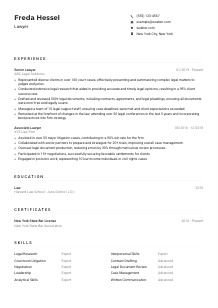
This is the section most likely to decide whether your resume stays in the pile. Legal employers want to see the kind of work you supported, the volume or pace you handled, and how reliably you managed documents, research, attorney coordination, and legal administration.
Read the job description with a legal workflow lens. Look for repeated responsibilities such as preparing agreements and subpoenas, organizing case files, supporting legal research, coordinating depositions or court dates, and handling billing or timekeeping. Those are the areas your experience bullets should reflect first, because they map directly to how legal assistants are evaluated in practice.
List your title, employer, and dates in a straightforward format, then make sure your bullets show the legal setting behind the title. If you worked in a law firm, corporate legal department, litigation team, or transactional environment, your bullet points should make that visible through the work itself. Titles vary, but responsibilities such as document preparation, attorney support, and records management tell employers where you can contribute.
Focus each bullet on a concrete responsibility or result tied to legal operations. The sample resume does this well with points like preparing more than 100 legal documents and coordinating over 200 meetings, depositions, and court appearances. That is stronger than saying you "assisted attorneys," because it shows the actual workload and the kinds of legal deliverables you handled.
Metrics are especially useful in legal support when they show volume, turnaround, efficiency, or precision. File counts, number of matters researched, scheduling volume, attorney team size, billing accuracy, or process improvements all help. Managing 500 files, supporting 50+ legal research matters, or improving filing efficiency by 25% gives hiring teams a clearer picture of your operating range than vague claims about being organized.
Keep the strongest space for work that mirrors the target role. Legal software use, document control, research support, court or deposition scheduling, and attorney-facing administration should appear before generic office duties. If you have older experience that is less relevant, trim it back. For this profession, specificity around legal process always carries more weight than broad administrative language.
Your experience section should leave no doubt that you understand the day-to-day mechanics of legal support. When employers can quickly see document handling, research support, scheduling coordination, and operational accuracy in your bullets, they can picture you stepping into the workflow with less ramp-up.
Education matters here because many legal assistant postings still use it as a baseline filter, especially when they ask for legal studies or a related field. Present it cleanly, and use it to reinforce your grounding in legal concepts, research, and professional writing.
If the posting requires a bachelor's degree, list that credential clearly and in standard form. For this example, a Bachelor's degree in Legal Studies directly matches the requirement. When your field is related rather than exact, use the official title and let your experience and skills carry the rest of the alignment.
Use a simple structure with degree, field of study, school name, and graduation year or date. Legal hiring often moves quickly through factual checks, so clarity helps. There is no need to overdesign this section if your academic qualification already meets the baseline.
When your degree matches the role closely, let that connection work for you. A Legal Studies degree immediately supports work involving legal research, document review, and procedural awareness. In the sample resume, that direct academic match strengthens the overall case for legal assistant work without needing extra explanation.
Recent graduates can strengthen this section with selected coursework such as legal research and writing, civil procedure, contract law, business law, or litigation support. Keep it brief and only include courses that help explain your preparation for the legal tasks listed in the posting.
Academic honors, law review-style writing work, moot court participation, or research-heavy projects can help when you do not yet have much direct legal experience. Choose details that suggest disciplined writing, source handling, and analytical work rather than unrelated campus activities.
This section does not need a long explanation. It should quickly show that you meet the academic requirement and, where relevant, that your studies supported the research, writing, and procedural discipline expected in legal assistant work.
Certifications are not mandatory in every legal assistant search, but they matter when a posting names them or when you want to show deeper commitment to legal administration. List credentials that support the work you will actually be doing, not generic professional development courses.
If the employer calls out a Legal Administrative Assistant certification such as CLAA, place it prominently. That kind of credential speaks directly to legal office procedure, documentation standards, and administrative support in a legal environment. When a certification is preferred rather than required, it can still help distinguish you from applicants with similar experience.
Only include certificates that strengthen your case for legal support work. A legal administration certification, e-discovery training, records management credential, or court filing training can add value. General certificates that do not connect to document handling, legal systems, or office operations usually do not need space on a legal assistant resume.
Show the year earned or the active date range when relevant. The sample resume lists the CLAA certification as "2018 - Present," which signals ongoing validity at a glance. That small detail is useful in a profession where compliance, procedure, and current practice standards matter.
Legal support work changes with software, filing practices, and firm operations. If you are pursuing new training, choose courses that improve your value in document management, legal technology, research platforms, billing workflows, or court-facing administration. Ongoing learning is most persuasive when it sharpens your day-to-day legal support capability.
A well-chosen certification tells employers that your legal support skills are structured, current, and taken seriously. When it lines up with the posting, it gives extra weight to the rest of your experience.
A legal assistant skills section should read like the toolkit behind your daily workflow. The best version mixes legal software, document handling, research ability, and communication skills that support attorneys, clients, and court-facing processes.
Start with the skills the employer named directly, then add closely related ones you genuinely use. In this example, LexisNexis, Microsoft Office Suite, written and verbal communication, and attention to detail are all clear priorities. Those should appear before broader or less relevant skills because they connect immediately to the role's responsibilities.
Do not rely only on tool names. Pair software knowledge with the work it supports, such as legal research, document management, billing support, calendar coordination, correspondence, or contract preparation. The sample skill list works because it balances platforms like LexisNexis and Microsoft Office with legal research, document management, and legal writing.
A shorter, sharper list is usually more effective than a long catalog of generic strengths. Choose the skills most tied to legal assistant performance, such as legal document preparation, records organization, research support, filing systems, communication, and administrative accuracy. Every item should help explain how you support legal workflow.
Your skills should reinforce what your experience already proves. When the tools and capabilities here match the document work, research tasks, software use, and coordination duties in your work history, the resume reads as consistent and credible.
Language ability matters in legal work when it affects client communication, document handling, or coordination across diverse parties. Keep this section factual, and prioritize the language proficiency the employer explicitly needs for the role.
If the posting says clear English communication is essential, list English prominently with an honest proficiency level. For legal assistants, written English is especially important because it affects correspondence, document preparation, scheduling notices, and daily coordination with attorneys and clients.
If you speak another language well enough to use it professionally, include it. In some legal settings, a second language can help with client intake, scheduling, document explanation, or communication with external parties. The sample resume lists Spanish as fluent, which can be useful in client-facing environments, though it is an added strength rather than a universal requirement.
Stick to standard terms such as Native, Fluent, Intermediate, or Basic. Legal environments leave little room for overstating communication ability, especially when accuracy matters in written and verbal exchanges. Choose the level that reflects how you can actually operate in professional settings.
Only list languages if they are accurate and potentially useful in the role. For some legal assistant jobs, English alone is enough. For others, multilingual ability can support client service or internal coordination. Include what helps an employer understand how you can communicate in the legal environment they run.
Present language ability in practical terms. The value is not simply that you know another language, but whether you can use it in client contact, scheduling, intake, research support, or office communication without creating risk or confusion. That framing makes the section more relevant to legal hiring.
For legal assistant roles, language skills matter when they improve communication accuracy and client service. Keep the section honest, concise, and tied to how you would operate in the office or on legal matters.
The summary sits near the top of the resume, so it should establish your legal background quickly and in the employer's language. Focus on years of experience, the kind of legal support you provide, and the tools or strengths that show up repeatedly in the posting.
Before writing, identify the two or three responsibilities that define the position. For legal assistant roles, that often means legal document preparation, file management, research support, attorney coordination, and administrative follow-through. Build your summary around those functions rather than broad claims about being hardworking or organized.
Start with a direct line such as "Legal Assistant with 7+ years of experience" if that is true for you. This immediately tells the reader both your professional identity and your level of exposure to legal workflow. The sample resume uses this approach well and then follows with specifics that support it.
Mention capabilities you can prove in your experience section, such as preparing agreements and subpoenas, maintaining large legal file systems, conducting legal research, supporting billing and timekeeping, or managing attorney schedules. Strong summaries stay close to documented experience rather than introducing brand-new claims.
Aim for a short paragraph of about three to five lines. That is enough room to establish your experience, legal support scope, and one or two distinguishing strengths such as software proficiency, accuracy, or high-volume document handling. Leave the detail for the experience section and use the summary to frame the reader's first impression.
A good summary makes the rest of the resume easier to read. By the end of those first few lines, the employer should already understand your level, your legal support scope, and the kind of work you are ready to handle.
A legal assistant resume works best when each section reinforces the same message: you know how to keep legal work organized, accurate, and moving on schedule. Use Wozber's free resume builder to shape that message into an ATS-compliant resume, then refine the wording with its ATS resume scanner so the posting's legal terminology, software requirements, and workflow priorities show up where they should.
When the document is finished, the hiring team should be able to see your experience with legal documents, research, records, scheduling, and administrative coordination in minutes. That is the standard your resume should meet.