




Use Wozber and land your dream job
Create Resume
No registration required
Hunting top talent, but your resume lacks appeal? Check out this Recruitment Manager resume example, built with Wozber free resume builder. Learn how to match your sourcing skills to job requirements, ensuring your career prospects don't end up in the "Not a fit" pile!
Recruitment Managers are trusted with more than filling openings. They shape how a company hires, how consistently recruiters work across teams, and how well hiring data stands up in front of senior leadership. Your resume needs to show that operating level clearly, with evidence of process ownership, team leadership, and measurable recruiting outcomes such as time-to-fill, quality of hire, pipeline growth, or KPI attainment.
Screening often starts by separating hands-on recruiters from candidates who have actually led recruiting operations. A tailored resume makes that distinction visible fast by matching the language of hiring strategy, ATS and HRIS use, reporting, and team management. Wozber's free resume builder helps organize that experience into an ATS-compliant resume, so both recruiters and hiring leaders can quickly see whether you've run the function, coached recruiters, and improved hiring performance.
For a Recruitment Manager, the personal details section should feel polished and practical. Hiring teams notice accuracy here because the role itself depends on clear communication, organized records, and professional credibility with candidates, recruiters, agencies, and internal stakeholders.
Use your full name as the clearest identifier on the resume, placed prominently at the top. Keep formatting clean and professional. In a hiring role, presentation matters because your resume is also a sample of the standard you bring to candidate-facing communication and internal documentation.
Place "Recruitment Manager" under your name if that is the role you are targeting. This helps frame the rest of the resume immediately, especially if your recent title was Senior Recruiter, Talent Acquisition Lead, or a similar adjacent role. It tells the reader which level of responsibility your experience is meant to support.
Include a reliable phone number and a professional email address in a simple format. Recruitment leaders are expected to communicate clearly and consistently, so avoid anything casual or outdated. If a hiring team wants to move quickly, your contact details should never create friction.
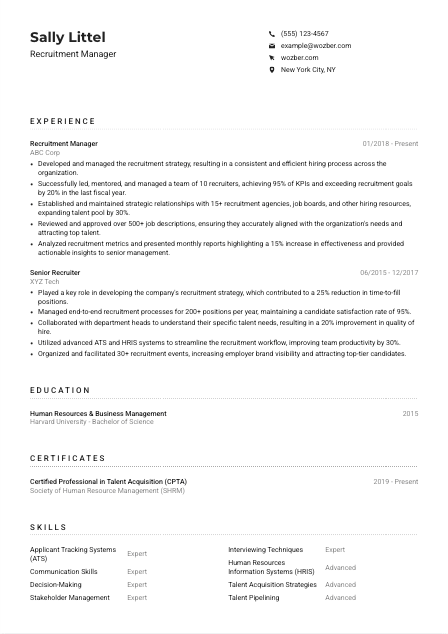
If the job calls for a specific location or relocation, include city and state to remove guesswork. In the example, listing "New York City, NY" directly supports the employer's location requirement. Use this approach when location is part of the screening criteria, but do not force it when a posting does not ask for it.
A LinkedIn profile or professional website can strengthen your application if it aligns with your resume and reflects your recruiting scope. For this role, that might include team leadership, hiring projects, employer branding work, or talent acquisition systems experience. Make sure titles, dates, and achievements match what appears on the resume.
This section should confirm that you are organized, reachable, and already operating at a professional standard expected in recruitment leadership. Keep it clean, current, and aligned with the role's practical requirements.




This section carries the most weight for a Recruitment Manager resume. Hiring teams want to see whether you have led recruiters, improved hiring processes, worked across stakeholders, and used recruiting data to make decisions. Titles matter, but the bullets underneath them are what show management scope and business impact.
Before writing bullets, identify the parts of the job that define the role's level. Here, the major themes are recruitment strategy, recruiter leadership, ATS and HRIS proficiency, external sourcing partnerships, interview guidance, and reporting to senior management. Those priorities should shape which accomplishments you lead with and which details you cut.
List your most recent role first and keep each entry easy to scan with title, employer, and dates. For recruitment leadership positions, this order helps show progression from hands-on recruiting into team management, strategic ownership, or broader talent acquisition responsibility. That career movement matters in a management search.
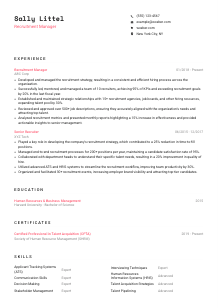
Recruitment Manager bullets should show what you owned and what changed because of your work. Strong bullets often include hiring process improvements, recruiter coaching, stakeholder partnership, agency management, and job description approval. The example does this well with details such as leading a team of 10 recruiters and reviewing 500+ job descriptions, which immediately shows management scope rather than only individual contributor recruiting work.
Numbers carry weight when they reflect how recruiting performance is actually measured. Use figures tied to KPIs, time-to-fill, recruiter productivity, candidate satisfaction, talent pipeline growth, sourcing channel effectiveness, or hiring goal attainment. In the sample, outcomes like exceeding recruitment goals by 20%, expanding the talent pool by 30%, and improving effectiveness by 15% make the impact concrete and easy to understand.
Keep the emphasis on strategic and leadership experience, especially if you also have earlier execution-heavy recruiting roles. A Recruitment Manager resume should give more space to process ownership, team coaching, reporting cadence, vendor relationships, and hiring decision support than to routine scheduling or basic sourcing tasks. Every bullet should reinforce that you can run a recruiting function, not just participate in one.
When this section is tailored well, a hiring team can quickly see your hiring volume, leadership scope, system fluency, and results. That is the clearest way to show you are ready to manage recruiting performance, not simply contribute to it.
Education usually will not decide a Recruitment Manager search on its own, but it does confirm that you meet the baseline requirement and understand the HR or business context behind talent acquisition work. Present it clearly so it supports the rest of your experience without slowing the reader down.
If the posting asks for a Bachelor's degree in Human Resources or a related field, make that easy to find. List the degree, field, school, and graduation year clearly. In the example, a Bachelor of Science in Human Resources & Business Management lines up well with the requirement and reinforces the candidate's HR foundation.
Keep the entry simple and scannable. Degree title, field of study, institution, and graduation date are usually enough. This helps both ATS parsing and human review, especially when education is a stated requirement rather than a differentiator.
When your degree is directly relevant, use wording that naturally reflects the posting. For example, "Human Resources," "Business Management," or another related field can help establish alignment quickly. Stay accurate to your transcript, but do not bury relevant degree language behind abbreviations or vague labels.
Most experienced Recruitment Managers do not need course lists. Still, if you are moving into management or your degree title is broad, a few relevant academic details can help. Topics such as organizational behavior, labor relations, HR systems, or talent management may be worth mentioning when they support the role you are targeting.
Honors, scholarships, or leadership activities are optional and usually most useful earlier in your career. Include them if they are genuinely relevant or help fill gaps, but keep the focus on material that supports recruiting leadership, people operations, or business-facing HR judgment.
For this level of role, education should quickly confirm that you meet the posting's baseline expectation. Clear presentation is enough. Let your management experience and recruiting results do the heavier lifting.
Certifications can add useful weight in Recruitment Manager hiring, especially when they relate directly to talent acquisition, HR operations, or recruiting best practices. They are particularly helpful when the employer has listed them as preferred rather than required, because they can separate you from otherwise similar candidates.
Start with certifications that match the employer's language most closely. In this case, CPTA or a comparable HR certification deserves clear placement because it connects directly to recruiting expertise and professional development in the field.
Use this section for credentials that support recruiting leadership, talent acquisition strategy, interviewing, compliance, or HR systems knowledge. The sample's Certified Professional in Talent Acquisition credential is a strong example because it reinforces specialized recruiting capability rather than broad, unrelated learning.
List the year earned or active date range when that helps show the certification is current. For roles involving process design, hiring standards, and system-driven workflows, recency matters because recruiting practices and compliance expectations change over time.
Recruitment changes with labor market conditions, sourcing channels, candidate expectations, and technology. Keeping certifications current or adding new ones in areas like talent acquisition, DEI hiring practice, HR analytics, or employment law shows that you continue to grow as a recruiting leader, not just as a practitioner.
Relevant credentials help confirm that your recruiting knowledge is current and intentional. When they align with the job posting, they can strengthen your case for leadership responsibility in talent acquisition.
A Recruitment Manager skills section should read like a concise operating profile. It needs to cover the systems, leadership capabilities, and recruiting judgment that support a full hiring function, not just a list of generic strengths.
Start with the abilities the job actually depends on. In this posting, that includes ATS and HRIS proficiency, interpersonal communication, stakeholder management, recruitment strategy, interviewing, and team leadership. Build the section from those recurring responsibilities instead of copying broad soft skills that could fit any office role.
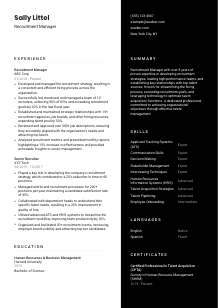
If a skill appears in the job description, give it a place when you genuinely have it. This helps with ATS optimization and makes your resume easier to match to the role. The sample handles this well by listing ATS, HRIS, stakeholder management, interviewing techniques, and talent acquisition strategies, all of which support the management scope of the position.
Avoid turning this section into a long inventory. A tighter list is usually stronger, especially for experienced candidates. Choose skills that support hiring delivery, recruiter oversight, process consistency, reporting, and cross-functional communication. That gives the reader a quick view of how you operate as a Recruitment Manager.
The best skill lists make it obvious that you can lead recruiting work, use the core systems, and partner effectively across the business. Keep the emphasis on capabilities that matter in day-to-day talent acquisition leadership.
Language ability can matter in recruitment because the work depends on clear communication with candidates, hiring managers, agencies, and internal teams. For a management role, list languages when they support the requirements or add practical value to the scope of hiring.
If the employer states a language requirement, list it clearly. Here, English proficiency is a prerequisite, so showing English prominently helps remove uncertainty early in the review. Use an honest level such as Native, Fluent, or Professional.
Extra languages can be useful when the hiring environment is diverse, candidate markets are broad, or the organization recruits across regions. In the example, Spanish adds potential value for communication with a wider candidate pool, though it should be treated as an advantage rather than a universal requirement for every Recruitment Manager role.
Choose language levels you can support in a professional setting. Recruitment work often involves interviews, negotiation, candidate care, and stakeholder communication, so overstating fluency can create problems quickly. Clear levels set the right expectations.
Some Recruitment Manager positions involve high-volume frontline hiring, global recruiting, or multilingual labor markets, where extra language ability can matter more. If language skills directly support your hiring scope, include them. If not, keep the section brief and factual.
Used well, this section can hint at your ability to work across diverse candidate populations and internal teams. That is especially relevant in recruitment, where relationship-building, candidate experience, and stakeholder trust all depend on communication that is clear and culturally aware.
For this profession, languages are useful when they support communication with the talent market or meet a stated requirement. Keep the section honest, relevant, and tied to the actual scope of hiring work.
The summary is where you frame your recruiting career at the right level before the reader reaches the experience section. For a Recruitment Manager, it should communicate seniority, leadership range, recruiting specialization, and a few business-relevant outcomes in a compact opening statement.
Start by identifying the themes that best represent your track record. For this role, that often means recruitment strategy, recruiter management, process improvement, stakeholder partnership, and hiring performance. Those are the ideas your summary should surface first.
Lead with a direct professional identifier and your years of experience. A line such as "Recruitment Manager with 8+ years of experience" works because it gives immediate context. The sample follows this approach and quickly establishes both seniority and specialization in talent acquisition.
After the opening line, include two or three points that mirror the posting's priorities. For this job, that could mean developing recruitment strategy, leading recruiter teams, improving hiring processes, and using ATS or HRIS tools to support efficiency. Keep the wording close to the employer's language where it reflects your real background.
Aim for a summary that can be read in seconds but still communicates scope. Focus on management-level value, not a full biography. The sample works because it combines years of experience with strategic leadership and process improvement, giving the reader a quick reason to expect strong recruiting operations experience in the sections that follow.
A well-written summary should make one thing clear immediately: you know how to lead recruiting, not just execute individual requisitions. When that message lands early, the rest of the resume is easier to read in the right frame.
A Recruitment Manager resume should show that you can lead recruiters, improve hiring operations, work confidently with ATS and HRIS tools, and report on recruiting performance in a way senior stakeholders can use. When each section supports that story, the application reads with much more authority.
Use Wozber to shape that content into an ATS-friendly resume format, strengthen alignment with the job description, and refine wording with targeted ATS optimization. The finished resume should make it easy to judge your leadership scope, recruiting results, and readiness to run the hiring function.




