



Use Wozber and land your dream job
Create Resume
No registration required
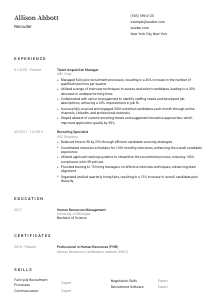
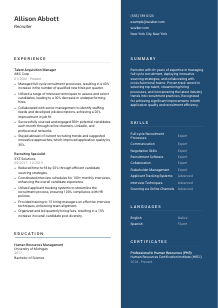
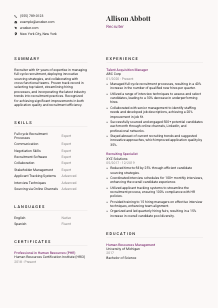
Matching talent, but your resume feels like a misfit? Browse through this Recruiter resume example, created with Wozber free resume builder. Learn how to spotlight your matching skills so they resonate with job descriptions, ensuring your career journey aligns perfectly with the candidates you bring on board!
Recruiting work is judged by outcomes that are easy to recognize and hard to fake. Can you run a full-cycle process, attract qualified candidates, guide hiring managers, keep interview flow organized, and close the right people efficiently. A Recruiter resume needs to show that operating range clearly, with real hiring volume, sourcing channels, stakeholder work, and measurable results.
A tailored resume changes how quickly that scope becomes visible. When your wording matches the language used in the target role, from full-cycle recruitment and interview techniques to ATS proficiency and candidate sourcing, Wozber's free resume builder helps you shape an ATS-compliant resume that is easier to parse and easier for hiring teams to connect to actual recruiting performance. That clarity matters when they need to distinguish a coordinator from someone who can own hiring end to end.
Recruiters are expected to notice small gaps, communicate clearly, and keep process details accurate. Your contact section should reflect the same standard. It is a short section, but hiring teams still read it as a signal of professionalism and attention to detail.
Use your full name as the most prominent text on the page. Keep it simple and professional so the resume opens cleanly, the same way a well-written outreach message or candidate brief would.
Place "Recruiter" directly under your name if that is the role you are pursuing. This helps frame the rest of your resume around recruiting work rather than broader HR support, operations, or admin experience.
Add a reliable phone number and a professional email address, ideally in a straightforward format such as firstname.lastname. Recruiters know how often process breakdowns happen because of small errors, so this section should be clean and accurate.
Some openings have geography-based requirements, whether for onsite collaboration, market coverage, or compliance reasons. Here, the employer asks for New York City, New York, so listing that in your contact details immediately removes a practical question about availability.
A LinkedIn profile can reinforce your recruiting brand, especially if it shows hiring scope, industries supported, sourcing activity, or employer branding work. Make sure the dates, titles, and achievements match your resume so the profile strengthens your credibility instead of creating discrepancies.
Your personal details should read like the start of a well-run hiring process. Clear title, accurate contact information, and any requested location details make the basics easy to confirm.




This is the section that carries the most weight for a Recruiter. Hiring teams want to see how you handled requisitions, candidate pipelines, interview coordination, sourcing strategy, and hiring outcomes, not just that you were employed in a talent role. Strong bullets show process ownership and business impact in the same line.
Read the job description closely and mark the work that defines success in the role. In this case, that includes full-cycle recruitment, interview techniques, hiring manager collaboration, sourcing through online channels, and keeping up with recruiting trends. Those are the themes your experience bullets should cover.
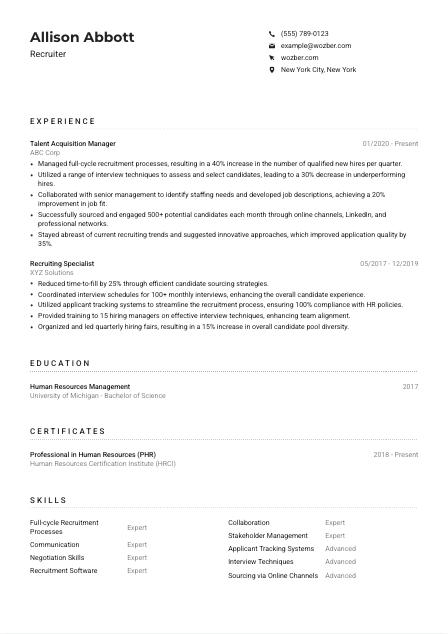
List your experience in reverse chronological order and focus on the parts of each job that mirror recruiter work. Good bullets usually combine the activity, the scale, and the result. The sample resume does this well with lines about managing full-cycle recruitment, developing job descriptions with leadership, and sourcing 500+ candidates monthly.
Recruiting performance is naturally measurable, so use numbers where they are real. Time-to-fill, qualified hires, interview volume, acceptance rate, underperforming hires, candidate pipeline growth, and application quality all help show how you worked. A 40% increase in qualified hires or a 25% reduction in time-to-fill tells more than a generic statement about being effective.
Keep the bullets close to actual recruiter responsibilities. Mention pre-screening, interview scheduling, feedback loops, job description development, sourcing channels, stakeholder communication, or process improvement before broader HR tasks that are less relevant. If you trained hiring managers on interview techniques, that is useful because it shows influence beyond coordination.
ATS alignment works best when the wording is accurate and natural. If you have used applicant tracking systems, run full-cycle hiring, or sourced through LinkedIn and professional networks, say so plainly. Wozber's ATS resume scanner can help you compare your resume against the posting and surface missing terminology while keeping your phrasing grounded in real experience.
Your experience section should make it easy to understand what roles you recruited for, how you managed the process, and what improved because of your work. That is the difference between sounding adjacent to recruiting and sounding ready to own it.
Education matters more in recruiting when it directly supports the work. A degree in Human Resources, Business, Psychology, or a related field signals familiarity with workplace structure, communication, and people processes, especially early in a recruiting career.
If the employer asks for a bachelor's degree, make sure that credential is easy to find. Here, a Bachelor of Science in Human Resources Management lines up closely with the requirement and reinforces formal grounding in the field.
List degree, field of study, school, and graduation year in a consistent order. That makes the section easy to scan for both hiring teams and ATS systems, especially when they are checking minimum qualifications quickly.
Do not stop at "Bachelor of Science" if the major adds value. Stating Human Resources Management immediately connects your education to recruiting workflows, talent practices, and broader people operations.
If you are earlier in your career, selected coursework can help bridge limited experience. Subjects like employment law, organizational behavior, compensation, labor relations, or talent management can support your positioning for recruiting roles.
Recruiting changes with labor market shifts, sourcing tools, interview practices, and employer branding trends. If you have completed extra training in interviewing, DEI recruiting, sourcing, or HR compliance, include it where it strengthens your profile. A credential such as PHR can also reinforce that continued development.
Education should confirm that you meet the baseline requirement and, where relevant, add context for your understanding of HR and talent acquisition. Keep it direct and easy to verify.
Certifications are not mandatory for every recruiter role, but they can strengthen your resume when they connect to hiring practice, HR knowledge, or process discipline. They are especially useful when you want to show formal development beyond day-to-day recruiting experience.
If the posting does not require a certificate, only list ones that add real value. HR and recruiting credentials such as PHR, SHRM-CP, sourcing certifications, or interviewer training can reinforce your command of hiring practices and employment standards.
Choose certificates that speak to the role you want. For a Recruiter, that usually means credentials tied to talent acquisition, HR operations, interviewing, compliance, or workforce planning. The PHR in the example works because it strengthens the candidate's HR foundation.
If a certification has a renewal cycle or continuing education requirement, include the dates so employers know it is current. That matters more than simply naming the credential, especially in HR-related disciplines that change with regulation and practice.
Recruiters are expected to stay current on sourcing channels, interviewing standards, and shifts in candidate expectations. Ongoing certification or training can show that you are keeping pace with the market, not relying only on past process knowledge.
Certifications should deepen your profile, not pad it. Use them to show current HR knowledge, recruiting discipline, and continued investment in the craft.
Recruiter skill sections work best when they combine process skills, systems knowledge, and people-facing strengths. The list should sound like someone who can source, screen, coordinate, influence, and close, not someone who copied generic HR keywords into a box.
Start with the language in the job description, then match it against your background. Here, the employer calls out applicant tracking systems, recruitment software, interview techniques, communication, and negotiation. Those are all worth reflecting if they are part of your real toolkit.
Prioritize skills tied to hiring execution, such as full-cycle recruitment, candidate sourcing, applicant tracking systems, interview technique, stakeholder management, and negotiation. The sample skill list is effective because it mixes recruiting process strengths with communication and collaboration, which matter when working with hiring managers and candidates.
Avoid long skill dumps. A focused list of the capabilities most relevant to recruiting gives a clearer picture of how you work. If you use proficiency labels, make sure they feel credible and are supported by your experience bullets.
Your skills section should quickly show the tools, methods, and interpersonal strengths you bring to hiring. Keep the emphasis on capabilities that directly affect sourcing quality, interview flow, and hiring outcomes.
Language ability can matter in recruiting because the job depends on clear communication with candidates, hiring managers, and internal teams. Even when a posting only names English, listing other languages can be useful if they genuinely support the markets or talent pools you work with.
If the employer specifically asks for strong English communication, include English and label your proficiency accurately. For a recruiter, that requirement often connects to interview quality, stakeholder communication, and written outreach.
Order the section so the language tied to the role appears at the top. That keeps the most relevant information visible right away and avoids making the reader search for a stated requirement.
Additional languages can strengthen your profile when they help with diverse candidate pipelines, relationship building, or market coverage. Spanish, for example, may be useful in many hiring environments, but it should be presented as an added asset rather than a universal requirement.
Use honest ratings such as Native, Fluent, Professional Working, or Conversational. Recruiters are often expected to communicate live and with nuance, so inflated language claims can quickly become a problem.
When extra languages are relevant, they suggest broader reach across candidate communities and smoother communication in diverse workplaces. That can be valuable in high-volume hiring, community outreach, or multilingual labor markets.
List languages when they are relevant and rate them accurately. For recruiting, the main point is clear communication and the ability to work credibly across different candidate groups.
Your summary should capture the kind of recruiter you are in a few lines. It needs to establish scope, strengths, and results quickly, whether your background leans toward corporate recruiting, agency work, high-volume hiring, or specialist search.
Start with your title, years of experience, and the recruiting work you handle best. A line such as "Recruiter with 6+ years of experience in full-cycle recruitment and sourcing strategy" immediately gives the reader a usable frame.
Follow with proof of performance. You might mention stronger application quality, reduced time-to-fill, higher qualified hire volume, or improved job fit. The example summary works because it points to recruitment efficiency and stronger talent outcomes rather than vague enthusiasm.
Aim for three to five lines with concrete language. Skip broad claims about being dynamic or passionate unless they are backed by hiring outcomes, industries served, or recruiting scope.
Bring in relevant terms from the job description where they reflect your real experience. Phrases such as full-cycle recruitment, interview techniques, applicant tracking systems, sourcing strategies, and hiring manager collaboration can strengthen ATS optimization and make your focus immediately clear.
This section should tell the reader, fast, what kind of hiring work you have done and what results tend to follow when you run the process. If they finish the summary with a clear picture of your recruiting range, it is doing its job.
A recruiter resume should read like it was written by someone who understands the hiring process from both sides. Clear scope, measurable recruiting results, strong ATS language, and credible communication skills all matter because they mirror the work itself.
Use Wozber's free resume builder to structure your content in an ATS-friendly resume format, then refine it with targeted language and relevant metrics. When your resume makes full-cycle ownership, sourcing reach, interview coordination, and hiring impact easy to see, you are ready to apply with confidence.




