



Use Wozber and land your dream job
Create Resume
No registration required
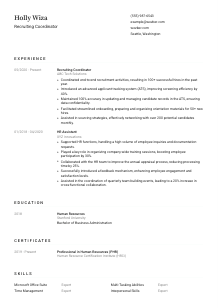
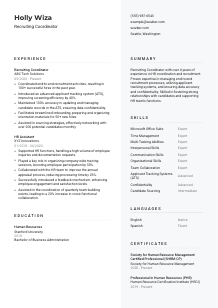
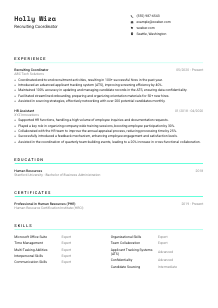
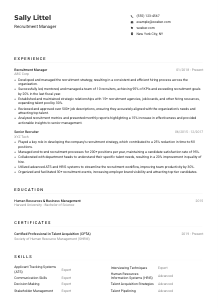
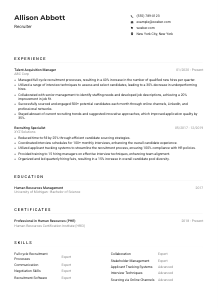
Juggling candidate calls, but your resume isn't making the interview list? Check out this Recruiting Coordinator resume example, built with Wozber free resume builder. It shows how to showcase your talent scouting skills and land at the top of the candidate pool and on company radars!
Recruiting coordinators keep hiring from slipping into chaos. When interviews are moving, candidate records need to stay accurate, and onboarding materials have to be ready on time, the value of the role shows up in clean execution, steady communication, and details that do not get dropped. Your resume should make that operational reliability visible, not bury it under generic HR language.
A tailored Recruiting Coordinator resume quickly clarifies whether you can support a real hiring workflow, from ATS updates to interview scheduling and candidate communication. Wozber's free resume builder helps you match the job description with clear wording and ATS optimization, so hiring teams can see early whether you have handled the coordination load, systems accuracy, and professionalism the role depends on.
Recruiting is built on responsiveness and trust, so your contact details need to look as organized as the work you do. This section should confirm that you are easy to reach, professionally presented, and aligned with any practical requirement the employer has already stated.
Place your full name at the top in a clean, readable format. Keep it simple and easy to scan. For a Recruiting Coordinator, that first visual cue should already suggest order and professionalism, the same qualities needed when managing interview calendars, candidate follow-ups, and hiring records.
Match your title to the role you are pursuing when it reflects your experience. "Recruiting Coordinator" works well here because it immediately connects your profile to recruiting operations, scheduling, sourcing support, and ATS administration rather than broader HR work that may be less relevant.
List a reliable phone number and a professional email address, then check them carefully. Recruiting teams move fast, and a missed callback or typo can cost you an interview. If your current resume includes a website or LinkedIn profile, make sure it matches the same work history, titles, and dates shown on the resume.
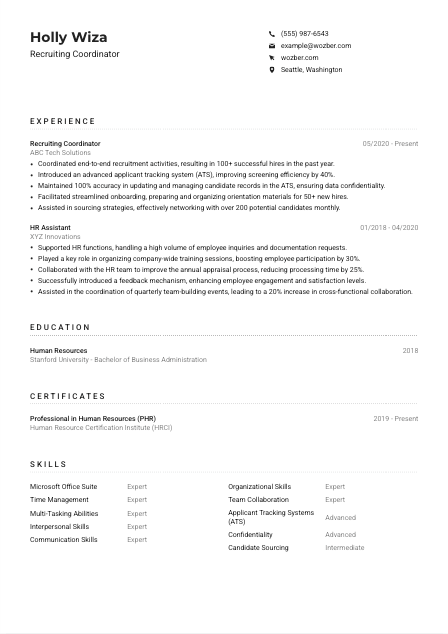
If the job asks for a specific location or relocation readiness, address that directly in your personal details. In this example, listing Seattle, Washington immediately answers a stated requirement and removes uncertainty before the reader reaches your experience section.
A LinkedIn profile can strengthen your application when it reinforces your recruiting background, certifications, or HR coordination experience. Keep it current. If it shows outdated titles or thin detail, fix it before adding the link, because recruiters often cross-check it against your resume.
This part of the resume should answer the basic operational questions fast: who you are, what role you are targeting, how to reach you, and whether you meet any practical location requirement. That leaves more room for your experience to carry the conversation.




This is where a Recruiting Coordinator resume either becomes credible or stays generic. Hiring teams want to see how you supported recruiting activity in practice, whether through scheduling, ATS upkeep, candidate communication, sourcing support, onboarding coordination, or day-to-day HR administration.
Read the job description for the actual flow of work, not just the title. Here, the key actions include posting jobs, screening candidates, scheduling interviews, maintaining ATS records, helping with onboarding, supporting sourcing, and handling HR administration. Your experience bullets should echo that workflow with matching verbs and outcomes drawn from your own background.
List your most recent position first and make the progression easy to follow. If you have held both recruiting and broader HR support roles, keep the emphasis on the work closest to recruiting operations. The example does this well by placing the Recruiting Coordinator role above an earlier HR Assistant position, showing a clear move toward talent acquisition support.
Each bullet should show what you handled and what changed because of it. For this role, that might mean interview volume managed, candidate records kept current, onboarding materials prepared, or sourcing activity supported. The sample bullet about introducing an ATS and improving screening efficiency by 40% works because it ties a system change to a real recruiting outcome.
Numbers matter in recruiting operations because they show pace and load. Use figures such as hires supported, interviews scheduled per week, candidate pipelines maintained, onboarding classes coordinated, or response-time improvements. Metrics like "100+ successful hires," "50+ new hires onboarded," or "200 potential candidates contacted monthly" make the scope of your coordination tangible.
Keep the section centered on hiring support, HR process coordination, communication, and data accuracy. General office duties only belong if they connect to recruiting outcomes or team support. Even in an HR Assistant role, choose bullets that show documentation handling, training coordination, process improvement, or employee communication over unrelated administrative tasks.
A strong experience section for a Recruiting Coordinator shows more than job titles. It shows that you can keep calendars moving, records clean, candidates informed, and hiring activity organized at real volume. Build that picture clearly, and your ATS-compliant resume will read like someone ready to step into the process without slowing it down.
Education matters most here when it confirms that you meet the baseline the employer asked for. For Recruiting Coordinator roles, that usually means a bachelor's degree in Human Resources, Business Administration, or a related field, presented clearly and without extra clutter.
If your degree aligns with the posting, make that easy to see. A bachelor's in Human Resources, Business Administration, or a related field should be listed in standard form. The example's Bachelor of Business Administration in Human Resources is a direct match and works because it answers the requirement without explanation.
List the school, degree, field of study, and graduation year or date in a clean format. Recruiting roles rarely need a long academic narrative, so clarity matters more than detail. Let this section confirm qualifications quickly, then move the reader back to your recruiting experience.
If your degree title is broad, include the concentration or field when it helps connect you to recruiting or HR coordination work. A business degree paired with a focus in human resources gives better context than a degree title alone and can help your resume align more closely in ATS screening.
Coursework is most useful when you are early in your career or your degree is less obviously tied to the role. Classes in human resources, organizational behavior, business communication, or employment law can support your case, but only if they add information your experience section cannot yet provide.
Honors, HR-related student organizations, or projects can help if you are a recent graduate or making the transition into recruiting coordination. Choose items that connect to administration, communication, event coordination, or people operations rather than listing general campus involvement.
For this role, education should confirm that you meet the degree requirement and support your HR or business foundation. Once that is clear, let your experience, systems knowledge, and recruiting coordination work carry more weight.
Certifications can strengthen a Recruiting Coordinator resume when they show formal HR knowledge and ongoing professional development. They are usually not the first thing that wins interviews for this role, but they can help, especially when the posting names them as a plus.
Prioritize certifications that directly support recruiting and HR operations. If you hold PHR or SHRM-CP, place them prominently because they are widely recognized and were specifically mentioned in this example. They add weight by showing grounded knowledge of HR practices, compliance, and people processes.
Do not overload this section with every training course you have completed. A short list of certifications tied to human resources, recruiting systems, compliance, or onboarding is stronger than a long catalog of unrelated credentials.
Add the year earned and, if relevant, an active date range or renewal status. That helps the reader understand whether the certification is current. In HR, recency matters because policies, compliance expectations, and best practices change over time.
Certifications work best when they support the story told in your experience section. If your background already shows ATS administration, candidate coordination, and onboarding support, HR credentials can round that out by showing you also understand the broader people-operations side of the function.
For Recruiting Coordinator roles, the right certifications sharpen your profile when they connect directly to HR practice and the employer's stated preferences. Keep them relevant, current, and easy to scan. Wozber's ATS resume scanner can also help you catch certification language worth mirroring from the job description.
This section should read like the operating toolkit behind your experience. For Recruiting Coordinator roles, that means a practical mix of system knowledge, scheduling discipline, communication, confidentiality, and the ability to manage several hiring tasks without losing track of details.
Start with the skills named in the posting, then compare them with your own experience. Here, that includes applicant tracking systems, Microsoft Office Suite, organization, time management, multi-tasking, interpersonal skills, professionalism, discretion, and strong English communication. Those are not filler keywords. They describe the day-to-day demands of moving candidates through a hiring process accurately and on time.
Recruiting Coordinators need both tool proficiency and people-facing skills. Pair hard skills such as ATS usage, scheduling software, spreadsheet work, or document preparation with operational soft skills like stakeholder communication, calendar management, confidentiality, and follow-through. The sample skills list does this well by combining ATS, Microsoft Office, and candidate sourcing with organizational and interpersonal strengths.
Choose skills you can back up elsewhere in the resume. If you list ATS expertise, your experience section should mention record management, screening workflow, reporting, or process improvement. If you include candidate sourcing or onboarding, there should be bullets showing that work in action. Relevance and consistency matter more than volume.
A Recruiting Coordinator skills section should sound like someone who can manage hiring activity, communicate clearly, and protect process accuracy. When the wording matches both your real experience and the job description, the section supports stronger ATS-friendly resume format and a clearer read for the hiring team.
Language skills matter in recruiting when they strengthen communication with candidates, hiring managers, or diverse employee groups. Even when only English is required, this section can still reinforce your communication profile if you present it clearly and honestly.
If the posting calls for strong English communication, list English first and state your level plainly. That matters in a role where email follow-ups, interview scheduling, candidate communication, and orientation materials all depend on clear written and verbal communication.
Additional languages can be useful when the organization hires across varied communities or candidate pools. They are especially relevant if you have used them in sourcing, candidate communication, or onboarding support. The example includes Spanish, which may be an advantage, but only list extra languages when you can use them with confidence.
Use clear labels such as Native, Fluent, Advanced, Intermediate, or Basic. Avoid overstating your ability. In recruiting, language claims can quickly be tested in candidate interactions, written communication, or bilingual coordination tasks.
If another language has helped you source candidates, support new hires, or communicate across teams, that can reinforce its value. Keep the point practical. Employers care less about the fact of speaking another language than about where it helps the hiring process run more smoothly.
Not every Recruiting Coordinator role needs multiple languages, so let the job guide how prominent this section should be. If the employer serves a multilingual workforce or operates across regions, your language ability may deserve more attention. If not, keep the section concise and accurate.
For this role, language skills are most useful when they strengthen candidate communication, onboarding, or internal coordination. Present them clearly, keep proficiency honest, and let them support the broader picture of you as a dependable recruiting partner.
The summary should give a fast, concrete picture of the kind of recruiting support you provide. Avoid vague claims about being people-oriented or organized. Use the space to name your experience level, the recruiting processes you handle, and the kind of results or scale you have supported.
Before writing, identify the few themes the employer cares about most. In this case, those include recruiting coordination, ATS accuracy, scheduling and screening support, onboarding preparation, strong communication, and professionalism. Your summary should bring those themes together in a way that sounds grounded in actual work, not copied from the job ad.
Start with a direct description of who you are professionally. A line such as "Recruiting Coordinator with 4+ years of experience in recruitment and HR coordination" works because it establishes seniority and functional focus immediately. It also helps ATS matching when your current or recent work aligns with the title.
Follow your opening with the parts of the job you are strongest in, such as managing interview scheduling, maintaining accurate candidate records, supporting sourcing, or preparing onboarding materials. If you have a standout result, like improving screening efficiency or coordinating high hiring volume, include it briefly. The sample summary does this by pairing process ownership with ATS use and data accuracy.
Aim for a short paragraph that reads smoothly in under five lines. Cut generic traits unless they connect to the work. "Professional and discreet in handling candidate information" says more for this role than broad statements about being hard-working or passionate.
Your summary should make it easy to picture you supporting a live recruiting pipeline, not just applying for one. When it reflects your actual experience with coordination, systems, communication, and hiring support, it sets up the rest of the resume well. Wozber's AI resume builder can help refine that wording so your strengths align closely with the employer's language and ATS screening.
A Recruiting Coordinator resume works when it shows reliable execution behind the scenes: interviews scheduled accurately, candidate records maintained, onboarding prepared, and communication handled with professionalism. Those are the details that tell a hiring team you can step into a busy process and keep it moving.
Use the job description to shape your wording, keep your examples concrete, and make your metrics do real work. With Wozber's ATS-friendly resume template and ATS resume scanner, you can tighten alignment, improve ATS readability, and submit a resume that makes your recruiting coordination experience easy to judge.