



Use Wozber and land your dream job
Create Resume
No registration required
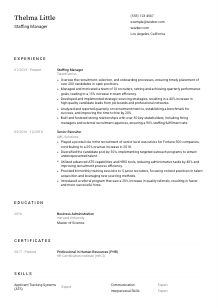
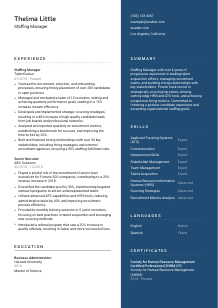
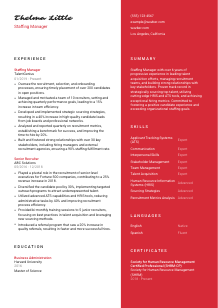
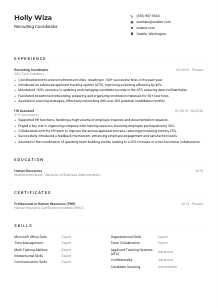
Matching talents, but your resume seems misplaced? Check out this Staffing Manager resume example, created with Wozber free resume builder. Learn how to present your recruitment prowess to meet job standards, positioning your career to be the perfect hire in any situation!
Staffing Managers are expected to keep hiring moving when requisitions pile up, recruiter workloads shift, and hiring managers want faster results without weaker candidate quality. A resume for this role needs to show that you can run the full hiring engine, from sourcing strategy and team direction to onboarding flow and fill-rate performance.
Early resume screens for Staffing Manager roles often hinge on whether your background clearly connects recruiting leadership with measurable hiring outcomes. Wozber's free resume builder helps you shape that story in an ATS-friendly resume format, so ATS parsing and recruiter review both surface the same core message: you know how to lead recruiting operations and deliver timely placements.
At the top of the page, hiring teams want quick confirmation that you are reachable, professionally presented, and positioned for the role's basic requirements. For Staffing Manager roles, that includes a clean title and, when the posting asks for it, location details that remove avoidable friction from the hiring process.
Use your full name as the most visible text in the header. Keep it simple and professional. Staffing Managers spend their days evaluating candidate records, so your own resume should model the same clarity and order you would expect from a recruiter on your team.
Place "Staffing Manager" under your name if that is the role you are pursuing. This immediately aligns your resume with the position and helps frame your experience around recruiting leadership, staffing delivery, and team oversight rather than broader HR work.
Include a working phone number and a professional email address you check regularly. Since this role depends on responsive communication with candidates, recruiters, and hiring managers, even your header should reflect that you are organized and easy to reach.
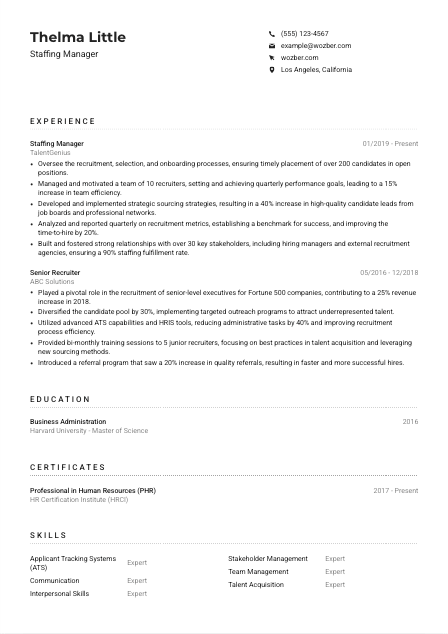
Some openings include a location filter early in the review process. Here, Los Angeles, California is specifically requested, so listing it helps remove questions about availability or relocation timing. Treat this as job-specific tailoring, not a rule for every Staffing Manager resume.
Add LinkedIn or another professional profile if it reinforces your recruiting background. For this field, a strong profile can support your resume with recruiter leadership history, industry network depth, recommendations, or hiring volume context.
This section should confirm the basics fast and without clutter. When your contact details are clean, role-aligned, and tailored to the posting, the reader can move straight to your staffing results and leadership record.




This section carries the most weight for a Staffing Manager because the role is judged through hiring volume, team leadership, sourcing effectiveness, stakeholder trust, and process control. Your bullets should make it easy to see how you improved recruiting output, not just that you participated in it.
Read the posting closely and mark the operating priorities behind it. For a Staffing Manager, that usually means recruiter supervision, sourcing strategy, onboarding oversight, hiring manager partnership, ATS or HRIS use, and recruiting metrics. Build your bullets around those themes so the employer sees the same language they use to define success.
Present your positions in reverse chronological order with title, company, and dates. In staffing and talent acquisition, progression matters. Moving from recruiter to senior recruiter to staffing manager, for example, shows increasing ownership over requisitions, team output, and stakeholder management.
Each bullet should show what you led, improved, or delivered. Focus on measurable staffing outcomes such as placements made, recruiter team size, sourcing-channel performance, time-to-hire reduction, offer acceptance rates, or fulfillment rates. The sample resume does this well by pairing responsibilities with outcomes like managing 10 recruiters and improving time-to-hire by 20%.
Numbers matter here because recruiting performance is naturally measured. Include data that reflects your impact on hiring speed, candidate quality, process efficiency, team productivity, or stakeholder satisfaction. A bullet about increasing high-quality candidate leads by 40% says far more than a generic claim about "successful sourcing."
If an older bullet does not help prove recruiting judgment, people leadership, process improvement, or hiring results, cut it or rewrite it. This is especially important if your background includes general HR duties. Keep the emphasis on the work that shows you can lead staffing operations and deliver against open headcount.
Your experience section should leave little doubt about scale, ownership, and results. When the bullets show team management, sourcing strategy, system fluency, and measurable hiring outcomes, you look prepared to step into a Staffing Manager seat quickly.
Education is rarely the section that wins a Staffing Manager search, but it does help confirm your foundation in business, HR, and people operations. Keep it clear and relevant, especially when the posting names a degree requirement.
If the role asks for a bachelor's degree in Human Resources, Business Administration, or a related field, make sure that qualification is easy to find. Place the degree, field of study, school, and graduation year in a clean format. If you hold a more advanced degree, list that first.
Use a simple structure for every education entry so the reader can scan it quickly. Staffing leaders are used to reviewing high volumes of candidate data, and a tidy education section reinforces your own attention to organization and process discipline.
Degrees connected to HR, business administration, organizational leadership, or related disciplines are especially relevant because Staffing Managers work at the intersection of hiring strategy and business needs. In the example, Human Resources and Business Administration both strengthen that connection.
Most experienced Staffing Managers do not need a long course list. Include specific coursework only if it directly supports the target role, such as labor relations, organizational behavior, workforce planning, or talent management, and only when it adds information the rest of the resume does not already show.
Honors, projects, or leadership activities belong here only if they add meaningful context. Early-career candidates might benefit from a relevant HR project or student leadership role. With more experience, those lines usually matter less than hiring metrics, recruiter management, and stakeholder results.
For this role, education should confirm the required academic background without stealing space from your staffing accomplishments. A concise, well-ordered section does that job well.
Certifications can add weight in staffing and talent acquisition, especially when they reflect current HR knowledge and professional commitment. They are particularly useful when a posting lists them as preferred rather than required, as this one does with PHR and SHRM-CP.
Prioritize certifications that directly support staffing leadership, compliance awareness, and HR practice. PHR and SHRM-CP are strong examples because they signal familiarity with core people processes, employment standards, and the broader business side of talent operations.
Do not crowd this section with every course completion or internal training badge. Show the certifications that strengthen your case for managing recruiting teams, partnering with hiring leaders, and operating effectively inside HR systems and workflows.
Add certification dates or active ranges so employers can see whether the credential is current. In HR and staffing, that matters because practices around hiring compliance, candidate handling, and process standards change over time.
If you have maintained active credentials or completed recent professional development in recruiting operations, workforce planning, or talent strategy, include it. That tells employers you are keeping pace with the field instead of relying only on past experience.
Relevant certifications will not replace real staffing results, but they do strengthen your profile. When listed cleanly and selectively, they support the picture of a manager who understands both recruiting execution and the broader HR environment.
A Staffing Manager skills section should read like the toolkit behind your hiring results. The best lists combine systems knowledge, people leadership, sourcing ability, and recruiting analytics instead of leaning on broad soft-skill filler.
Start with the capabilities that actually drive staffing performance. For this role, that includes ATS proficiency, HRIS familiarity, sourcing strategy, recruiter coaching, stakeholder management, onboarding coordination, and recruitment metrics analysis. These are the skills that connect directly to day-to-day delivery.
Keep the list focused on the employer's hiring priorities. If the job emphasizes ATS and HRIS, do not bury those tools under generic strengths. If it stresses team management and stakeholder communication, make sure those appear in language that matches your actual experience.
Arrange skills so the most relevant capabilities appear first and read cleanly. A tight list of recruiting systems, leadership strengths, and analytical capabilities is easier to process than a long mixed inventory. The example's combination of ATS, stakeholder management, team management, talent acquisition, HRIS, and recruitment metrics is a useful model of that balance.
This section works best when it confirms the methods behind your results. A focused skills list should make it obvious that you can manage recruiting operations, use the right systems, and guide a team toward hiring goals.
Language ability matters in staffing because the job depends on clear communication with candidates, hiring managers, agencies, and internal teams. Most roles will prioritize fluent English, while additional languages can be valuable in diverse labor markets or candidate populations.
If the posting specifies language ability, list that language clearly with an accurate proficiency level. Here, fluent English is required, so it should appear first. That removes doubt about your ability to handle interviews, stakeholder communication, and written recruiting processes.
Additional languages can strengthen your profile when they help you engage broader candidate pools or communicate across diverse teams. In many staffing environments, that can improve outreach, candidate experience, and relationship-building, especially in multilingual markets.
Use clear labels such as Native, Fluent, Advanced, or Conversational. Staffing Managers deal in accurate candidate representation every day, so your own resume should avoid vague or inflated language claims.
Do not list another language just as an ornament. Include it when it supports sourcing, candidate screening, onboarding communication, or employer relationships. For example, Spanish can be useful in some Los Angeles hiring environments, but that depends on the employer's candidate base and business needs.
Only list languages you can use in real business interaction. If your proficiency has improved, update it. If it has faded, scale it back. Accurate language levels help employers understand where you can contribute immediately.
For Staffing Manager roles, language skills should support real recruiting work. Lead with the required proficiency, add other languages that strengthen your reach, and keep every rating credible.
The summary should quickly define the level of recruiting responsibility you have held and the kind of hiring outcomes you produce. For a Staffing Manager, this is where you establish that you are not simply an experienced recruiter, but someone who can lead recruiting operations and improve performance.
Start with a direct description of your background, such as years in staffing or talent acquisition and the level of leadership you bring. This helps employers immediately place you in the right lane, especially when they are separating recruiter profiles from manager-level candidates.
Bring in the most relevant strengths from the job description, such as recruiter supervision, ATS and HRIS proficiency, sourcing strategy, onboarding oversight, or recruitment metrics. This is also a good place to align language naturally for ATS optimization without turning the summary into a keyword list.
A summary becomes much more credible when it includes proof. Mention outcomes that fit the role, such as reducing time-to-hire, improving recruiter productivity, increasing candidate pipeline quality, or maintaining strong fulfillment rates. The example summary works because it combines leadership scope with hiring performance.
Aim for three to five sentences that sound like an experienced staffing leader speaking plainly about their work. Avoid generic claims about being passionate or results-driven unless you immediately support them with recruiting metrics, systems expertise, or team leadership context.
When this section is written well, the reader knows within seconds that your background includes staffing leadership, system fluency, and measurable recruiting results. That makes the rest of the resume easier to trust and easier to shortlist.
A Staffing Manager resume should show that you can keep hiring organized, measurable, and on pace with business demand. Every section should support that picture, from the title in your header to the recruiting metrics in your experience bullets and the systems knowledge in your skills list.
Use Wozber's free resume builder to structure your content in an ATS-compliant resume, then refine it with the ATS resume scanner so the language, priorities, and terminology match the role you are targeting. The finished resume should make it easy to judge your ability to lead recruiters, improve hiring performance, and meet staffing goals.




