



Use Wozber and land your dream job
Create Resume
No registration required
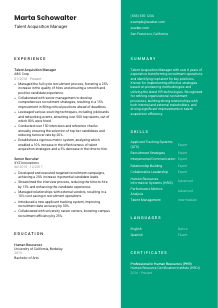
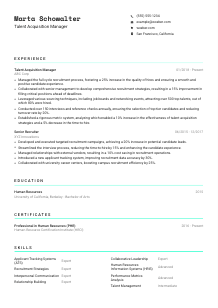
Hunting for top-notch gigs, but your resume feels like a mismatch? Browse this Talent Acquisition Manager resume example, created with Wozber free resume builder. Learn how to spotlight your staffing savvy so it matches job requirements, making sure your career portfolio catches as many star candidates as your LinkedIn feed!
Talent Acquisition Managers are expected to run a hiring function with structure, judgment, and pace. A resume for this role needs to show more than recruiting activity. It should show how you partnered with hiring managers, built sourcing channels, improved candidate experience, and tracked outcomes such as time-to-hire, quality of hire, or retention.
When the resume is tailored well, hiring teams can quickly see whether your background matches their recruiting environment, from full-cycle hiring to ATS and HRIS fluency. Wozber's free resume builder helps you organize that experience into an ATS-compliant resume that reflects the language of the role and makes your recruiting leadership easier to read at a glance.
For a Talent Acquisition Manager, the header should communicate professionalism and availability without distraction. This section is simple, but it still carries practical signals, especially when a posting includes location or communication requirements.
Use your full name in a clean, readable format at the top of the page. Talent Acquisition leaders work in high-volume, detail-sensitive environments, so even basic presentation should feel organized and polished.
Place "Talent Acquisition Manager" directly under your name when that reflects the role you are pursuing. Matching the title helps frame your background immediately, especially when your recent experience includes recruiting leadership, workforce planning, or team oversight.
Include a reliable phone number and a professional email address. If you also share a LinkedIn profile or portfolio page, make sure it supports your recruiting work with visible hiring scope, industry focus, employer branding activity, or leadership experience.
Some talent acquisition roles are tied to a specific market because they require local hiring knowledge, onsite partnership with business leaders, or proximity to the office. Here, listing "San Francisco, California" directly addresses the stated requirement and removes an early question about eligibility.
A current LinkedIn profile can reinforce your employer branding instincts and professional network. For this kind of role, it is useful when it reflects recruiting specialties, ATS or HRIS familiarity, hiring volume, and relationships with business stakeholders.
Your personal details should make it easy to contact you and easy to confirm key basics. For a Talent Acquisition Manager, that means clear identity, professional contact information, and any location detail the employer has explicitly asked to see.




This section carries the most weight for Talent Acquisition Manager roles. Hiring teams want to see how you managed the full recruiting cycle, influenced hiring plans, improved funnel performance, and supported business growth through stronger hiring outcomes.
Before rewriting your bullets, pull out the responsibilities that define the role's day-to-day work. In this posting, that includes full-cycle recruitment, partnership with hiring managers, sourcing across multiple channels, interview oversight, reference checks, and metric tracking. Those priorities should shape which achievements you lead with.
List your most recent recruiting and leadership work first. For each position, include your job title, employer, and dates clearly so the reader can follow your progression from recruiter to manager, or from execution-heavy hiring work into team leadership and strategy.
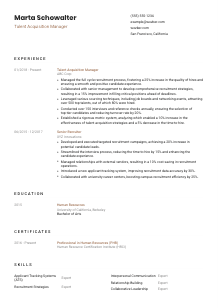
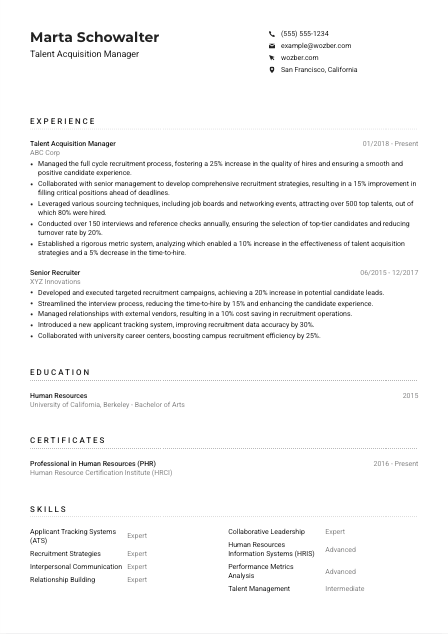
Bullets should show what changed because of your work. Instead of writing that you "managed recruitment," show the result of that management. The example resume does this well with outcomes such as a 25% increase in hire quality, a 15% improvement in filling critical roles ahead of deadlines, and a smoother candidate experience tied to full-cycle process ownership.
Talent acquisition performance is measured. Include numbers tied to hiring volume, time-to-hire, offer acceptance, source effectiveness, retention, cost savings, or candidate pipeline growth. Metrics like conducting 150+ interviews annually, reducing turnover by 20%, or improving recruiting effectiveness by 10% give real scale to your work.
Choose bullets that reflect the tools, workflows, and collaboration surfaces common to the target role. Sourcing across job boards, referrals, social channels, and events is directly relevant here, as is work with ATS platforms, HRIS data, vendor management, and hiring manager communication. Keep unrelated accomplishments out unless they support those same recruiting goals.
A Talent Acquisition Manager resume should read like a record of recruiting decisions, process ownership, and measurable outcomes. If your experience section makes hiring volume, sourcing strategy, stakeholder partnership, and recruiting metrics easy to understand, you are already speaking the employer's language.
Education is usually a checkpoint in talent acquisition hiring, not the main decision-maker. Still, when a posting asks for a bachelor's degree in Human Resources, Business Administration, or a related field, your resume should make that qualification easy to confirm.
List your highest relevant degree in a way that clearly connects to the posting. A bachelor's degree in Human Resources, Business Administration, Psychology, or a related field usually belongs near the top of this section. In the example, a Bachelor of Arts in Human Resources aligns neatly with the requirement.
Include degree, field of study, school, and graduation year or date. Simple formatting helps both ATS parsing and quick human review, which matters when recruiters and hiring leaders are screening many applications in a short window.
If your degree directly supports recruiting work, do not bury the field of study. Human Resources, organizational psychology, business administration, and labor relations all reinforce your grounding in hiring, people operations, and workforce planning.
Most experienced Talent Acquisition Managers do not need to list classes. Include coursework, honors, or projects only if they add something useful, such as training in employment law, compensation, organizational behavior, or data analysis that supports your recruiting background.
If you have completed later learning in recruiting operations, DEI hiring, interview design, HR systems, or talent analytics, you can reflect that in education or certificates depending on format. Ongoing learning is especially useful when you want to show fluency in newer hiring tools or modern recruiting strategy.
This section does not need a long explanation. It needs to confirm that you meet the academic baseline and, when relevant, support your path into recruiting leadership with a field of study that fits the work.
Certifications are not always mandatory for Talent Acquisition Manager roles, but they can strengthen your standing in competitive searches. They are especially helpful when they support your knowledge of HR practice, compliance, and recruiting operations.
Choose certifications that support hiring, HR operations, or people management. Credentials such as PHR, SHRM-CP, SHRM-SCP, or recruiting-specific training can reinforce your expertise in structured hiring and talent strategy. The example's PHR certification is a solid fit for this kind of role.
Only include certifications that add weight to your candidacy. A Talent Acquisition Manager does not need a long list of loosely related credentials. Prioritize those tied to recruiting leadership, interview process quality, employment practices, HR systems, or workforce planning.
If a certification is current, in progress, or recently renewed, include the date range or issue date. That helps show ongoing engagement with the field and can matter for credentials that reflect active professional standing.
Recruiting changes quickly, from sourcing channels to compliance expectations to ATS workflows. Recent certifications or continuing education can show that your knowledge is current, especially if your experience spans both traditional recruiting and more data-driven talent acquisition work.
The right credential adds useful context to your experience. For Talent Acquisition Manager roles, certifications work best when they back up your command of HR practice, recruiting process design, and leadership judgment.
A Talent Acquisition Manager skills section should reflect how you actually run recruiting, not just broad workplace traits. Focus on the tools, process capabilities, and relationship-heavy strengths that matter in full-cycle hiring and team coordination.
Scan the job description for systems, workflows, and people-facing requirements. Here, ATS, HRIS, recruitment strategy, interpersonal communication, stakeholder relationship building, and leadership all belong in your shortlist because they map directly to the work described.
Show both operational and human sides of the role. ATS and HRIS proficiency matter because they support reporting, workflow discipline, and candidate tracking. Skills such as interview management, sourcing strategy, hiring manager partnership, and candidate experience show that you can execute beyond the software layer.
Do not crowd this section with every capability you have picked up across HR. A shorter list built around recruiting strategy, sourcing, screening, metrics, communication, and leadership is stronger than a long generic inventory. The example resume keeps the focus on ATS, recruitment strategies, HRIS, relationship building, and metrics analysis, which is the right direction.
This section should quickly tell the reader what recruiting environment you can handle. When your skills line up with the systems, sourcing methods, analytics, and stakeholder work in the target role, the match becomes much easier to see.
Language ability can matter in talent acquisition when the role involves broad candidate outreach, diverse markets, or cross-functional communication. Include languages when they are relevant to the job or strengthen your ability to recruit and build relationships.
If the posting states that English competency is required, list English clearly with an honest proficiency level. That is a direct qualification check and should never be left unclear.
Additional languages can be valuable when recruiting across multilingual communities, working with global teams, or building candidate relationships in diverse labor markets. In the example, Spanish adds useful breadth without distracting from the core requirement.
Choose levels such as Native, Fluent, Professional Working, or Intermediate and use them consistently. Talent Acquisition Managers are expected to communicate precisely, so your language section should reflect that same accuracy.
If another language has helped you source harder-to-reach talent pools, support regional hiring, or improve candidate communication, it is worth keeping. If it has no clear connection to your recruiting work, it can stay off the resume.
For this profession, languages matter because they expand your ability to build trust with candidates and stakeholders. Include them as a practical recruiting asset, not as a decorative detail.
Language skills are most useful here when they support outreach, relationship building, or candidate experience. If they help you recruit more effectively or meet a stated requirement, they belong on the page.
Your summary should give a fast, specific picture of your recruiting background. For a Talent Acquisition Manager, that means showing seniority, hiring scope, core strengths, and the kind of outcomes you deliver without repeating your entire work history.
Start by naming your role and level of experience in talent acquisition. A line such as "Talent Acquisition Manager with 6+ years of experience in full-cycle recruiting and hiring strategy" tells the reader where you sit immediately and sets the frame for the rest of the resume.
Mention the strengths that match the posting, such as recruiting strategy, ATS and HRIS proficiency, stakeholder partnership, sourcing execution, and candidate experience management. Keep these tied to actual work, not generic claims about being people-oriented.
A summary becomes much stronger when it includes proof. Pull in metrics or outcomes that represent your range, such as improving time-to-hire, increasing hire quality, reducing turnover, or building stronger pipelines for critical roles. The example summary points in the right direction, but it becomes even stronger when paired with clearer recruiting metrics.
Aim for a short paragraph that can be read in seconds. Three to five lines is usually enough to establish your recruiting leadership, systems fluency, and business impact before the reader moves into your experience section.
Your summary should quickly establish whether you are a recruiter who can manage hiring operations, partner with the business, and improve results. Once that is clear, the rest of the resume has a stronger foundation.
A well-tailored Talent Acquisition Manager resume should make your hiring scope, recruiting strategy, ATS and HRIS fluency, and measurable outcomes easy to understand from the first scan.
Use Wozber's free resume builder, ATS-friendly resume templates, and ATS resume scanner to align your wording with the role, strengthen ATS optimization, and present your experience in a format that clearly supports recruiting leadership.
When the document is finished, a hiring team should be able to see how you run full-cycle recruitment and improve hiring results without having to search for the proof.