



Use Wozber and land your dream job
Create Resume
No registration required
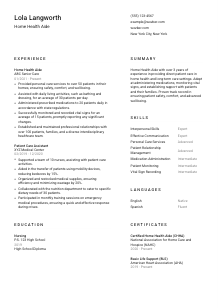
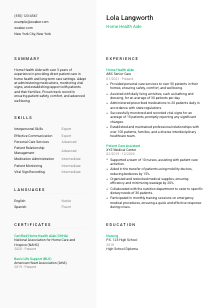
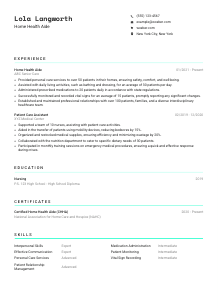
Caring at homes, but your resume seems under the weather? Flip through this Home Health Aide resume example, made with Wozber free resume builder. Learn how to build a career care plan that matches job needs, so your caregiving credentials stay in good health!
Home Health Aide hiring turns on trust. Employers need to see that you can handle intimate daily care, notice changes in a patient's condition, and communicate clearly with families and supervising nurses while working in someone's home, often with limited direct oversight. Your resume should make that judgment easier by showing how you support safety, dignity, and consistent care in real patient settings.
Screening gets sharper when your resume uses the same care language the employer uses. Wozber's free resume builder helps you shape an ATS-compliant resume around the posting's terms, from personal care and vital signs to medication support and patient communication, so the hiring team can quickly recognize where your experience matches day-to-day home care work.
Home care roles are personal by nature, and your contact section should feel dependable from the first line. Keep it simple, accurate, and aligned with the position so employers can immediately place you as a Home Health Aide candidate who is reachable and ready to work.
Use your full name in a clean, readable format at the top of the resume. This section does not need decoration. It needs clarity, especially in healthcare hiring workflows where recruiters and coordinators may review many resumes quickly before scheduling interviews or reference checks.
Place "Home Health Aide" directly under your name when that is the role you are pursuing. This makes your direction clear right away and avoids any confusion if your recent title was slightly different, such as Patient Care Assistant or Caregiver. In the sample resume, using the exact target title helps connect prior direct care experience to the opening without extra explanation.
Include a phone number you answer reliably and a professional email address. In healthcare, missed calls can mean missed interview windows, shift discussions, or onboarding steps. Double-check every digit and character before sending your resume.
If the employer asks for candidates to be in a specific city or willing to relocate, include your city and state. For this opening, listing New York City, New York immediately addresses a stated requirement and removes a common point of uncertainty around scheduling and start-date logistics.
A LinkedIn profile can help if it reinforces your care background, certifications, employment dates, or bilingual ability. Skip personal links that do not support your healthcare experience. If you include a profile, make sure it matches your resume titles, dates, and credential details exactly.
Your personal details should confirm that you are easy to contact, professionally presented, and available for the setting the employer needs. In home health, that kind of reliability matters before the first interview even starts.




This is the section most likely to decide whether your resume moves forward. Home Health Aide experience is judged through patient care tasks, observation, safe routines, and communication with nurses and families, so your bullets should show what care you delivered, for whom, and what changed because of your work.
Read the job description and underline the duties that appear central to the role. Here, that includes personal care, activities of daily living, medication administration, vital signs, and reporting changes in condition. Those responsibilities should shape the examples you choose from your own history so your resume reflects the employer's actual care environment rather than a generic healthcare background.
List your most recent role first, then work backward. This structure helps hiring teams see your current level of direct patient care, recent care settings, and progression from support roles into more independent home-based care. It also makes it easier to spot whether you meet the experience threshold, such as more than 1 year in direct care.
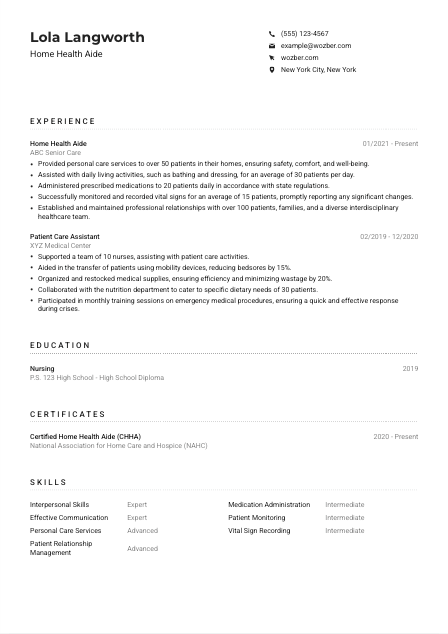
Each role should show the work you performed and the result of doing it well. Strong Home Health Aide bullets often include assisting with bathing, dressing, mobility, toileting, medication support, meal assistance, observation, and documentation. The sample resume does this well with bullets like providing personal care services in patients' homes and reporting significant changes after monitoring vital signs. That kind of phrasing translates directly to hiring needs.
Healthcare employers respond well to numbers when they clarify patient volume, frequency, team support, or measurable improvement. Examples include number of patients served, visits completed per day, medications administered, fall reduction, pressure injury reduction, or support provided across a nurse team. In the sample, "over 50 patients" and "30 patients per day" give a clearer picture of pace and capacity than vague statements ever could.
If an older bullet does not show patient care, safety, mobility support, documentation, communication, or another role-relevant function, trim it or rewrite it. Even support tasks should connect back to care delivery. For example, supply organization matters more when tied to treatment readiness or smoother daily operations, as shown in the sample bullet about reducing waste and improving efficiency in a medical setting.
Hiring managers should be able to picture you in the home, supporting daily living, noticing changes, and keeping care routines safe and steady. When your experience section does that clearly, your resume starts to feel job-ready.
Education is usually a straightforward section for Home Health Aide roles, but it still carries screening value. Employers often need to confirm a diploma or GED and may look for training that supports safe patient care, especially when state-approved aide or nurse aide preparation is part of the requirement.
If the posting asks for a high school diploma or GED, include it plainly so there is no doubt that you meet the baseline requirement. Do not bury this detail. In this case, a simple entry for a high school diploma is enough to satisfy one of the employer's stated qualifications.
Include the school name, credential, field if relevant, and graduation year or date. This section should be quick to scan. Healthcare recruiters are not looking for design here. They are confirming qualification status and moving on to the care experience that matters most.
If you completed a state-approved Home Health Aide or Certified Nurse Aide program, list it prominently either here or in certifications, depending on how your resume is structured. That training is directly tied to employability in this field and carries more value than unrelated coursework.
Most experienced aides do not need a long coursework list. Add it only if it helps explain recent training or a limited work history, such as patient safety, infection control, anatomy, or basic nursing skills. Keep the focus on practical care knowledge that supports home visits and daily living assistance.
Awards, honors, or healthcare-related student achievements can be useful if you are early in your career, but they should stay brief. Once you have solid patient care experience, educational extras matter less than your ability to deliver safe, compassionate care in real homes or long-term care settings.
For most Home Health Aide resumes, education confirms eligibility and training. Once that is clear, let your experience, certifications, and care responsibilities carry the stronger hiring weight.
Certifications carry real weight in home care because they speak to patient safety, state compliance, and current hands-on readiness. If a posting asks for BLS, CPR, or aide training credentials, make those easy to find and easy to trust.
Put required or strongly preferred certifications at the top of this section. For this role, a Home Health Aide credential or nurse aide training and current BLS or CPR belong first because they map directly to the employer's requirements and to the realities of patient care in the home.
Prioritize certifications that strengthen your profile for direct care, emergency response, mobility support, dementia care, infection prevention, or similar patient-facing work. A short, targeted list is more effective than padding the section with credentials that do not relate to bedside or home-based care.
Include the certificate name, issuing body, and date earned or renewal status. This matters in healthcare because expired credentials can block hiring. The sample resume handles this well by pairing CHHA and BLS with recognized issuers and current date ranges.
Renew expiring certifications before you start applying when possible. An active BLS or CPR card can move your application along faster, especially for employers who need aides ready for orientation, compliance review, and patient assignment without delay.
This section should reassure the employer that you meet care standards and can step into patient-facing work with current training. In home health, that confidence matters early in the review process.
A Home Health Aide skills section should read like the reality of the job. Employers are looking for a blend of hands-on care ability and calm communication, because the work depends on both physical support and trustworthy interaction with patients, families, and clinicians.
Pull out the skills the employer names directly, then match them only if you truly have them. For this opening, that includes interpersonal skills, communication, personal care, medication-related support, monitoring, and English proficiency. Mirroring this language improves relevance and also helps with ATS optimization when the terms reflect your actual experience.
Do not split your profile into only soft skills or only technical tasks. Home health work requires both. Include practical abilities such as personal care services, vital sign monitoring, mobility assistance, medication administration, and documentation, alongside communication, patience, and relationship-building with patients and families. The sample resume strikes that balance well by pairing personal care and monitoring with interpersonal strength.
Limit your skills to the abilities most relevant to the role you want. A shorter list of clearly matched skills is stronger than a crowded section full of generic traits. Grouping them mentally around care delivery, observation, safety, and communication can help you choose what stays.
Your skills section should confirm what your experience already shows: that you can support daily living, communicate clearly, and handle routine patient care with consistency. When the two sections match, your resume becomes much easier to trust.
Language matters in home health because instructions, reassurance, and observation all depend on clear communication. If the role requires strong English and you speak additional languages used in the community you serve, this section can add practical value to your application.
If the posting says English is required, list your English proficiency clearly. This is not a minor detail in a role that involves reporting patient changes, understanding care instructions, documenting observations, and communicating with family members and clinical staff.
Additional languages can strengthen your resume when they are relevant to the patient population or service area. For example, Spanish can be a meaningful advantage in many home care settings because it can improve comfort, reduce misunderstandings, and support smoother family communication.
Use clear proficiency labels such as Native, Fluent, Intermediate, or Basic. Avoid overstating what you can do. In patient care, language gaps show up quickly during medication discussions, symptom reporting, or daily care instructions, so accuracy matters.
When a second language genuinely helps you build trust, explain care routines, or understand patient concerns, it becomes more than a bonus line on the resume. It supports safer and more humane care, especially in homes where patients may feel more comfortable speaking their strongest language.
List only languages you could realistically use on the job. The value here is not cultural breadth in the abstract. It is whether you can communicate clearly during bathing assistance, mobility support, vital sign checks, scheduling discussions, or urgent updates to the care team.
For a Home Health Aide, language skills matter most when they make patient interactions clearer, calmer, and safer. If your resume shows that practical value, this section earns its place.
Your summary should quickly tell the employer what kind of Home Health Aide you are, how much relevant experience you bring, and which care strengths you can be trusted with. Keep it short, but make every phrase pull its weight.
Start with the responsibilities that define the job, not generic ambition. For this type of role, that usually means direct patient care, support with activities of daily living, patient safety, observation, and communication with families or nurses. Those are the themes your summary should surface first.
A direct first sentence works best here. Something like "Home Health Aide with 3+ years of direct patient care experience in home health and long-term care settings" gives immediate context and tells the employer both your function and your level.
Choose strengths that match the posting and your actual background. Good examples include medication administration, vital sign monitoring, mobility support, personal care assistance, and rapport with patients and families. The sample summary uses this approach well by combining hands-on care tasks with relationship-building.
Aim for a few lines, not a paragraph full of adjectives. This section should read like a focused clinical snapshot, not a personal statement. Clear wording tied to patient care tasks and care settings will outperform broad claims about passion or dedication every time.
By the time someone finishes your summary, they should already understand your care setting, your core strengths, and the kind of patient support you can deliver. That is the right tone to carry into the rest of the resume.
A Home Health Aide resume works best when it shows dependable daily care, close observation, and steady communication across patients, families, and the healthcare team. Use each section to reinforce those realities, from current certifications to patient-facing experience and language skills that support safer care.
Wozber can help you turn that experience into a sharper application with its free resume builder, ATS-friendly resume format, and ATS resume scanner for job-specific tailoring. The finished resume should make one thing clear right away: you are prepared to step into a patient's home and provide safe, compassionate support.




