



Use Wozber and land your dream job
Create Resume
No registration required
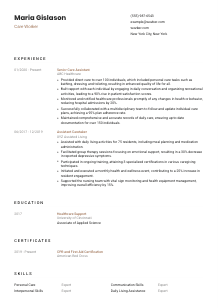
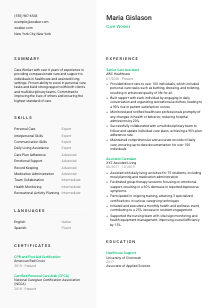
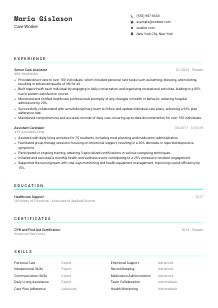
Nurturing souls, but your resume feels neglected? Check out this Care Worker resume example, created with Wozber free resume builder. It shows how easily you can match your compassion to job needs, setting your care career on a path of fulfillment and growth!
Care work is judged in everyday moments. Helping someone bathe safely, noticing a change in mood before it becomes a health issue, or keeping calm while following a care plan all require steady judgment and trust. Your resume needs to show that you can handle personal care, document what you observe, and support people with dignity in settings where consistency matters.
A tailored resume changes how quickly your hands-on care experience comes through, especially when employers screen for direct care, daily living support, and current certifications. Wozber's free resume builder helps you shape that experience into an ATS-compliant resume that uses the right caregiving terms and keeps the structure clean, so a hiring team can quickly see your readiness to support individuals safely and compassionately.
In care hiring, the contact section should remove friction. Managers often need to confirm location, reach you quickly for shift-based roles, and immediately see the title you are targeting. Keep this section straightforward and job-aligned.
Use your full name in a clear, readable format at the top of the page. No decoration needed. In care roles, a clean header sets the tone for a resume that feels organized, dependable, and easy to review.
Place "Care Worker" directly under your name if that matches the role you are pursuing. This helps the employer connect your resume to direct care work right away, rather than guessing whether your background is more clinical, domestic, or administrative.
Use contact information that supports fast follow-up for interviews, reference checks, and schedule discussions.
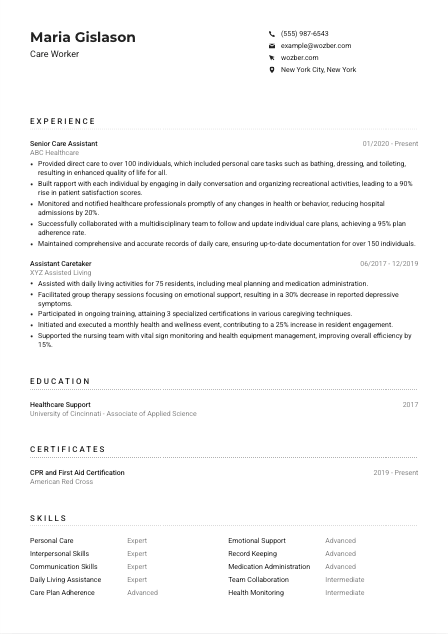
If the posting specifies a city or relocation requirement, include that in your contact details. Here, listing New York City, New York immediately addresses a stated requirement and prevents unnecessary screening concerns. For other applications, only add location when it helps clarify availability.
Do not include age, marital status, photo, or other personal details unrelated to care delivery. Hiring decisions should stay focused on your availability, communication, certifications, and ability to provide safe day-to-day support.
This section should answer the basics in seconds: who you are, what role you are targeting, how to reach you, and whether you meet any location requirement named in the posting. That keeps attention on your caregiving experience, where it belongs.




This is the section most employers read first for a care role. They want to see whether you have already supported people with activities of daily living, worked from care plans, communicated with families or clinicians, and noticed changes in condition early enough to act on them.
Start by marking the duties repeated in the posting. For care work, that often includes bathing, dressing, toileting, hygiene assistance, meal preparation, medication reminders, light housekeeping, emotional support, and reporting changes in health or behavior. These tasks should appear naturally in your bullets when they reflect your real work.
Begin with your most recent direct care position and work backward. For each role, include job title, employer, and dates. If you have worked in assisted living, home care, residential support, or a healthcare setting, make those environments easy to spot because they give useful context for the level of care you provided.
Each bullet should show what you did, who you supported, and what changed because of your work. The sample resume does this well by pairing direct care tasks with outcomes such as improved quality of life, stronger patient satisfaction, or reduced hospital admissions. That is much stronger than listing "helped residents" without scope or result.
Use metrics that make sense in caregiving. You might note the number of individuals supported, care plans followed, records maintained, appointments coordinated, or satisfaction or engagement improvements where those were formally tracked. Numbers like "supported 75 residents" or "maintained records for 150 individuals" show workload and responsibility without overstating the role.
Prioritize experience that shows hands-on support, observation, teamwork, and documentation. If you include older or less relevant jobs, trim them down. Space is better used on work that shows personal care ability, communication with multidisciplinary teams, and reliable record keeping.
Hiring teams need to see more than compassion. They need proof that you can deliver personal care safely, notice changes, follow instructions, and document accurately across a real caseload. If your bullets make those points clearly, your experience section is doing its job.
Care Worker roles do not always ask for a specific degree, but education still matters when it strengthens your caregiving profile. Training in healthcare support, patient care, human services, or related areas can help explain your foundation in safety, communication, and daily care routines.
Some care roles focus far more on direct experience and certifications than on formal education. Even so, a relevant degree or diploma can reinforce your understanding of patient support, health basics, and care environments. If the posting is light on education requirements, keep the section concise and relevant.
List your degree, field of study, school, and graduation year. A straightforward structure keeps the resume easy to scan. In the example, an Associate of Applied Science in Healthcare Support adds useful context because it connects directly to frontline care work.
If your degree or training relates to healthcare support, elderly care, disability services, or patient assistance, make that connection obvious. You do not need to over-explain it. The field name itself often does the work when it is clearly tied to caregiving.
For newer candidates, relevant courses can strengthen the section. Subjects such as patient care techniques, anatomy basics, infection control, nutrition, or communication in healthcare can help bridge limited work history. If you already have several years of direct care experience, coursework becomes less important.
Workshops, seminars, and employer training can also belong here or in certificates if they are substantial. Ongoing learning matters in care settings because procedures, safety expectations, and support approaches evolve over time.
Education should support your care profile, not overpower it. Include enough detail to show a relevant foundation, then let your direct experience and certifications carry the strongest part of the application.
Certifications matter in care work because they point to practical readiness. When a posting asks for CPR, First Aid, or a care-specific credential, employers want to know immediately whether you are current and able to step into a support role with the right baseline training.
Match this section to the posting before anything else. If CPR and First Aid are requested, list them prominently. In the example resume, CPR and First Aid Certification appears right away, which makes sense because it is one of the clearest job-alignment checks for this opening.
Lead with certifications tied to personal care, patient safety, mobility assistance, medication support, dementia care, or home health practice when they are relevant to the role. A credential such as Certified Personal Care Aide can help reinforce hands-on capability, but only include certifications you truly hold and can discuss.
Include the issuer and dates, especially for certifications that expire or require renewal. In care settings, current status matters because emergency response and safety procedures need to be up to date, not just completed at some point in the past.
Ongoing certification shows professional discipline and a willingness to stay current with care standards. Renew lapsed credentials promptly and add specialized training when it matches the population you support, such as elder care, disability support, or behavior management.
This section should make compliance easy to confirm. When the right certifications are visible, current, and relevant to direct care, employers can move on to the more important question of how well you deliver that care in practice.
A Care Worker skills section should reflect the real mix of hands-on tasks and people skills the job requires. Employers look for practical ability in personal care and observation, along with the communication needed to support individuals respectfully and work well with nurses, families, and other staff.
Read the posting closely and extract both technical and interpersonal requirements. Here, the clearest ones include personal care, hygiene assistance, emotional support, communication, teamwork, care plan follow-through, health monitoring, and record keeping. Those are stronger than generic labels such as "hardworking" or "people person."
Only include skills you can back up in your experience section. If you list medication reminders, daily living assistance, or care plan adherence, your work history should show where you used them. The sample resume handles this well by pairing skills like personal care and emotional support with bullets about bathing assistance, rapport building, and health monitoring.
Place the most role-critical skills first. For most care openings, that means direct care tasks, communication, observation, documentation, and team collaboration before broader supporting skills. A clean list helps the reviewer quickly connect your profile to the day-to-day demands of the role.
A useful skills section should read like a snapshot of how you work on shift. If the list reflects real care tasks, communication demands, and team coordination, it strengthens the rest of the resume instead of repeating it.
Communication is part of care delivery. Explaining a routine, offering reassurance, reporting concerns clearly, or helping someone feel understood all depend on language ability. That makes this section especially relevant when a posting explicitly asks for strong English skills.
If the role asks for strong English, include it explicitly and state your level accurately. For this opening, English is a stated requirement, so it should be easy to find in the language section rather than left implied elsewhere on the resume.
Additional languages can be valuable in home care, assisted living, and community-based support, especially in diverse populations. The example includes Spanish, which could be helpful in many settings, though that is an advantage rather than a universal requirement for every Care Worker role.
Choose labels such as Native, Fluent, Intermediate, or Basic and keep them realistic. In caregiving, overstating language ability can create problems in medication communication, appointment support, or emotional conversations where accuracy matters.
If you have worked with multilingual families, immigrant communities, or clients who are more comfortable in a language other than English, language ability can strengthen your application further. Include it when it genuinely improves the quality of support you can provide.
If you are actively improving a language that could be useful in your target setting, you can mention it, but keep the section focused. For most candidates, current usable proficiency matters more than future intentions.
For a Care Worker, languages are not an extra flourish. They can affect trust, comfort, and clear day-to-day support. Keep this section accurate and relevant to the people you may be caring for.
The summary sits near the top of the resume, so it needs to establish your care background quickly. A hiring manager should understand your experience level, the kind of support you provide, and one or two strengths that matter in daily care delivery before they reach the first job entry.
Pull the main themes from the posting before you write. For this role, that means direct care experience, personal care tasks, emotional support, teamwork, and accurate reporting. Your summary should reflect that mix rather than offering broad statements about being passionate or dedicated.
Open with your title, years of experience, and the environments where you have worked if they are relevant. A line like the example's "over 6 years of experience in healthcare and assisted living settings" works because it quickly places the candidate in the right part of the field.
Choose strengths that the employer actually needs, such as personal care support, rapport with clients, care plan adherence, or health change reporting. If you mention a strength, try to make it specific enough that the rest of the resume can immediately support it.
Aim for 3 to 5 lines with clear wording. Skip vague claims and save detail for the experience section. A concise summary gives the reader a reliable first picture of your caregiving scope without slowing down the resume.
A strong summary should quickly tell the employer that you understand direct care work and have done it in real settings. When it highlights experience, practical strengths, and care context in a few lines, the rest of the resume lands more clearly.
A Care Worker resume should make one thing easy to understand: you can support people safely, respectfully, and consistently in the routines that shape their day. When your sections clearly show direct care tasks, communication, documentation, teamwork, and current certifications, employers can picture you in the role much faster.
Use Wozber's free resume builder to organize that experience into an ATS-friendly resume template, refine the wording with its AI resume builder tools, and strengthen ATS optimization with the ATS resume scanner. The result should make your practical care ability, reliability, and readiness for the role easy to judge.




