



Use Wozber and land your dream job
Create Resume
No registration required
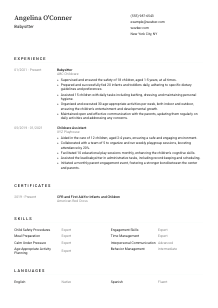
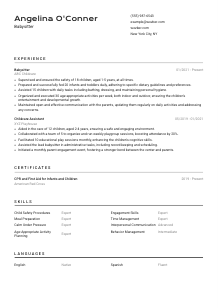
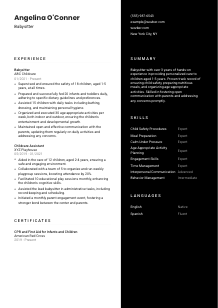
Juggling baby bottles, but your resume falls flat? Check out this Babysitter resume example, created with Wozber free resume builder. Learn how to show off your childcare skills to fit job cribs, paving a career path as tender and joyful as naptime stories!
Families hiring a babysitter look for trust before anything else. Your resume needs to make that trust concrete through childcare experience, safety habits, age-group familiarity, and the kind of daily care you can handle without constant direction, from meal prep to bath time to structured play.
A tailored babysitter resume also reduces a common screening problem: childcare experience can look generic if it is not tied to real responsibilities and outcomes. Using Wozber's free resume builder helps you organize that experience in an ATS-friendly resume format, so parents, agencies, or childcare employers can quickly see whether you match the care routines, communication style, and safety expectations of the role.
In childcare hiring, the top of the resume should answer practical questions fast. Parents and employers want to know who you are, how to reach you, and whether you are local and professionally presenting yourself for paid care work.
Place your full name at the top in a clean, readable format. Babysitting is a trust-based role, so clarity matters. A simple presentation looks more professional than decorative styling and helps your resume feel dependable from the first line.
Add "Babysitter" directly under your name if that is the position you are targeting. Matching the posted title keeps your resume aligned with the opening and makes your childcare focus obvious right away, especially when employers are comparing babysitters with broader childcare assistants or nanny profiles.
Include a phone number and professional email address that families or hiring staff can use without hesitation. Double-check both. In childcare hiring, missed calls and bounced emails can cost you interviews quickly because many decisions move fast when parents need coverage.
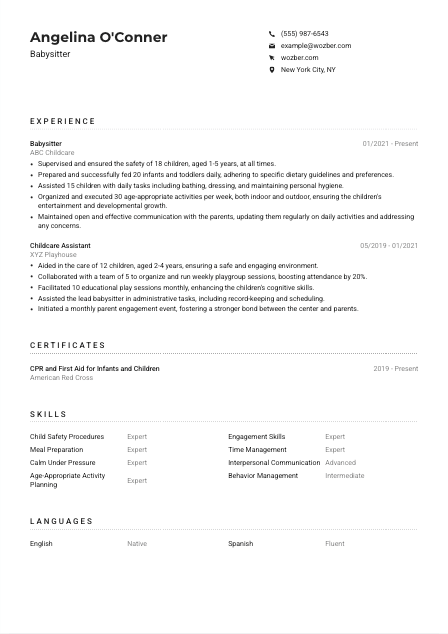
If the role asks for someone in a specific area, include your city and state. For this example, listing "New York City, NY" immediately confirms a stated requirement. Use location this way when proximity affects availability, commute reliability, or legal work eligibility.
A LinkedIn profile, personal website, or professional caregiving page can help if it reinforces your childcare background. Only include it when the content is current and relevant, such as childcare roles, certifications, parent-facing recommendations, or volunteer work with children.
Your personal details should remove friction. By the time someone finishes this section, they should know you are reachable, local if required, and presenting yourself as a serious childcare candidate.




Babysitting experience is strongest when it shows what happened under your care. Hiring teams and families look for signs that you can keep children safe, manage routines, communicate with parents, and stay calm when plans shift or children need extra support.
Read the posting and mark the responsibilities that define the daily work. For a babysitter, that often includes supervision, meal preparation, hygiene support, activity planning, and parent communication. Then shape your bullets so those duties appear in your own words, backed by what you actually handled in past roles.
Start with your most recent childcare position and work backward. For each entry, include your title, employer or family name if appropriate, and dates. This makes it easier to track your progression from related childcare support roles into more independent babysitting work, as the sample resume does from Childcare Assistant to Babysitter.
Focus each bullet on a concrete part of the job. Good babysitter bullets show supervision, feeding, routines, engagement, or communication with parents. The sample resume works because it names real tasks such as supervising children ages 1 to 5, preparing meals for infants and toddlers, and assisting with bathing and dressing.
Numbers help employers picture your workload. Include the number of children cared for, age ranges, activities run per week, or participation improvements when relevant. Metrics like "organized 30 age-appropriate activities per week" or "cared for 18 children" are useful because they describe scale, not because every babysitting bullet needs a number.
If you have jobs outside childcare, only keep them when they support the role through transferable skills like scheduling, customer communication, or responsibility. Your strongest space should go to work involving children, family communication, daily routines, and safety oversight, since that is what employers are hiring for here.
Your experience section should make one thing clear: children were safe, cared for, engaged, and well supervised when they were with you. That is the standard your bullets need to communicate.
Babysitting roles do not always require a specific degree, so education usually plays a supporting role. It helps most when it adds context around maturity, reliability, or knowledge that relates to child development, health, nutrition, or caregiving.
If the job posting does not ask for formal education, keep this section straightforward. Your experience and certifications will usually carry more weight for babysitting roles, but education can still reinforce consistency and background.
List the school name, degree or diploma, and graduation date if applicable. Keep the layout easy to scan. Babysitting resumes do not need an overbuilt education section unless your studies are directly connected to childcare or early childhood learning.
If you completed coursework or training in childhood development, psychology, education, nutrition, or health, include it. Those details can strengthen your profile by showing you understand more than supervision alone and can support developmental routines and age-appropriate care.
When your main degree is unrelated, a short note about useful classes can still help. Courses tied to child behavior, first aid, family studies, or nutrition are more valuable here than a full academic list.
Leadership roles, tutoring, camp volunteering, or student groups involving children can be worth mentioning if they show organization, patience, and accountability. Keep the focus on experiences that connect naturally to caregiving rather than listing general school achievements.
Use education to add helpful background, not to compete with your childcare experience. If it strengthens your credibility with children, routines, or care knowledge, it belongs here.
For babysitting roles, certifications often carry direct hiring weight because they speak to safety and emergency readiness. When a posting asks for CPR and First Aid, that credential should be easy to find and impossible to miss.
Start with any certification named in the job posting. Here, that is CPR and First Aid for infants and children. Because emergency response is part of the trust equation in childcare, this credential is not a minor add-on. It is a core qualifier.
If you hold multiple certificates, list the ones tied most closely to caregiving first. Infant and child CPR, pediatric First Aid, babysitting courses, safe sleep training, or child nutrition training all carry more relevance than unrelated certificates.
Include issue dates and renewal status when relevant so employers can see whether your certification is current. The example resume handles this well by showing the CPR and First Aid certification as active from 2019 to present, which helps confirm it is still valid.
Childcare standards evolve, and families often prefer sitters who keep their training current. Renewing CPR on time or adding short courses in behavior support, infant care, or emergency preparedness can make your resume more credible for future roles.
This section should reassure a parent or employer that you are prepared for more than routine care. Up-to-date safety training tells them you can respond responsibly when a child needs immediate help.
A babysitter skills section works best when it reflects what happens during a real shift. Safety awareness, child engagement, meal preparation, behavior management, and calm communication matter more than generic traits that could belong on any resume.
Start with the exact capabilities the role asks for. In this job description, that includes interpersonal communication, child safety, engagement, and handling emergencies calmly. Those are the terms to mirror when they match your real background.
Build a balanced list. Babysitting is not only supervision. Include practical care skills such as meal preparation, hygiene assistance, and activity planning alongside soft skills like parent communication and patience. The sample resume does this well with skills such as Child Safety Procedures, Meal Preparation, Calm Under Pressure, and Age-Appropriate Activity Planning.
Order matters. Lead with the abilities that affect daily childcare performance and match the target opening most closely. This also supports ATS optimization because the most relevant childcare terms appear early and clearly in the section.
After reading this section, an employer should understand how you keep children safe, occupied, and cared for throughout the day. Keep the list practical and close to the actual work.
Language ability matters in babysitting because the job depends on clear communication with both children and parents. It can affect daily instructions, emergency response, behavior guidance, and the quality of updates you provide at pickup or by text during the day.
If the posting mentions English, list it clearly with your proficiency level. For this job, English is a stated asset, so placing it in the languages section helps confirm that you can communicate with parents, understand care instructions, and handle urgent situations without confusion.
Other languages can strengthen your profile, especially in diverse communities or multilingual households. The sample resume includes Spanish, which can be a real advantage when communicating with children or parents who are more comfortable in that language.
Use clear levels such as Native, Fluent, Intermediate, or Basic. Accuracy matters here because language skill affects trust and safety. If you list a language, be prepared to use it in real caregiving communication.
You do not need to list every language you have studied. Prioritize the ones you can use meaningfully with families, children, or childcare employers. Practical communication value matters more than quantity.
If you mention a second language, keep it active enough to use naturally in conversation. In childcare, even simple abilities like giving directions, calming a child, or updating a parent can make multilingual skills especially useful.
Language skills are part of care quality. They help you communicate instructions, build rapport with families, and respond clearly when something needs attention.
The summary is where you frame your childcare experience in a few focused lines. For babysitting roles, it should quickly establish experience level, age groups served, core care strengths, and the kind of environment you can manage responsibly.
Start by identifying the duties that matter most in the target role. For babysitting, that usually means safety, routines, engagement, and communication with parents. Your summary should bring those themes forward immediately rather than opening with vague personality statements.
Open with a direct introduction such as "Babysitter with 3+ years of experience" or "Childcare professional with 2+ years supporting infants and young children." This gives hiring readers immediate context and mirrors the experience threshold many babysitting roles ask for.
Choose strengths that reflect the target posting and your track record. The sample summary works because it mentions child safety, meal preparation, age-appropriate activities, and parent communication, all of which connect directly to the responsibilities in the job description.
Aim for a summary that is compact enough to scan quickly but specific enough to separate you from generic childcare applicants. Avoid overexplaining. A few well-chosen details about age ranges, caregiving strengths, or certifications will do more than broad claims about passion.
Your summary should tell a parent or hiring manager, in seconds, what kind of care you provide and how confidently you can provide it. If the rest of the resume expands on that promise, the section is doing its job.
A babysitter resume works when it makes daily care responsibilities easy to trust at a glance. That means showing recent childcare experience, clear safety credentials, practical skills, and a communication style families can rely on.
Use Wozber's free resume builder and ATS resume scanner to tailor each section around the posting, strengthen childcare wording, and keep everything in an ATS-compliant resume structure. The finished resume should make one decision easier for the reader: you are prepared to keep children safe, cared for, and well supported.




