



Use Wozber and land your dream job
Create Resume
No registration required
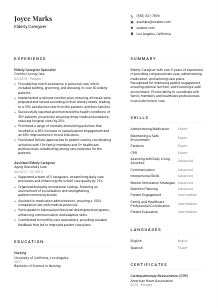
Tending to seniors, but your resume feels old-fashioned? Check out this Elderly Caregiver resume example, created with Wozber free resume builder. Learn how to present your nurturing nature and elderly care expertise to match the job description, making your career journey as enriching as the lives you touch!
Elderly caregiving resumes are strongest when they show how you support daily life with consistency, judgment, and calm communication. Families and care coordinators are trusting you with medication routines, personal care, safety, nutrition, and changes in condition that can escalate quickly, so your resume needs to make that level of responsibility visible from the start.
For this kind of role, tailoring changes whether your background reads as general caregiving or as direct elder care experience tied to ADLs, health monitoring, and family coordination. Wozber's free resume builder helps you shape that experience into an ATS-compliant resume with the right caregiving terms and structure, so the hiring team can quickly see that you match the day-to-day demands of senior care.
Contact details do more than identify you. In caregiving, they also show whether you meet practical hiring requirements quickly, especially when a family or agency needs someone local, reachable, and ready to start discussions without extra back-and-forth.
Use your full name in the most visible spot on the page. Keep it simple and easy to scan, since home care agencies and care managers often review resumes quickly before moving to your hands-on experience and certifications.
Place "Elderly Caregiver" directly under your name if that is the role you are applying for. This immediately connects your resume to the posting and helps separate your background from adjacent roles such as nanny, home health aide, or general caregiver.
Add a current phone number and a professional email address that you check regularly. Care roles often move fast, especially when schedules, interviews, or trial shifts are being arranged, so make it easy for employers to reach you without confusion.
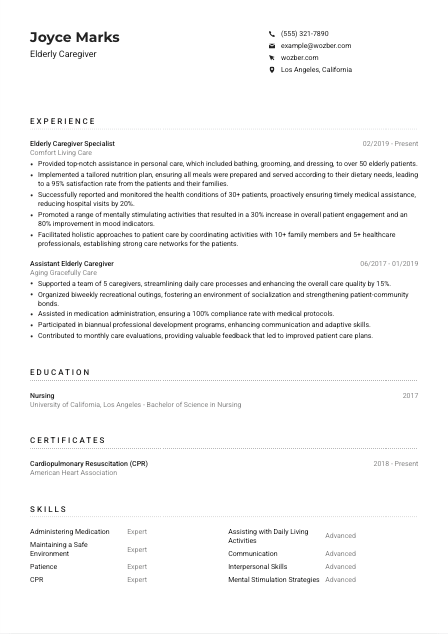
If the posting requires local availability, include your city and state. Here, listing "Los Angeles, California" directly supports a stated requirement, which is useful in both human screening and ATS filtering. Do this when location is relevant to the job, not as a blanket rule for every resume.
A LinkedIn profile or professional website can work if it adds something useful, such as care-related experience, recommendations, or training history. Skip it if it is outdated or generic. In caregiving, credibility comes from clear experience, references, and role-specific qualifications, not extra links for their own sake.
Keep this section clean, local when needed, and directly aligned to the caregiving role you want. It should remove basic doubts before the reader reaches your care experience.




This section carries the most weight for an Elderly Caregiver. Hiring teams want to see the kind of support you provided, the condition of the people you cared for, how you handled routines and changes, and whether your work improved safety, comfort, or continuity of care.
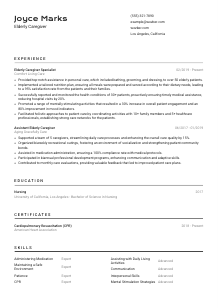
Pull the main responsibilities from the posting and reflect them in your bullets using your actual experience. For elder care, that usually includes personal care, medication support, meal preparation, safety, observation, and communication with families or clinicians. The sample resume does this well by covering bathing, grooming, dressing, nutrition planning, condition monitoring, and coordinated care.
For every position, list your title, employer, and dates in a consistent format. Clear structure matters because reviewers often compare several caregivers at once and need to understand your timeline, care settings, and progression without digging through dense text.
Do not stop at listing tasks like "assisted with bathing" or "prepared meals." Show what your work changed. A bullet such as improving dietary adherence, reducing hospital visits, or increasing participation in activities tells the employer that you were not just present, but effective in the care plan.
Metrics work well in caregiving when they stay grounded in the job. You might mention number of patients supported, medication compliance rate, reduction in avoidable incidents, family satisfaction, or improvement in engagement. In the example, reporting a 20% reduction in hospital visits and a 95% satisfaction rate adds believable performance context.
Prioritize roles that involve seniors, personal assistance, home care, assisted living, rehabilitation support, or healthcare coordination. If you include less relevant jobs, keep them brief unless they show transferable skills such as patient communication, safety awareness, or schedule reliability. The closer your bullets stay to elderly care routines, the stronger this section reads.
Your experience should make it easy to picture you in a client's home or care setting, handling daily routines, watching for health changes, and working smoothly with family members and medical professionals.
Education is rarely the main deciding factor in caregiving, but it can strengthen your profile when it supports clinical judgment, patient care knowledge, or familiarity with health and safety standards. Present it in a way that reinforces your ability to care for older adults responsibly.
If you have a degree in nursing, health sciences, social work, gerontology, or a related field, include it clearly. The job posting here does not require a degree, yet a Bachelor of Science in Nursing is still relevant because it adds weight to medication support, observation, and communication with healthcare professionals.
List the degree, school, field of study, and graduation year. That is usually enough. In caregiving resumes, education should support the story without crowding out the sections that show hands-on patient care.
When your education directly connects to elder care, use the proper degree and field wording rather than abbreviating it too heavily. "Bachelor of Science in Nursing" tells the reader more than a shortened label and immediately signals training tied to patient support and health monitoring.
You do not need a long academic list, but coursework in geriatric care, nutrition, patient safety, dementia care, or rehabilitation can help if you are earlier in your career or moving from a broader healthcare background into elder care.
If you are taking additional classes or attending training related to caregiving, include that selectively. Ongoing learning matters in areas such as mobility support, memory care, infection control, and emergency response, where better training directly improves day-to-day care.
Use education to reinforce practical care ability, not to fill space. When it connects clearly to patient support and safe caregiving, it adds useful depth to your resume.
Certifications carry real weight in caregiving because they point to current safety training and readiness to respond in urgent situations. For many elder care jobs, this section answers a basic hiring question right away: can this person step into care responsibly and safely?
When a posting asks for BLS or CPR, list those certifications prominently and use the full credential names. In this example, both CPR and Basic Life Support directly match the employer's requirement and should be impossible to miss.
Order certifications by relevance to the work. Emergency response, first aid, medication-related training, dementia care, and home care credentials usually matter more than broad professional development courses because they connect directly to patient safety and daily support.
Add the issuing organization and the date or renewal range so employers can see the certification is current. For caregiving roles, up-to-date credentials matter because they speak to readiness in real care scenarios, not just past training.
If you renew CPR, BLS, or other care-related training regularly, make that visible. Current certification status is especially helpful when an employer needs someone who can start quickly without additional compliance delays.
This section should quickly confirm that your emergency response training and care credentials are current, relevant, and ready for the demands of elder care.
A caregiver skills section works best when it mirrors the actual work. That means balancing technical care tasks with the interpersonal abilities that keep routines calm, safe, and respectful for older adults and the people involved in their care.
Start with the abilities named in the job description, especially medication administration, assistance with daily living activities, maintaining a safe environment, communication, patience, and interpersonal skills. These are central to elder care and should appear in your skills list if they reflect your experience.
After the essentials, include skills that show how you support quality of life and coordinated care, such as nutrition planning, mental stimulation strategies, patient observation, mobility assistance, or family communication. The sample resume adds several of these, which helps round out the picture beyond basic task support.
Avoid filling this section with broad traits that could belong on any resume. Choose skills that connect to elder care workflows, safety, and patient well-being. A shorter list with strong alignment is more useful than a long list that mixes unrelated abilities.
Your skills section should read like the toolkit of someone who can manage daily care, support health routines, and maintain trust with both patients and families.
Language matters in caregiving because instructions, reassurance, and health updates all depend on clear communication. This section is especially useful when the job requires English proficiency or when additional languages help you serve patients and families more effectively.
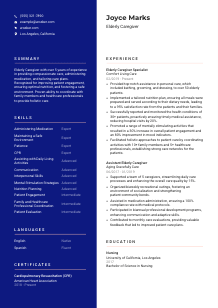
If the employer states that English is essential, list English first and note your proficiency accurately. In this example, "English" as "Native" directly addresses a stated requirement and supports the communication demands of medication routines, reporting, and family discussions.
Lead with the language needed for the role, then add others that may be useful in your care setting. In a diverse market such as Los Angeles, Spanish can be a real asset when communicating with patients, relatives, or support staff, though it is an added strength rather than a universal requirement.
Extra languages can strengthen your profile when they improve trust, comfort, and day-to-day coordination. In elder care, that may mean explaining routines more clearly, easing anxiety, or helping families stay informed.
Choose straightforward ratings such as Native, Fluent, Advanced, or Conversational. Accurate language levels help employers understand how confidently you can communicate in sensitive care situations.
When you speak more than one language, think about how that supports your work. In elder care, communication is tied to safety, emotional comfort, and care continuity, so language ability can directly improve the experience of both patients and families.
List languages in a way that shows practical communication strength. For caregiving, that means helping employers see how you will explain, reassure, report, and connect in everyday care situations.
Your summary should quickly position you as someone who can handle elder care with competence and steadiness. In a few lines, show your years of experience, the type of care you provide, and the responsibilities you are trusted to manage.
Start with a direct line such as "Elderly Caregiver with 5+ years of experience" so the reader immediately knows your professional focus. This is especially effective when the employer asks for at least 2 years of elder care experience.
Use one sentence to define your core caregiving scope. Mention work such as personal care, medication support, meal preparation, mobility assistance, or health monitoring, depending on what you actually do most often.
Choose details that connect tightly to the role, such as administering medication, maintaining a safe environment, supporting nutrition needs, or coordinating with family members and healthcare professionals. The sample summary uses this approach well by combining compassionate care with practical responsibilities and care coordination.
Aim for 3 to 5 lines with no filler. This section should read like a compact introduction to your care background, not a personal statement. Every phrase should point to work you have done and responsibilities you can handle now.
A focused summary helps the reader understand, within seconds, what kind of elderly care you deliver and why you are ready to step into the role.
A well-tailored Elderly Caregiver resume should now show the essentials clearly: hands-on elder care experience, safe daily support, current certifications, and steady communication with families and healthcare professionals.
Use Wozber's AI resume builder and ATS resume scanner to tighten wording, match the employer's language, and present everything in an ATS-friendly resume format. The final result should make one thing easy to judge: you can be trusted with consistent, compassionate care.




