



Use Wozber and land your dream job
Create Resume
No registration required
Tending to others, but your resume feels under the weather? Check out this Personal Care Aide resume example, brought back to health with Wozber free resume builder. Learn how to align your caregiving skills with job criteria, creating a career profile as strong and nurturing as the patients you support!
Personal Care Aide hiring often turns on trust. Employers need to see, quickly, whether you can handle intimate daily care with consistency, notice changes in a resident's condition, and communicate calmly with families and supervising staff. A resume for this field should make that kind of day-to-day responsibility visible, not bury it under vague claims about being caring or hardworking.
When the resume is tailored well, the difference between general caregiving experience and the exact support a role needs becomes much easier to read, especially in an ATS-compliant resume. Wozber's free resume builder helps organize that tailoring around the language of the job description, so tasks like ADL support, medication reminders, care-plan collaboration, and recordkeeping stand out in the places hiring teams check first.
For a Personal Care Aide, the top of the resume should confirm basic readiness without distractions. Contact details, title, and location all matter here because care roles are scheduled, regulated, and often filled quickly when coverage is needed.
Place your full name at the top in a clean, readable format. Keep it more prominent than the rest of the header so the resume looks professional and is easy to reference during interview scheduling or shift coordination.
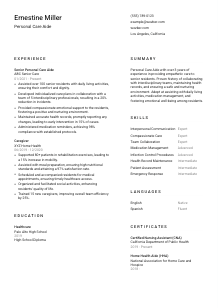
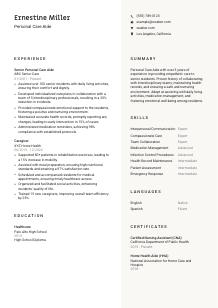
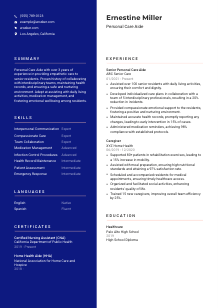
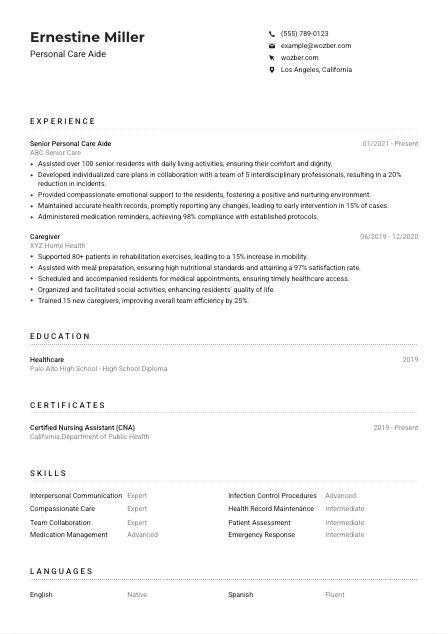
If you are applying for a Personal Care Aide position, use that title directly under your name when it reflects your background. This immediately places you in the right candidate pool. In the example, "Personal Care Aide" works well because the rest of the resume supports it with senior care and home health experience.
List a current phone number and a professional email address you check regularly. Care employers often move fast when arranging interviews, reference checks, or onboarding, so accuracy matters. If you include a website or LinkedIn profile, make sure it supports your caregiving background rather than distracting from it.
Some care jobs have immediate scheduling, travel, or state-based compliance needs. If the employer specifies a city or state, include it clearly in your header. Here, listing Los Angeles, California directly addresses a stated requirement and removes an avoidable question for the employer.
A profile link is useful when it reinforces your experience with residents, home care, senior living, or related certifications. Skip anything outdated or incomplete. In caregiving, a concise and credible header is more valuable than extra links that add no hiring value.
This section should answer the basic practical questions right away: who you are, how to reach you, what role you do, and whether you meet any stated location requirement. That gives the rest of the resume room to focus on resident care, documentation, and teamwork.




Experience is where Personal Care Aide resumes earn credibility. Employers want to see the kind of residents you supported, the care tasks you handled, how closely you worked with nurses or care managers, and whether you can document and respond to changes in condition.
Before writing bullets, mark the core duties in the posting. For this role, that includes daily living assistance, companionship, medication reminders, vital sign and health record maintenance, and care-plan collaboration. Those are the functions your experience section should emphasize if they match your background.
Start with your most recent caregiving work and move backward. For each role, include job title, employer, and dates. This format helps employers quickly track your recent hands-on care experience, whether it comes from senior care facilities, home health, hospice, or similar settings.
Describe what you actually did and what changed because of your work. Strong bullets show scope, consistency, and results. The sample resume does this well with details like assisting more than 100 senior residents, maintaining accurate health records, and contributing to a 20% reduction in incidents through individualized care plans.
Prioritize duties that reflect how Personal Care Aides are evaluated on the job: bathing, grooming, dressing, meal prep, mobility support, companionship, observation, reporting, and coordination with the care team. Even supportive tasks such as organizing social activities or escorting residents to appointments are useful when they show resident engagement, safety, or continuity of care.
Metrics work best when they match caregiving realities. Resident volume, protocol compliance, incident reduction, early reporting, satisfaction rates, or training impact all add substance. A bullet like "achieved 98% compliance with medication reminder protocols" tells an employer far more than a generic statement about being detail-oriented.
Your experience section should show that you can deliver dependable daily care, document what matters, and work as part of a care team. If those points are clear in your bullets, the resume reads like someone ready to step into resident support from day one.
Education carries a straightforward but important role on a Personal Care Aide resume. Many openings ask for a high school diploma or equivalent, and this section should confirm that requirement cleanly while leaving room for your hands-on care experience to lead.
If the job asks for a high school diploma or equivalent, list it plainly. There is no need to over-explain. In this case, including a High School Diploma directly matches the employer's minimum education requirement.
Include the school name, credential, and graduation year or date. This section should be quick to scan, especially since caregiving employers are often reviewing practical qualifications such as certifications and relevant work experience at the same time.
If your education included health, caregiving, or patient support coursework, it can strengthen your foundation, especially earlier in your career. The sample resume lists a healthcare-related field alongside the diploma, which helps connect classroom learning to care work without overstating it.
Mention classes such as basic health science, nutrition, anatomy, or patient care only when they support your application and fit naturally on the page. For experienced aides, this is optional. Practical caregiving history will usually carry more weight than a long course list.
Honors, leadership roles, or volunteer work tied to healthcare can be worth including if you are new to the field or have limited paid experience. If your resume already has solid caregiving experience, keep this section lean and let the more job-specific material do the work.
For this role, education is usually a qualification check rather than the main selling point. Present it clearly, match the posted requirement, and let your caregiving experience and certifications carry the deeper story.
Certifications matter in personal care because they connect your resume to legal requirements, care protocols, and employer confidence. When a posting mentions CNA or HHA credentials, the certificate section becomes one of the first places a hiring manager will check.
Put required or preferred credentials first. If a role mentions CNA or HHA certification, list those before anything less central. In the example, both certifications directly support the application and align well with the job's wording.
Prioritize certifications tied to direct resident support, safety, and regulated care environments. For Personal Care Aides, that often means CNA, HHA, CPR, first aid, dementia care, or infection control training, depending on the role and state requirements.
Add the year earned, renewal period, or current status when applicable. This helps employers understand whether your credential is current and usable for scheduling, compliance, or onboarding. The sample format of "2019 - Present" makes ongoing validity easy to read.
Caregiving employers value candidates who stay current on safe care procedures and regulatory expectations. If you have recent training that supports medication assistance, hospice support, senior care, or patient safety, include it when it strengthens the role match.
A clear certificate section helps an employer confirm that you meet the care setting's requirements without hunting through the resume. For roles involving direct resident support, that speed matters.
The skills section should translate your caregiving ability into terms employers and ATS systems can recognize quickly. For a Personal Care Aide, that means balancing human care skills with the practical tasks that keep residents safe, comfortable, and properly supported.
Start with the employer's wording. In this case, interpersonal communication, compassionate care, medication management, and collaboration are clear priorities. Using the same language where it truthfully matches your background improves ATS optimization and makes the resume easier to scan.
Only include skills you can back up in your experience section. If you list health record maintenance or emergency response, there should be a bullet somewhere showing documentation, reporting, observation, or action in care situations. The sample resume handles this well by pairing skills like medication management and record maintenance with specific work examples.
Choose skills that reflect the real work of the role. Good options include ADL assistance, patient observation, meal preparation, mobility support, infection control, vital sign monitoring, emotional support, family communication, and team collaboration. A shorter, role-shaped list is stronger than a long generic inventory.
This section works best when it reinforces the care tasks, communication ability, and safety awareness already shown elsewhere. If the skills align with your bullets and the job posting, the resume feels coherent and credible.
Language ability can matter greatly in personal care. Residents may need instructions repeated clearly, families may have questions during stressful moments, and small communication gaps can affect comfort, trust, and care quality.
If strong English proficiency is listed, make that visible. Place English first and state your level clearly. This directly addresses a core requirement for documenting care, following instructions, and communicating with residents and families.
Any second language can be valuable when it improves rapport, comfort, and communication in a diverse care setting. The example's Spanish fluency is a strong addition, especially in communities where families and residents may prefer bilingual support.
Use clear labels such as Native, Fluent, Conversational, or Basic. Avoid vague wording. Care settings depend on accurate communication, so realistic proficiency levels are more helpful than inflated ones.
Multilingual ability is especially relevant when the role involves family updates, emotional reassurance, appointment coordination, or explaining routines and instructions to residents. Include languages that genuinely improve how you deliver care, not just to fill space.
If you are studying a language that is genuinely relevant to the resident population you serve, you can note it briefly. Keep it secondary to the languages you can already use confidently in care conversations and day-to-day support.
In caregiving, language skills are practical tools. List them in a way that helps employers understand how well you can communicate with residents, families, and the broader care team.
The summary should give a hiring manager a quick picture of the care environment you know, the support you provide, and the level of responsibility you can handle. For Personal Care Aides, this is the place to combine compassion with concrete care work.
Read the posting closely before drafting your summary. If the employer emphasizes senior care, emotional support, medication reminders, and care-plan collaboration, those ideas should shape your opening lines when they reflect your experience.
Lead with your title and years of experience, then anchor it in the setting you know best, such as senior living, home health, or hospice support. The sample summary does this effectively by naming more than 3 years of experience and centering empathetic care for senior residents.
Choose strengths that matter for this kind of hiring decision: assisting with daily living activities, maintaining records, communicating with interdisciplinary teams, or supporting resident well-being. Keep them specific enough to sound grounded in actual care work.
Aim for 3 to 5 lines. That is enough space to show your care focus, relevant experience, and a few role-matched strengths without repeating the bullet points that appear later in the resume.
A well-written summary helps the employer understand your setting, your strengths, and the kind of resident support you can provide before they reach the rest of the resume. It should read like a concise care profile, not a list of generic traits.
A Personal Care Aide resume works best when it shows practical caregiving in clear language: daily living support, resident comfort, accurate documentation, medication reminders, and communication with nurses, care managers, and families. If you tailor each section around those responsibilities, the employer can quickly see how your experience fits the demands of the role.
Wozber can help you build that structure faster with ATS-friendly resume templates, an ATS resume scanner, and AI-assisted tailoring that brings your wording closer to the job description without losing accuracy. The final result should make one thing easy to judge: whether you can provide safe, compassionate, dependable care from the first shift.




