



Use Wozber and land your dream job
Create Resume
No registration required
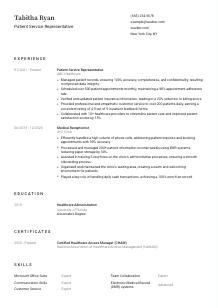
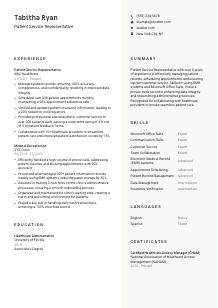
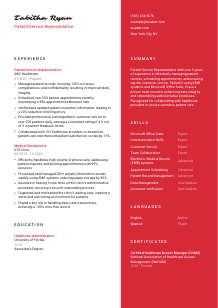
Navigating patient needs, but your resume feels under the weather? Check out this Patient Service Representative resume example, created with Wozber free resume builder. Learn how to detail your care coordination skills so they resonate with job requirements, keeping your career as healthy as those you serve!
Patient service work sits at the point where patient experience and healthcare operations meet. Hiring teams want to see that you can keep check-ins moving, handle insurance and payment questions without errors, protect confidential records, and stay calm when the front desk gets busy. Your resume should make that day-to-day reliability visible from the first few lines.
Screeners often separate patient service candidates by how clearly their resume shows real healthcare workflow experience, especially with scheduling, EMR documentation, and patient-facing communication. Wozber's free resume builder helps you shape an ATS-compliant resume around those specifics, so your background is easier to read as direct preparation for appointment flow, record accuracy, and steady patient support.
At the front desk, small details matter. Misspelled contact information, an unprofessional email, or a missing location can create the same concern as an inaccurate patient file. This section should show the same care you would bring to registration, scheduling, and record handling.
Use your full name in a clear, readable format, then place the target title directly beneath it. Writing "Patient Service Representative" immediately tells the employer where your experience belongs, especially if your previous title was Medical Receptionist, Front Desk Coordinator, or another closely related healthcare support role.
Mirror the posted job title when it accurately reflects your background. That simple match helps position your resume for both ATS filtering and human review. In the example, using "Patient Service Representative" instead of a broader administrative label keeps the focus on patient intake, scheduling, and service coordination.
List a phone number you answer regularly and a professional email address, ideally a simple format such as firstname.lastname@email.com. Check every character. In a role built around appointment accuracy, insurance verification, and clear patient communication, basic contact errors undermine confidence quickly.
If the employer specifies a city requirement, include your city and state. Here, New York City, NY is part of the stated criteria, so showing that location removes an avoidable question about availability or relocation. Save the space by listing the city rather than a full street address.
A LinkedIn profile or professional website can help if it reflects your healthcare administration background, customer service experience, or certifications consistently with your resume. Only include it if the information is current and reinforces your work with patients, providers, and administrative systems.
These details should read like a well-managed patient intake record: accurate, current, and easy to process. When your contact section is clean and role-aligned, the employer can move straight to your healthcare experience without distractions.




For Patient Service Representative roles, employers look past job titles quickly. They want to see volume, accuracy, patient interaction, insurance handling, scheduling discipline, and coordination with clinical staff. Your experience section should show how you supported patient flow and kept administrative work dependable in a healthcare setting.
Before writing bullets, identify the operational work the employer cares about most: greeting patients, checking them in, scheduling appointments, verifying insurance, collecting payments, updating records, and coordinating with providers. Then build your experience bullets around those same functions, using wording that matches the employer's language where it reflects your actual work.
List your most recent healthcare role first, followed by earlier positions. Include employer name, job title, and dates for each entry. This format makes it easier to track whether you meet requirements such as 2+ years in a healthcare setting and to see your progression from reception or administrative support into full patient service responsibility.
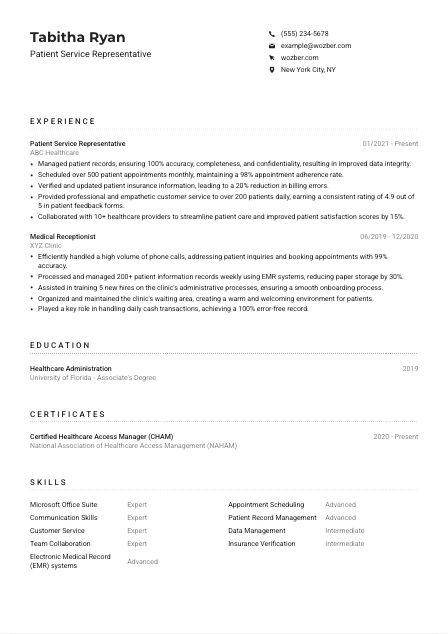
Do not stop at duty statements like "answered phones" or "scheduled appointments." Show the standard you maintained. The sample resume does this well with bullets such as managing patient records with 100% accuracy and confidentiality, which speaks directly to a front-desk healthcare environment where documentation mistakes create downstream billing and care issues.
Metrics are especially useful here because they show pace and control. Appointment volume, check-in count, billing accuracy, patient feedback scores, records processed, call accuracy, or reduction in insurance errors all help. "Scheduled over 500 patient appointments monthly" and "reduced billing errors by 20%" are strong examples because they connect administrative work to clinic efficiency and patient service quality.
If you have mixed administrative experience, lead with bullets tied to medical offices, clinics, hospitals, insurance intake, EMR use, or payment collection. General office work only belongs if it supports the same skills, such as confidential record handling, calendar management, or high-volume customer interaction. Keep the emphasis on the parts of your background that show you can support patient care without slowing operations.
This section should make it easy to picture you at the front desk handling check-ins, schedules, records, and patient questions with accuracy. When your bullets show healthcare volume, measurable results, and coordination with providers, your experience reads as immediately usable.
Education matters here because many employers want an associate's degree or equivalent background in healthcare or a related field. It is usually a supporting section, not the main proof of fit. Keep it straightforward, then let your healthcare experience carry the heavier weight.
If the posting asks for an associate's degree or equivalent experience, make sure your section clearly shows which one you have. A degree in healthcare administration, medical office administration, health information, or another related field is worth naming plainly because it lines up with patient service work and administrative healthcare processes.
List the school, degree, field of study, and graduation year or date. Recruiters and hiring coordinators should be able to confirm your educational background in seconds. For this type of role, clarity matters more than decorative formatting.
When your field of study supports the role, do not bury it. "Associate's Degree in Healthcare Administration," as shown in the example, immediately connects to healthcare operations, patient records, office workflow, and service coordination. That is much more useful than listing only the degree level.
If you are early in your career or changing into healthcare administration, include a short note on coursework related to medical terminology, health information systems, patient relations, billing, or office administration. If you already have solid front-desk healthcare experience, keep this section lean.
Honors, leadership activity, or projects can help when they relate to service, organization, teamwork, or healthcare operations. Keep only the details that support the actual work of the role. A long list of unrelated campus activity will not help as much as one clear line tied to administrative responsibility or patient-facing service.
Your education section should confirm that you meet the baseline requirement and understand the healthcare environment. Once that is clear, let your experience with patients, scheduling, records, and insurance carry the application forward.
Certifications are not always required for patient service roles, but the right one can sharpen your profile. They work best when they reinforce healthcare access, patient registration, administrative accuracy, or knowledge of front-end operations rather than adding unrelated credentials.
If a certification supports patient intake, healthcare administration, revenue cycle tasks, or service operations, it is worth listing. A credential such as CHAM is relevant because it points to structured knowledge in healthcare access and front-desk processes, even when the posting does not name a certification explicitly.
One or two relevant certifications are stronger than a scattered list. Prioritize credentials that strengthen your work with registration, insurance verification, scheduling, privacy standards, or patient interaction in medical settings. That keeps the section tied to the responsibilities employers actually need covered.
Include the issue date or active period, especially for credentials that need renewal. In healthcare administration, current training matters because systems, compliance expectations, and patient access processes change. Clear dates also prevent employers from guessing whether a certification is active.
Ongoing learning matters in healthcare support roles because front-desk work often touches EMR workflows, billing procedures, privacy expectations, and service standards. If you have completed recent training that improves your patient-facing or administrative performance, this is the place to show it.
Relevant certifications add another layer of credibility to your healthcare support background. They are most useful when they reinforce the exact work the employer needs done well, from patient access to administrative accuracy.
This section should read like the operating toolkit for a healthcare front desk. Employers want a quick view of the systems you can use, the service tasks you can handle, and the interpersonal strengths that help you manage patients, providers, and administrative demands in the same shift.
Patient service roles usually require a mix of software proficiency and people-facing execution. From this posting, key examples include EMR systems, Microsoft Office Suite, verbal and written communication, confidentiality, insurance handling, scheduling, and collaboration. Those are the terms worth checking against your own background first.
Prioritize skills tied to the actual workflow: appointment scheduling, patient check-in, insurance verification, payment collection, EMR documentation, record management, phone handling, and customer service in a healthcare environment. The sample resume handles this well by combining software knowledge with operational skills such as appointment scheduling and patient record management.
Do not crowd this section with every soft skill you have ever used. Focus on the capabilities that support accurate intake, efficient scheduling, smooth provider coordination, and respectful patient communication. A shorter list with direct healthcare relevance is stronger for ATS optimization and faster for a hiring manager to scan.
By the time someone finishes this section, they should understand that you can work the systems, handle the patient-facing flow, and support the administrative side of care without constant supervision. That is the combination the role depends on.
Language ability can matter a great deal in patient service work because understanding instructions, registration questions, and insurance information affects both service quality and accuracy. List languages in a way that supports safe, clear communication rather than trying to make the section look impressive.
When a posting specifically asks for strong English, list English at the top with an accurate proficiency level. For a Patient Service Representative, that requirement connects directly to check-in conversations, written communication, appointment instructions, and handling billing or insurance questions clearly.
Do not bury English under additional languages. If the employer names it, surface it immediately. A simple entry such as "English - Native" or "English - Fluent" works well and addresses the requirement without extra explanation.
Additional languages can be a real advantage in clinics and hospitals serving diverse communities. If you can assist patients in another language during scheduling, front-desk questions, or basic service interactions, include it. In the example, Spanish adds practical value because it broadens patient communication capacity.
Choose clear levels such as Native, Fluent, Intermediate, or Basic. That helps employers understand how confidently you can communicate with patients and coworkers. Overstating language ability is risky in healthcare support roles, where misunderstanding instructions or forms can create real problems.
Only list languages you would be comfortable using in a patient-facing setting. The advantage is not just that you know another language. It is that you may be able to improve patient comfort, reduce confusion at check-in, and support clearer communication during scheduling or registration.
Accurate language information helps employers judge how well you can support patient communication in a real care setting. When listed honestly, it adds practical value to a patient service resume.
Your summary should quickly establish your level of healthcare experience and the kind of administrative and patient-facing work you handle well. This is where you connect years of experience with the specific front-desk functions the employer needs, using the language of healthcare operations rather than generic enthusiasm.
Before drafting your summary, identify the core parts of the role you can already do well: patient check-in, scheduling, insurance verification, EMR updates, payment handling, or provider coordination. Build the summary around those strengths instead of writing a broad statement about being hardworking or people-oriented.
Lead with your title or closely related background and your years of experience in healthcare support. A summary such as the example's opening, which states more than 3 years of relevant experience, works because it places the candidate immediately in a medical office context rather than a general customer service one.
Use the job description's language where it reflects your real background. Mention EMR systems, Microsoft Office Suite, communication skills, confidentiality, scheduling, or insurance work if you have done them. This helps with ATS alignment and also tells a hiring manager that your experience maps to the job's daily tasks.
Aim for 3 to 5 lines with concrete information, not a long personal statement. The best summaries for this role usually combine experience length, healthcare environment, core systems or tasks, and one or two outcomes such as improved accuracy, smoother scheduling, or stronger patient satisfaction. That gives the reader a fast, useful picture of your value.
After reading your summary, an employer should already expect to see a candidate who can manage patient-facing administration with accuracy, professionalism, and steady coordination. If that message lands early, the rest of the resume has a much easier job.
A Patient Service Representative resume works best when it shows the mechanics behind good patient care: accurate registration, efficient scheduling, careful record handling, insurance follow-through, and calm communication at the front desk. Keep each section tied to those real healthcare workflows, and use results where you have them.
With Wozber's AI resume builder, ATS-friendly resume format, and ATS resume scanner, you can tailor your content around the language employers use while keeping the resume clear and readable. The finished document should make one thing easy to judge: you can support patients and providers without letting the administrative details slip.




