



Use Wozber and land your dream job
Create Resume
No registration required
Rejuvenating faces, but your resume seems a little tired? Uncover the fresher side with this Aesthetic Nurse resume example, created with Wozber free resume builder. Learn how to blend your beauty and nursing skills with job needs, ensuring your career path is as flawless as your patients' complexions!
Aesthetic nursing sits at the intersection of clinical judgment and patient-facing care. Hiring teams want to see more than a general RN background. They look for nurses who can assess skin concerns, deliver injectables safely, explain treatment expectations clearly, and document every step with the same care they bring to the procedure room.
Resume tailoring changes how quickly that picture comes into focus. When your wording reflects the treatments, patient education, and charting standards the employer uses, an ATS-compliant resume is far more likely to surface the right experience instead of burying it under broad nursing language. Wozber's free resume builder helps organize that language in an ATS-friendly resume format, so your resume shows where your injectable experience, patient outcomes, and team-based care already match the role.
For an Aesthetic Nurse, the top of the resume should answer basic practical questions fast. Can this candidate be reached easily, do they present themselves professionally, and do they meet any location requirement named in the posting? Keep this section clean, direct, and relevant to the clinic or practice environment.
Use your full name in the largest text on the page so it is easy to find in a printed resume, PDF, or ATS preview. Aesthetic nursing is a patient-facing specialty, and your resume should open with the same professionalism you bring to consultations, charting, and treatment planning.
Place "Aesthetic Nurse" directly below your name if that is the role you are pursuing. This helps recruiters and ATS systems connect your background to the job quickly, especially if your recent title was broader, such as Registered Nurse, Cosmetic Nurse, or RN Injector.
List a reliable phone number and a professional email address. Double-check both. In a field built on patient communication, follow-up, and scheduling precision, small mistakes here can suggest carelessness you do not want attached to your application.
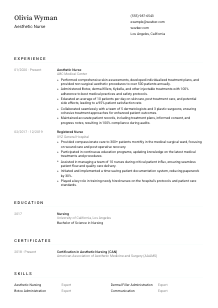
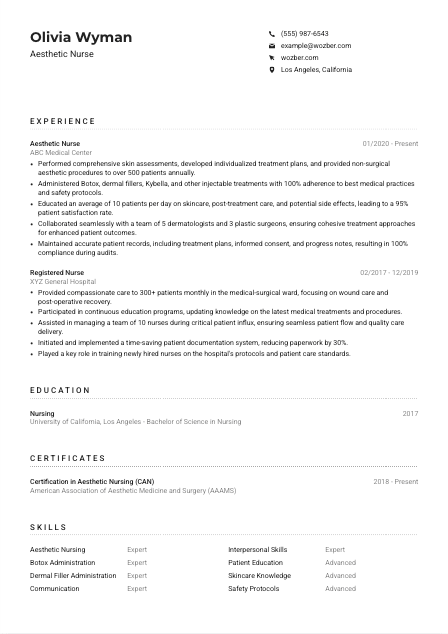
If the employer specifies a city or state, include yours clearly. In the example, listing Los Angeles, California directly supports a stated requirement and removes uncertainty about local availability. If you are relocating, say so plainly instead of leaving the employer to guess.
A LinkedIn profile can help when it reinforces your resume with matching dates, certifications, and specialties such as injectables, skin assessments, or patient education. Keep the content aligned so the employer sees one consistent professional record rather than two different versions of your background.
This section does not need personality statements or extra detail. It needs to show that you are professionally presented, easy to contact, and positioned to step into the clinic setting without avoidable friction.




This is the section hiring teams read most closely for an Aesthetic Nurse. They want to see clinical scope, treatment volume, injectable competency, patient education, and documentation standards. Your bullets should show what you handled, how you worked, and what outcomes followed.
Review the job description and mark the responsibilities that define day-to-day practice. For this role, that includes skin assessments, individualized treatment plans, injectables like Botox and dermal fillers, patient education, collaboration with dermatologists or plastic surgeons, and accurate records. Those are the experiences your resume should surface first because they reflect how aesthetic nursing is actually performed and reviewed.
List your most recent position first, then work backward. For each role, include job title, employer, and dates. That structure helps employers quickly distinguish direct aesthetics experience from earlier bedside, med-surg, or recovery nursing work, which can still add value when framed around patient care, documentation, and clinical teamwork.
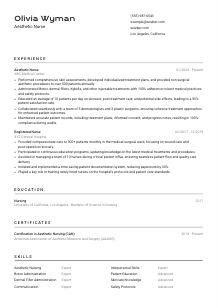
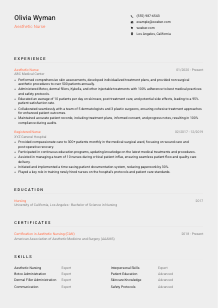
Each bullet should show a concrete piece of the work: what you assessed, administered, explained, documented, or coordinated. The sample does this well by naming skin assessments, individualized treatment plans, Botox, fillers, Kybella, and collaboration with specialists. That level of specificity is much stronger than broad claims like "provided excellent patient care."
Quantify your work with measures that make sense in aesthetics and nursing. Patient volume, procedures performed, satisfaction scores, audit compliance, consult volume, or documentation improvements are all useful. The example's "over 500 patients annually," "10 patients per day," and "95% patient satisfaction rate" give hiring teams a much clearer sense of pace, trust, and consistency.
Earlier nursing roles can stay on the resume, but trim them to the parts that transfer well, such as wound care, post-operative recovery, team coordination, or documentation improvements. If an older role does not connect to patient safety, procedural care, or communication, it should take far less space than your direct aesthetics experience.
An Aesthetic Nurse resume gains strength when the experience section reads like actual clinic practice. Make it easy to see your treatment scope, patient volume, safety standards, and collaboration with physicians or other specialists.
Aesthetic employers usually do not need a long education section, but they do need to see the right nursing foundation quickly. Your degree establishes that baseline, especially when the posting asks for a BSN or another nursing-related qualification.
Check the posting for the minimum education standard and mirror it accurately. Here, a bachelor's degree in Nursing or a related field is explicitly requested, so your degree should be easy to spot without the reader searching for it.
List the school, degree, field of study, and graduation year in a consistent order. Keep it straightforward. Recruiters and clinic managers are usually confirming eligibility here, not looking for a detailed academic narrative.
If you hold a Bachelor of Science in Nursing, write it in full. In the example, "Bachelor of Science in Nursing" from UCLA immediately answers the requirement and supports the RN progression shown elsewhere in the resume.
Most experienced Aesthetic Nurses do not need course lists. Add them only if you are early in your career or if the coursework directly supports the role, such as dermatology-related training, pharmacology, anatomy, or patient assessment. If your work history already proves those capabilities, keep the section lean.
Honors, scholarships, or student leadership can be useful when they strengthen your clinical profile or help explain early promise. Once you have solid hands-on experience with injectables, patient consultations, and treatment documentation, those details usually matter less than your recent practice.
Your education section should confirm that you meet the nursing standard for the role without slowing down the resume. Make the degree easy to find, then let your clinical experience carry the weight.
In aesthetic nursing, certifications do more than decorate the resume. They show legal eligibility, specialized training, and commitment to safe technique. This section should make current licensure and relevant aesthetics credentials visible at a glance.
Start with anything the employer specifically asks for, such as an active RN license. If the posting also mentions certification in aesthetic nursing or accepts equivalent experience, present whichever applies to you clearly so there is no doubt about eligibility.
List certifications that relate directly to injectables, patient safety, or aesthetic procedures. In the sample, the Aesthetic Nursing certification and California RN license are far more important than less relevant training because they connect directly to scope of practice and clinic credibility.
Include issue dates, renewal ranges, or "Present" where appropriate. This matters for RN licensure, ACLS, and any specialty credential that can expire or require continuing education. Current dates reassure employers that your qualifications are active and usable now.
Aesthetic medicine changes quickly, from injectable techniques to skincare protocols and safety guidance. If you complete newer training in fillers, neurotoxins, laser support, or complication management, add it when relevant. Ongoing education tells employers you treat aesthetics as a clinical specialty, not a side interest.
This section should let a recruiter or medical director confirm your license, specialty preparation, and professional upkeep in seconds. Put the most role-relevant credentials first and keep the information current.
Aesthetic nursing skills should read like the capabilities you use during consults, procedures, follow-up care, and charting. A mixed list of technical and interpersonal strengths works best when it matches the actual workflow of the job.
Use the job description as your starting point. If the role asks for proficiency with Botox, dermal fillers, patient education, interpersonal communication, and recordkeeping, those items belong in your skills section only if your experience genuinely supports them. This keeps your resume aligned with both ATS screening and clinical expectations.
Aesthetic clinics hire for both technical execution and consultation quality. Include injectable administration, skin assessment, treatment planning, skincare knowledge, safety protocols, and medical documentation alongside communication and patient education. That combination reflects how success is measured in practice, where outcomes depend on both technique and informed consent.
Do not overload the section with every nursing skill you have ever used. Prioritize the capabilities most tied to the target role. The sample list works because it stays close to aesthetic practice instead of drifting into unrelated hospital competencies that matter less for a cosmetic setting.
A useful skills section helps the employer picture you in consults, procedures, and follow-up care. Choose the abilities that support safe injectable work, strong patient communication, and reliable clinical documentation.
Language ability matters in aesthetic nursing because consults depend on clarity. Patients need to understand treatment options, aftercare instructions, possible side effects, and consent details. If you speak more than one language, that can add practical value in a diverse patient population.
If the employer specifies English fluency, list English clearly and use an accurate proficiency label. In this case, that requirement should be visible because it connects directly to consultations, patient education, and informed consent.
Order languages by job importance, not personal preference. English should appear first when it is required, then any additional languages that may help you communicate with patients, explain aftercare, or build rapport in a multicultural clinic environment.
Extra languages can strengthen your candidacy when they help with patient comfort and understanding. The example includes Spanish, which can be especially useful in many patient communities, though whether that matters will depend on the clinic's clientele rather than every aesthetics role universally.
Be precise with terms like "Native," "Fluent," "Intermediate," or "Basic." In nursing and aesthetics, overstating a language skill can create risk during patient communication, especially when discussing side effects, post-procedure care, or consent instructions.
If you speak more than one language well, that can improve consultations, reduce misunderstandings, and help patients feel more at ease during elective procedures. Mention languages as a practical care advantage, not just a nice extra line on the resume.
Language skills are most useful when they support safe, confident patient communication. Present them accurately so employers can see where you may add value in consultations and follow-up care.
The summary sits near the top of the resume, so it should quickly define your specialty, experience level, and treatment strengths. For an Aesthetic Nurse, that usually means naming your aesthetics background, injectable expertise, patient education work, and the clinical setting you are prepared to support.
Pull two or three defining requirements from the posting and make them central to your summary. For this role, that could mean skin assessments, individualized treatment plans, injectables, patient education, and collaboration with physicians. Using that language helps the employer recognize relevant experience immediately.
State that you are an Aesthetic Nurse, then add your experience level and specialty focus. The sample summary does this effectively by leading with more than 4 years of experience and then moving straight into assessments, injectable treatments, and skincare education.
Use the next sentence to show the strengths most relevant to the role, such as Botox and filler administration, patient satisfaction, detailed charting, or collaboration with dermatologists and plastic surgeons. Keep it grounded in real practice rather than vague personal traits.
Aim for 3 to 5 lines. That is enough space to communicate specialty, scope, and value without repeating the experience section. Strong summaries sound focused and informed, much like a concise patient handoff note rather than a generic career statement.
Your summary should tell the reader, early and clearly, that you understand aesthetic practice and can contribute safely from day one. If those first lines cover your scope with injectables, patient education, and collaborative care, the rest of the resume has a strong foundation.
An effective Aesthetic Nurse resume makes your clinical strengths easy to read in the language of the job. That means visible licensure, clear injectable experience, patient education work, accurate documentation, and measurable practice outcomes instead of broad nursing claims.
Use Wozber's AI resume builder, ATS resume scanner, and ATS-friendly resume template to tighten that alignment across each section. When the final resume is tailored well, hiring teams can quickly see your readiness to assess, treat, educate, and document with the standard aesthetic practice requires.




